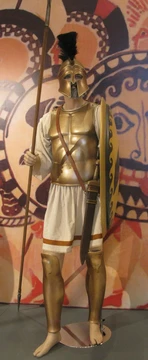
Cuisses
Not part of ancient Greek armor—cuisses are a medieval European invention.

In the context of ancient Greek military equipment, cuisses are not a recognized piece of armor. The term and concept belong strictly to medieval European armor, and no equivalent thigh protection was used by ancient Greek hoplites or other soldiers. Ancient Greek armies relied on other forms of leg defense, such as greaves (knemides) for the lower legs, but did not employ dedicated thigh armor like cuisses.
- type
- Armour
- period
- 12th–14th centuries
- region
- Europe (especially France and England)
- material
- Padded cloth, brigandine, splinted leather, steel plate
- function
- Thigh protection
- notable_variant
- English cuisses fully encapsulating the thigh
Lore & Background
Padded cuisses made in a similar way to a gambeson were commonly worn by knights in the 12th and 13th centuries, usually over chausses, and may have had poleyns directly attached to them. Whilst continental armours tended to have cuisses that did not protect the back of the thigh, English cuisses were typically entirely encapsulating, due to the English preference for foot combat over the mounted cavalry charges favoured by continental armies.
Reader's Guide
Cuisses represent a specific solution to a tactical vulnerability in medieval combat: the need to protect the thigh from blows that could come from below, bypassing the maille shirt or tassets. Their development reflects broader trends in armour technology, from padded cloth in the 12th and 13th centuries to steel plate from around 1340, and finally to single-plate iron or steel construction from 1370 onward. The divergence between continental and English designs—continental cuisses leaving the back of the thigh exposed, English ones fully encapsulating it—highlights differing military doctrines: continental armies favored mounted cavalry charges, while English forces emphasized foot combat. This entry also notes a parallel in ancient Greek armour, the perimeridia and parameridia, which were metal thigh coverings used occasionally by Greek warriors from at least the fifth century B.C. and more commonly by cavalry in the third century B.C. and later, though the source does not establish a direct link between these traditions.
Did You Know?
- Cuisses are medieval armor, not ancient Greek.
- Ancient Greek soldiers did not wear cuisses; they used greaves for lower leg protection instead.
- The term 'cuisses' comes from the French word for 'thigh' and is unrelated to ancient Greek military equipment.
The Tactical Gap Cuisses Were Built to Fill
Cuisses emerged to close a specific vulnerability in medieval leg defence. The lower skirt of a mail shirt or the tassets hanging beneath a cuirass could shield the upper legs from overhead strikes, yet they left a dangerous opening underneath. An opponent delivering a thrust from below could slip a blade past those hanging defenses entirely, leaving the thigh exposed. The cuisse solved this problem by wrapping directly around the thigh, sealing the window through which a low-angle attack could penetrate. The term itself derives from the French word cuisse, meaning thigh, and the plural form simply denotes the pair worn on both legs. Far from being ornamental, the cuisse was a targeted engineering response to a real combat problem: ensuring the leg stayed protected against blows arriving from every direction, not merely from above.
From Padded Layers to a Single Steel Plate
The construction of cuisses transformed dramatically across several centuries. During the 12th and 13th centuries, knights most often wore padded versions fashioned in a manner akin to a gambeson, typically layered over their chausses. These early iterations sometimes carried poleyns—knee protections—fixed directly onto the cuisse. Beyond soft padding, craftsmen also produced thigh guards from brigandine or splinted leather, offering a middle ground in rigidity. A decisive shift arrived around 1340, when steel plate became the dominant material, supplanting the softer constructions that had prevailed for generations. By 1370 the design had simplified further still: a single, continuous plate of iron or steel formed the entire piece, removing the need for multiple segments or layered materials. This trajectory from soft padding to one seamless steel plate mirrors the broader medieval drive toward greater protection and more streamlined fabrication.
English Encapsulation versus Continental Open-Back Design
A notable regional split shaped how cuisses were cut and fitted across Europe. Continental armourers generally produced thigh guards that left the rear of the leg uncovered, a choice rooted in the tactical assumptions of mounted warfare. Continental armies favoured cavalry charges, and in that context the back of the thigh was less likely to receive a direct blow. English armourers took the opposite approach, crafting fully encapsulating cuisses that wrapped completely around the thigh, including the posterior surface. This all-around coverage made practical sense given the English military tradition's strong preference for foot combat, where a soldier standing on the ground faced threats from every angle and could not rely on the limited exposure profile of a rider on horseback. The distinction between the two schools was therefore not cosmetic but a direct expression of how each culture envisioned the primary mode of battlefield engagement.
Thigh Armour in the Ancient Greek World
The idea of a dedicated thigh guard did not originate in the medieval period. In ancient Greece, metal thigh pieces called perimeridia and parameridia fulfilled the same protective role. Although they were not a standard element of the ordinary Greek panoply, they appear often enough on surviving monuments and vase paintings to confirm that warriors employed them at least as far back as the fifth century B.C. Greek authors writing from the third century B.C. onward reference these thigh guards almost exclusively in connection with cavalry, protecting both the rider and the horse. Some writers further distinguished between parapleuridia for horses drawn in chariots and parameridia for those ridden directly by mounted soldiers. This ancient tradition shows that the need to shield the thigh against combat blows was recognised millennia before the single-plate steel cuisses of the fourteenth century became standard equipment.
Frequently Asked Questions
What are cuisses in the context of medieval armor?
Cuisses are dedicated leg guards worn directly on the thigh to protect against upward thrusts and slashes. The name derives from the French word for 'thigh,' and the term is always used in its plural form.
Why did knights need cuisses when they already had mail shirts and cuirass tassets?
While the hem of a mail shirt or the tassets hanging from a breastplate could deflect blows coming from above, they left the thigh exposed to attacks delivered from below. Cuisses filled that gap by covering the front of the thigh with a dedicated shield against upward strikes.
What materials were cuisses made from during their period of use?
Early examples in the 12th and 13th centuries were typically padded cloth or brigandine, constructed much like a gambeson and often worn over chausses. Later versions transitioned to splinted leather and eventually full steel plate, with some designs incorporating attached poleyns for the knee.
When and where were cuisses most commonly worn?
They were in regular use across Europe, particularly in France and England, from roughly the 12th through the 14th centuries. During that span they evolved from soft padding to rigid plate as overall armor technology advanced.
What made the English variant of cuisses distinctive?
English cuisses were notable for fully encapsulating the entire thigh rather than leaving the sides or back partially exposed. This all-around coverage made them one of the most comprehensive thigh protections developed in medieval European armor.
More in Ancient Greek military equipment 1-24
Spotted an error? Know more?
This is a living reference — every entry is fact-audited, and reader corrections feed straight into our audit queue. Suggest an edit · See this site's audit record