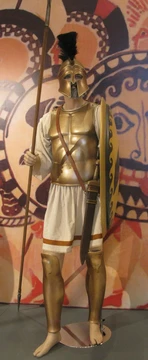
Xiphos
Double-edged Iron Age shortsword used by ancient Greek armies.

The xiphos (Ancient Greek: ξίφος) is a double-edged, one-handed Iron Age straight shortsword used by the ancient Greeks. It served as a secondary battlefield weapon for Greek armies after the dory or javelin, typically employed when the spear was broken, taken by the enemy, or discarded for close combat.
- type
- Shortsword
- origin
- Ancient Greece
- era
- Iron Age
- blade_length
- 45–60 cm (18–24 in); Spartan preference for 30 cm (12 in) around the Greco-Persian Wars
- weight
- 450–900 g (0.99–1.98 lb)
- cross_section
- Diamond or lenticular
- construction
- Two-piece handle with organic or iron guards; some with gold foil decoration
Lore & Background
The xiphos is attested in Mycenaean Greek Linear B as 𐀥𐀯𐀟𐀁 (qi-si-pe-e). Its etymology has been linked to Arabic saifun and Egyptian sēfet, though the presence of a labiovelar in Mycenaean complicates this. Another suggestion connects Ossetic äxsirf 'sickle', pointing to a virtual Indo-European *kʷsibʰro-.
Most xiphe handles followed a two-piece construction using native woods, ebony, or animal bone, attached to the tang with two or three pins. Hand guards were typically 'bridge'-shaped, made of organic material or iron, and secured with pins. Some swords from Italy or Macedonia had iron extensions along the handle. Surviving xiphe are rare, often found in burial sites, indicating household status and continued use into the Iron Age.
The xiphos sometimes has a midrib and was generally hung from a baldric under the left arm. Its leaf-shaped design, similar to the Mycenaean Naue II sword, lent itself to both cutting and thrusting. The early Celtic La Tène short sword had a virtually identical blade design.
Reader's Guide
The xiphos represents a key development in Iron Age weaponry, evolving from Bronze Age designs like the Mycenaean Naue II sword. Its leaf-shaped blade, optimized for both cutting and thrusting, made it effective in close combat when the primary spear was unavailable. The weapon's construction—using organic materials and iron—reflects the technological transitions of the period. Surviving examples, often ceremonial with gold foil hilts, provide insight into burial practices and social status. The xiphos's influence extended beyond Greece, with similar leaf-shaped short swords appearing across Europe in the late Bronze Age. Its legacy is seen in later swords like the gladius, though the article does not detail direct connections. The scarcity of surviving xiphe underscores the challenges of studying ancient arms, while the etymological debates highlight the complexity of tracing linguistic and cultural exchanges in the ancient world.
Did You Know?
- The xiphos is attested in Mycenaean Greek Linear B as 𐀥𐀯𐀟𐀁 (qi-si-pe-e).
- Spartans reportedly preferred blades as short as 30 cm (12 in) around the Greco-Persian Wars.
- Some xiphe have hilts decorated with gold foil, likely ceremonial and found in burial sites.
- The early Celtic La Tène short sword had a virtually identical blade design to the xiphos.
More in Ancient Greek military equipment 1-24
Spotted an error? Know more?
This is a living reference — every entry is fact-audited, and reader corrections feed straight into our audit queue. Suggest an edit · See this site's audit record