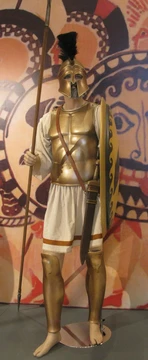
Thorakes lineoi
Ancient linen armor known from texts and art, not archaeology.

Thorakes lineoi (Greek: θώρακες λίνεοι) is the ancient Greek term for linen body armor, mentioned in texts from the 6th century BC to the third century AD. This type of upper body armor was used throughout the ancient Mediterranean world, often depicted in sculptures and paintings from Italy and Greece beginning around 575 BC. The modern term linothorax is derived from the Greek λινοθώραξ, meaning 'wearing a breastplate of linen.'
- field
- Ancient military equipment
- known_for
- Linen body armor used by hoplites and other warriors in the ancient Mediterranean
- earliest_textual_reference
- Poet Alcaeus, circa 650–550 BC
- earliest_artistic_depiction
- Circa 575 BC in Aegean art
- notable_users
- Alexander the Great, soldiers of the Roman emperor Caracalla's 'Macedonian phalanx' (circa 200 AD)
Lore & Background
The first clear reference to linen armor in any ancient language is often attributed to the poet Alcaeus, who lived around 650–550 BC, though some scholars note that Homer's Iliad may contain an earlier reference. From the fifth century BC to the first century AD, Greek and Roman writers mention soldiers from many nations wearing linen armor, but they rarely describe it in detail. These writers include Herodotus, Livy, Strabo, Suetonius, and Pausanias. The philosopher Plutarch says that Alexander the Great wore a 'double linen breastplate' at the battle of Gaugamela. References to linen armor become much rarer in the Roman imperial period, likely because the Roman army developed more practical forms of iron armor such as the lorica segmentata, while the lorica hamata remained expensive and time-consuming to produce.
Beginning around 575 BC, artists in the Aegean often show a distinctive style of armor with a smooth piece wrapped around the chest, two flaps over the shoulders, and a skirt of flaps covering the hips and belly. By the 4th century BC, armor with a similar shape appears in wall paintings in Italy, sealstones in Persia, gold combs in Crimea, and stone carvings in Gaul. Because only a few examples of armor shaped like this survive, researchers such as Peter Connolly identify the lost armor with the linen armor in texts. Linen would decay and so leave little archaeological evidence.
Reader's Guide
The thorakes lineoi is significant because it represents a type of armor widely used across the ancient Mediterranean but known almost entirely through textual and artistic sources, not archaeological finds. Its construction remains uncertain: it may have been quilted and stuffed with loose fiber, stitched together many layers thick, or made with a special weave called twining. A theory that it was made of layers of linen glued together comes from a mistranslation of a summary of a description of medieval armor in 1869. Modern reconstructions, such as those by Peter Connolly in the 1970s and by Gregory S. Aldrete and Scott Bartell at the University of Wisconsin–Green Bay, have been based on this mistaken glue theory. The project received considerable media attention after Aldrete tested his construction by shooting an arrow at Bartell. However, no culture before the 20th century is known to have made linen armor in this way. It is also entirely possible that the depictions show some form of metal armor with an external covering of linen, similar to later medieval brigandines. The legacy of the thorakes lineoi lies in the ongoing debate about ancient military technology and the challenges of reconstructing perishable materials.
Did You Know?
- The term linothorax is a modern term based on the Greek λινοθώραξ, meaning 'wearing a breastplate of linen.'
- Some scholars believe Homer refers to a linothorax when he describes Ajax the Lesser as 'linen-breasted' in the Iliad.
- The theory that linothorax was made of layers of linen glued together comes from a mistranslation of a summary of a description of medieval armor in 1869.
- Five extant pieces of armor shaped like the linothorax survive from sites in south-eastern Europe, but they are made of iron plate, iron scales, or mail, not linen.
More in Ancient Greek military equipment 1-24
Spotted an error? Know more?
This is a living reference — every entry is fact-audited, and reader corrections feed straight into our audit queue. Suggest an edit · See this site's audit record