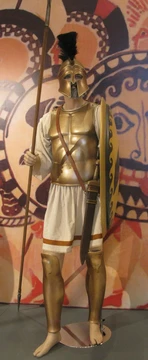
Pteruges
Strip-like defenses for limbs on Greco-Roman armor.

Pteruges (or pteryges, from the Greek word for "feathers") are strip-like defenses for the upper limbs, attached to armor in the Greco-Roman world. They appear as a skirt of leather or multi-layered linen strips hanging from the waist of Roman and Greek cuirasses, shielding the hips and thighs. Similar epaulette-like strips protect the upper arms from the shoulders. These strips are usually thought to belong to a single garment worn beneath the cuirass, though on a linen cuirass (linothorax) they might be built in. The cuirass itself could be made of plate-bronze, linothorax, scale, lamellar, or mail. Pteruges might be arranged in a single row of long strips or in two or more overlapping layers of shorter lappets with graduated lengths.
In the Middle Ages, particularly in the Byzantine Empire and the Middle East, depictions show such strips hanging from the back and sides of helmets to protect the neck while allowing movement. No archaeological evidence of leather strip defenses for helmets has been found, and these artistic elements could also represent vertically-stitched quilted textile defenses.
- field
- Military equipment
- known_for
- Strip-like limb defenses on Greco-Roman armor
- material
- Leather or multi-layered fabric (linen)
- period
- Greco-Roman world; possible later use in Byzantine Empire and Middle East
Lore & Background
Pteruges are strip-like defenses attached to armor of the Greco-Roman world, typically forming a skirt of leather or multi-layered linen strips hanging from the waist of cuirasses to protect the hips and thighs. Similar epaulette-like strips were worn on the shoulders, protecting the upper arms. These strips are usually interpreted as belonging to a single garment worn under a cuirass, though in a linen cuirass (linothorax) they may have been integral.
Reader's Guide
Pteruges represent a key element of Greco-Roman armor, providing flexible protection for the hips, thighs, and upper arms. They could be arranged as a single row of longer strips or in two or more layers of shorter, overlapping lappets of graduated length. The cuirass itself could be variously constructed of plate-bronze (muscle cuirass), linothorax, scale, lamellar, or mail. During the Middle Ages, especially in the Byzantine Empire and the Middle East, similar strips are depicted descending from the back and sides of helmets to protect the neck, though no archaeological remains of such leather strip defenses for helmets have been found. Artistic depictions of these strip-like elements can also be interpreted as vertically-stitched quilted textile defenses. The uncertainty regarding their exact construction and use in later periods highlights the challenges of interpreting ancient armor from artistic sources alone.
Did You Know?
- Pteruges is from Ancient Greek πτέρυγες (ptéruges) meaning 'feathers'.
- They formed a defensive skirt of leather or multi-layered fabric (linen) strips.
- Similar epaulette-like strips were worn on the shoulders, protecting the upper arms.
- No archaeological remains of leather strip defenses for helmets have been found.
More in Ancient Greek military equipment 1-24
Spotted an error? Know more?
This is a living reference — every entry is fact-audited, and reader corrections feed straight into our audit queue. Suggest an edit · See this site's audit record