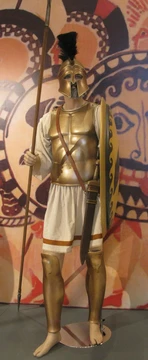
Muscle cuirass
Armor shaped to mimic an idealized male human torso.

The muscle cuirass, also known as the anatomical cuirass or heroic cuirass (Latin: lorica musculata), is a type of body armor designed to fit the wearer's torso and mimic an idealized male human physique. It first appeared in late Archaic Greece and became widespread throughout the 5th and 4th centuries BC, originally made from hammered bronze plate. Commonly depicted in Greek and Roman art, it was worn by generals, emperors, and deities during periods when soldiers used other types of armor.
- materials
- Hammered bronze plate
Lore & Background
The muscled cuirass gradually replaced the bell cuirass around 480 BC. Examples from the 5th century BC have been found in Thracian tombs, where cavalrymen wore them. The earliest known depiction in Greek art appears on the Chigi vase (c. 650–640 BC) or early Attic black-figure pottery. The cuirass is also shown on Attic red-figure pottery from around 530 BC into the late 3rd century BC. From about 475 to 450 BC, the cuirass was shorter, covering less of the abdomen, and more nipped at the waist than later examples, worn over a chitoniskos. In Neo-Attic art, it was worn over a longer chiton.
Reader's Guide
The muscle cuirass holds significance as a fusion of functional armor and artistic idealization. Its sculpted form, replicating the human body, may have been inspired by the concept of heroic nudity and linked to idealized male portraiture in Greek art. The development of an idealized standard musculature, known in French as the cuirasse esthétique, was attributed by Kenneth Clark to Polykleitos, whose control of muscle architecture created a formalized torso design used in armor. In Roman contexts, the cuirass distinguished senior officers' uniforms and was often highly ornamented with mythological scenes, as seen on the Augustus of Prima Porta. Archaeological finds of simpler versions indicate that unadorned cuirasses were worn in combat. The cuirass also influenced Renaissance parade armor, such as that made for Charles V in 1546.
Did You Know?
- The muscle cuirass first appeared in late Archaic Greece and became widespread throughout the 5th and 4th centuries BC.
- Italian muscle cuirasses lacked the shoulder-guards found on Greek examples.
- The monument of Aemilius Paulus at Delphi shows Roman infantrymen wearing both mail shirts and muscle cuirasses.
- The cuirass on the Augustus of Prima Porta includes a scene of a Parthian king returning the Roman standards.
More in Ancient Greek military equipment 1-24
Spotted an error? Know more?
This is a living reference — every entry is fact-audited, and reader corrections feed straight into our audit queue. Suggest an edit · See this site's audit record