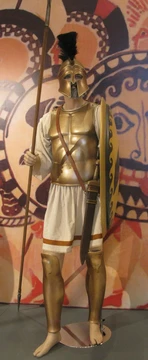
Loricae linteae
Linen armor used across the ancient Mediterranean world.

Loricae linteae is the Latin term for linen body armor used throughout the ancient Mediterranean world, mentioned in texts from the 6th century BC to the third century AD. The armor is known primarily from ancient Greek and Latin writings, as well as artistic depictions in sculptures and paintings from Italy and Greece beginning around 575 BC. Because linen decays, no archaeological examples survive, leaving modern scholars to rely on textual and visual evidence to understand its construction and use.
- field
- Ancient military equipment
- known_for
- Linen body armor mentioned in ancient texts and depicted in art
- period
- 6th century BC to third century AD
- region
- Ancient Mediterranean world (Greece, Italy, Persia, Gaul, Crimea)
Lore & Background
The term loricae linteae appears in Latin texts, while Greek sources use θώρακες λίνεοι (thorakes lineoi). Writers such as Herodotus, Livy, Strabo, Suetonius, and Pausanias mention soldiers from many nations wearing linen armor, though they rarely describe it in detail. Plutarch states that Alexander the Great wore a 'double linen breastplate' at the battle of Gaugamela. The Roman emperor Caracalla equipped a 'Macedonian phalanx' with linen armor around 200 AD, according to Cassius Dio.
Artistic depictions from around 575 BC show a distinctive style of armor with a smooth chest piece, shoulder flaps, and a skirt of flaps covering the hips and belly. This style appears in vase paintings, wall paintings, sealstones, gold combs, and stone carvings across the Mediterranean and beyond. The Alexander Sarcophagus and Alexander Mosaic show Alexander and his soldiers wearing this type of armor. By the Roman imperial period, depictions become rare, likely because cheap iron armor like the lorica hamata reduced demand for linen armor.
Reader's Guide
The loricae linteae is significant because it represents a widespread but poorly understood type of ancient armor. Its existence is attested by numerous ancient authors and artistic representations, yet no physical examples survive due to linen's biodegradability. This has led to considerable scholarly debate about its construction. Theories include quilted and stuffed linen, multiple layers stitched together, or a special twining weave. A popular but now discredited theory held that it was made of layers of linen glued together, based on a mistranslation of a medieval description. Some scholars suggest the artistic depictions might actually show metal armor with a linen covering, similar to later medieval brigandines. The linothorax project at the University of Wisconsin–Green Bay, led by Gregory S. Aldrete, reconstructed and tested a glued-linen version, but this method has no ancient precedent. The armor's legacy lies in highlighting the challenges of studying perishable materials in archaeology and the importance of critically evaluating modern reconstructions.
Did You Know?
- The term loricae linteae is Latin for 'linen body armor,' equivalent to the Greek θώρακες λίνεοι.
- Plutarch wrote that Alexander the Great wore a 'double linen breastplate' at the battle of Gaugamela.
- The theory that linothorax was made of glued linen layers originated from a mistranslation of a medieval description in 1869.
- Five extant pieces of armor shaped like the linothorax survive from the 4th century BC to the 1st century AD, but they are made of iron plate, iron scales, or mail, not linen.
More in Ancient Greek military equipment 1-24
Spotted an error? Know more?
This is a living reference — every entry is fact-audited, and reader corrections feed straight into our audit queue. Suggest an edit · See this site's audit record