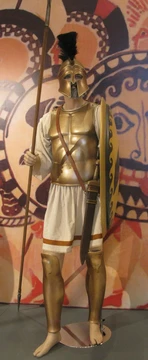
Linothorax
Ancient linen armor known from texts and art, not archaeology.

The linothorax is a type of upper body armor used throughout the ancient Mediterranean world, known primarily from ancient Greek and Latin texts and artistic depictions rather than archaeological finds. The term is modern, based on the Greek λινοθώραξ, meaning 'wearing a breastplate of linen.' References to linen body armor appear in texts from the 6th century BC to the third century AD, and artists in the Aegean began showing a distinctive style of armor around 575 BC that is often identified with the linothorax.
- field
- Ancient armor
- known_for
- Linen body armor used by hoplites and other warriors in the ancient Mediterranean
- material
- Linen (possibly quilted, twined, or layered; gluing theory is a mistranslation)
- period
- 6th century BC to third century AD
- region
- Ancient Mediterranean world (Greece, Italy, Persia, Gaul, Crimea)
Lore & Background
The linothorax is mentioned in ancient texts from the 6th century BC onward, including works by Alcaeus, Herodotus, Livy, Strabo, Suetonius, Pausanias, and Plutarch. Plutarch states that Alexander the Great wore a 'double linen breastplate' at the battle of Gaugamela. The Roman emperor Caracalla equipped a 'Macedonian phalanx' with linen armor around 200 AD. Artistic depictions from 575 BC onward show a smooth chest piece, shoulder flaps, and a skirt of flaps; similar armor appears in wall paintings in Italy, sealstones in Persia, gold combs in Crimea, and stone carvings in Gaul by the 4th century BC.
Reader's Guide
The linothorax is significant because it represents a widespread but poorly understood type of ancient armor that has left almost no physical remains due to linen's biodegradability. Modern scholars can only guess at its construction, with theories including quilting, stuffing with loose fiber, twining, or gluing layers—though the gluing theory originated from a mistranslation of a medieval description in 1869. The armor's depiction in art and literature suggests it was a practical alternative to bronze cuirasses, possibly due to lower cost, lighter weight, or cooler material. Its legacy is complicated by the possibility that the artistic representations show metal armor with a linen covering, similar to later medieval brigandines. Research projects, such as those by Peter Connolly and Gregory S. Aldrete, have attempted reconstructions, but no ancient culture is known to have made linen armor by gluing layers.
Did You Know?
- The theory that the linothorax was made of glued linen layers comes from a mistranslation of a summary of a description of medieval armor in 1869.
- Five extant pieces of armor shaped like the linothorax survive from the 4th century BC to the 1st century AD, but they are made of iron plate, iron scales, or mail, not linen.
- The poet Alcaeus, who lived around 650–550 BC, provides the first clear reference to linen armor in any ancient language.
- A team at the University of Wisconsin–Green Bay led by Gregory S. Aldrete tested a glued-linen reconstruction by shooting an arrow at a volunteer.
More in Ancient Greek military equipment 1-24
Spotted an error? Know more?
This is a living reference — every entry is fact-audited, and reader corrections feed straight into our audit queue. Suggest an edit · See this site's audit record