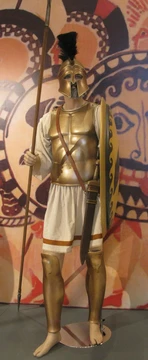
Ksour Essef cuirass
Italiote triple-disc cuirass found in a Punic tomb in Tunisia.

The Ksour Essef cuirass is a triple-disc breastplate from Southern Italy, discovered in 1909 inside a Punic tomb near Ksour Essef, Tunisia. It is now a key exhibit in the ancient department of the Bardo National Museum in Tunis, alongside other artifacts from the same burial.
The tomb was found by Tunisian workers on February 20, 1909, during earthworks at a site called Hammada-El-Mekata, about 12 kilometers southwest of Mahdia. Alfred Merlin, director of Tunisia’s antiquities service, and inspector Louis Poinssot examined the tomb the following month. The excavation caused some damage: two amphorae were broken (later restored from fragments), and the sarcophagus planks were also damaged and later repaired at the Bardo’s laboratory.
The tomb was a shaft tomb, a common type in the Tunisian Sahel. The shaft measured 2.30 by 1.30 meters and was filled with stones from nearby Rejiche quarries. It led to two burial chambers: one empty, the other larger (2 by 2.40 meters, 1.60 meters high). Inside this chamber lay a cypress-wood sarcophagus, painted red, 0.84 meters high, 1.80 meters long, and 0.68 meters wide. This sarcophagus style was widespread from Byzacium to Gigthi. Initial reports mention a single body lying on its back, with poorly preserved bones coated in reddish-brown pigment (cinnabar). Merlin suggested the deceased may have undergone ritual emaciation.
Besides the sarcophagus and cuirass, the tomb contained four amphorae, a bowl, a wooden dish (still holding ochre), a black-glazed lamp, elements of a bronze belt, and copper plates (later identified by Habib Ben Younès as parts of a casket). The cuirass was found next to the lamp. Some items were rediscovered in museum storage in the 1990s; Ben Younès noted that many finds from early 20th-century Punic necropolis excavations have since been lost.
The cuirass (inventory number 01-02-03-01) is a gilded bronze "kardiophylax" (heart guard). It measures about 30 centimeters in height (or 28 by 30 centimeters for the pectoral), with a front side of 42.5 by 44 centimeters and a reverse side of 42 by 66 centimeters. The breastplate and back piece feature three raised circles. One circle depicts a helmeted Minerva with large eyes, thick lips, and visible hair strands. The cuirass is similar in design to a triple-disc specimen from Ruvo di Puglia in the National Archaeological Museum in Naples, though the t
- type
- Triple-disc cuirass (kardiophylax)
- material
- Gilded bronze
- dimensions
- 30 cm height (pectoral); front 42.5 cm × 44 cm; reverse 42 cm × 66 cm
- discovery_date
- 20 February 1909
- discovery_location
- Hammada-El-Mekata, near Ksour Essef, Tunisia
- current_location
- Bardo National Museum, Tunis (inv. 01-02-03-01)
- origin
- Southern Italy (Italiote)
Quick Facts
- Material
- Gilded bronze
- Created
- Late 4th century BC - early 3rd century BC ?
- Discovered Place
- Ksour Essef
- Discovered Date
- 20 February 1909
- Location
- Bardo National Museum
- Culture
- Italiote
Facts from the source article.
Lore & Background
The cuirass was discovered by Tunisian workers in a Punic shaft tomb at Hammada-El-Mekata, 12 km south-west of Mahdia. The tomb contained a cypress wood sarcophagus, four amphorae, a bowl, a wooden dish, a black glazed lamp, elements of a bronze belt, and copper metal plates. The armour was found next to the lamp. The archaeological material was damaged during excavation but later restored.
The cuirass features a breastplate with three raised circles, including a representation of the goddess Minerva helmeted, with acorn necklace and floral motifs. The back has an eight-pointed rosette. A central motif, probably silver, is now missing. The armour is similar in design to a triple-disc specimen from Ruvo di Puglia in the National Archaeological Museum in Naples, though the two differ in decorative details such as central motifs and rosette patterns.
Reader's Guide
The Ksour Essef cuirass is significant as a rare example of Italiote military equipment found outside Italy, prompting historical links to the Second Punic War and Hannibal's campaigns (211–203 BC). However, in-depth examination of the tomb's other objects—amphorae dating from the 5th to 4th centuries BC, an Attic lamp from the 4th century BC—suggests a date in the second half of the 4th century BC or earlier, before the First Punic War. This chronological discrepancy has led scholars to question the initial hypothesis. The cuirass remains an emblematic piece in the Bardo Museum's ancient department, and its presence in Tunisia may indicate trade, mercenary activity, or other cultural exchanges between Southern Italy and Carthage. The uncertainty around its dating and owner underscores the challenges of interpreting isolated finds from early 20th-century excavations.
Did You Know?
- The cuirass was found in a Punic tomb with a shaft measuring 2.30 m × 1.30 m, filled with stones from the Rejiche quarries.
- The tomb contained two skeletons; one was a male individual 1.70 m tall, in his forties, with traces of red ochre on the skull.
- The cuirass is almost identical to one from Ruvo di Puglia in the National Archaeological Museum in Naples.
- The excavator Alfred Merlin remained cautious about linking the cuirass to Hannibal, suggesting it might be an imported product like other Campanian goods.
Frequently Asked Questions
What is the Ksour Essef cuirass and what type of armor is it?
It is a gilded bronze triple-disc breastplate, known technically as a kardiophylax, produced by Italiote (Southern Italian Greek) metalworkers. The front panel spans roughly 42.5 by 44 cm, the back extends to about 66 cm in length, and the pectoral section stands around 30 cm tall.
Where was the Ksour Essef cuirass found and when?
Tunisian laborers uncovered it on 20 February 1909 while carrying out earthworks at a spot called Hammada-El-Mekata, about twelve kilometers southwest of Mahdia. The piece lay inside a Punic burial chamber, and antiquities officials Alfred Merlin and Louis Poinssot examined the site the following month.
Where can I see the Ksour Essef cuirass today?
It is displayed in the ancient department of the Bardo National Museum in Tunis, catalogued under inventory number 01-02-03-01. It is shown together with other grave goods recovered from the same Punic tomb.
Why does the Ksour Essef cuirass matter for understanding Greek military equipment?
It demonstrates that the triple-disc kardiophylax design, typically associated with Greek and Italian workshops, reached Punic funerary contexts in North Africa, highlighting the wide circulation of Italiote craft. Its gilded bronze construction also signals that such breastplates could serve as high-status prestige objects rather than purely battlefield gear.
Did the 1909 excavation damage the cuirass or other items?
The digging process did cause some harm to the tomb's contents, and two other artifacts were noted as affected by the excavation. Despite that, the breastplate itself survived in a condition good enough to anchor the museum's display of the burial's finds.
More in Ancient Greek military equipment 1-24
Spotted an error? Know more?
This is a living reference — every entry is fact-audited, and reader corrections feed straight into our audit queue. Suggest an edit · See this site's audit record