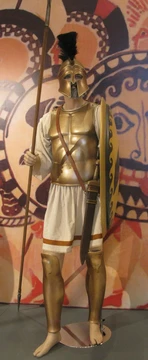
Kopis
A forward-curving blade used for cutting meat and cavalry combat.

The kopis (Ancient Greek: Κόπις) was a type of heavy knife or single-edged sword used in Ancient Greece, characterized by a forward-curving blade. It served both as a tool for cutting meat and ritual slaughter, and as a weapon for cutting or cut-and-thrust combat.
- type
- Knife or sword
- origin
- Ancient Greece (possibly Etruscan origin)
- blade_length
- Up to 65 cm (early examples); about 48 cm (later Macedonian examples)
- edge
- Single-edged, recurved (concave near hilt, convex toward tip)
- related_terms
- Kopis, makhaira, khopesh
- primary_use
- Meat cutting, ritual sacrifice, cavalry warfare
Lore & Background
The term kopis derives from the Greek noun κοπίς and the verb κόπτω, meaning 'to cut, to strike,' though an alternative derivation from the Egyptian khopesh has been postulated. The sword was one-handed, with early examples reaching blade lengths of up to 65 cm, comparable to the spatha, while later Macedonian versions were shorter at about 48 cm. Its blade was single-edged, concave near the hilt and swelling to convexity toward the tip, a shape that distributed weight to deliver blows with the momentum of an axe while retaining a long cutting edge and some thrusting capability. Some scholars claim an Etruscan origin, as such swords have been found in Etruria as early as the 7th century BC.
Reader's Guide
The kopis is often compared to the Iberian falcata and the Nepalese kukri. In ancient texts, the distinction between kopis and makhaira is not entirely clear, but modern specialists tend to classify single-edged cutting swords with a forward curve as kopides and those without as makhairai. The Ancient Greeks used single-edged blades in warfare, though the double-edged xiphos is more widely represented. The kopis was especially suited to mounted warfare; the general Xenophon recommended it for cavalry, stating that from horseback the cut of a machaira (which he did not distinguish from the kopis) served better than the thrust of a xiphos. Greek art depicts Persian soldiers wielding the kopis or an axe rather than the straight-bladed akinakes. It has been suggested that the Ottoman yatagan was a direct descendant of the kopis.
Did You Know?
- The term kopis may derive from the Ancient Egyptian word khopesh for a cutting sword.
- Early kopis blades could be up to 65 cm long, nearly equal in size to the spatha.
- Xenophon recommended the kopis for cavalry because the cut from horseback was more effective than a thrust.
- Some scholars claim an Etruscan origin for the kopis, with examples found in Etruria from the 7th century BC.
Frequently Asked Questions
What is a kopis and what does it look like?
The kopis is a heavy, single-edged blade with a pronounced forward-curve, serving as both a utility knife and a combat weapon in ancient Greece. Its edge is recurved—concave near the hilt and convex toward the tip—which gives it a powerful chopping arc.
How long was a kopis blade?
Early examples could reach up to 65 cm in blade length, while later Macedonian variants came in around 48 cm. This made it a substantial cutting weapon rather than a small dagger.
What was the kopis actually used for besides fighting?
It doubled as a practical meat-cutting tool and a blade for ritual animal sacrifice. On the battlefield it was especially prized by cavalry for its cutting power and cut-and-thrust versatility.
How does a kopis differ from a makhaira or a khopesh?
All three are single-edged, curved blades, but the kopis is the specific Greek (possibly Etruscan-origin) variant with its characteristic recurve. The makhaira is a closely related Greek term often used interchangeably, while the khopesh is the broader Near Eastern sickle-sword family the kopis likely descends from.
Where did the kopis originate and who wielded it?
Though firmly associated with ancient Greece, its design may trace back to Etruscan or wider Near Eastern blade traditions. It became a signature weapon of Greek and later Macedonian cavalry forces.
More in Ancient Greek military equipment 1-24
Spotted an error? Know more?
This is a living reference — every entry is fact-audited, and reader corrections feed straight into our audit queue. Suggest an edit · See this site's audit record