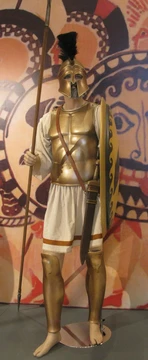
Λινοθώραξ
Linen armor of the ancient Mediterranean, known from texts and art.

The linothorax, a term derived from the Ancient Greek λινοθώραξ meaning "wearing a breastplate of linen," refers to a type of upper body armor used across the ancient Mediterranean. The word itself is modern, but ancient Greek and Latin writings from the 6th century BC to the 3rd century AD mention "linen body armor" (θώρακες λίνεοι or loricae linteae). These references are typically linked to armor depicted in sculptures and paintings from Italy and Greece beginning around 575 BC. How this linen armor was actually made remains largely unknown. It could have been quilted and stuffed with loose fibers, stitched together in many layers, or crafted using a special weaving technique called twining. The idea that it consisted of layers of linen glued together stems from a mistranslation of a 19th-century summary describing medieval armor.
By the late 6th century BC, Aegean art frequently shows hoplites and other warriors wearing the linothorax instead of a bronze cuirass. This shift may have been due to its lower cost, lighter weight, or cooler material. Such depictions continued into the Hellenistic period after Alexander the Great's death. Around 200 AD, the Roman emperor Caracalla equipped a "Macedonian phalanx" with linen armor, as recorded by Cassius Dio. It is also possible that the artistic representations actually show metal armor covered with linen, similar to later medieval brigandines, which were favored for their practicality during campaigns.
Some scholars interpret Homer’s description of Ajax the Lesser as "linen-breasted" in the *Iliad* as a reference to a linothorax, though others argue it means a linen tunic or smooth skin. The earliest clear mention of linen armor in any ancient language comes from the poet Alcaeus, active around 650–550 BC. From the 5th century BC to the 1st century AD, Greek and Roman writers—including Herodotus, Livy, Strabo, Suetonius, and Pausanias—note soldiers from various nations wearing linen armor, but rarely describe it in detail. Plutarch states that Alexander the Great wore a "double linen breastplate" at the Battle of Gaugamela. References to linen armor become scarce during the Roman imperial period, likely because cheap iron armor like the *lorica hamata* reduced demand.
Starting around 575 BC, Aegean artists often depict a distinctive armor style: a smooth piece wrapped around the chest, two flaps over the sh
- field
- Ancient armor
- known_for
- Linen body armor used in the ancient Mediterranean world
- earliest_mention
- c. 650–550 BC (poet Alcaeus)
- earliest_depiction
- c. 575 BC (Aegean art)
- latest_reference
- c. 200 AD (Roman emperor Caracalla)
Lore & Background
Beginning around 575 BC, artists in the Aegean often show a distinctive armor style: a smooth piece wrapped around the chest, two flaps over the shoulders, and a skirt of flaps covering the hips and belly. By the 4th century BC, similar armor appears in wall paintings in Italy, sealstones in Persia, gold combs in Crimea, and stone carvings in Gaul. Because only a few examples of armor shaped like this survive, researchers such as Peter Connolly identify the lost armor with the linen armor in texts; linen would decay and leave little archaeological evidence. On the Alexander Sarcophagus and Alexander Mosaic, Alexander the Great and his soldiers wear this type of armor. Five extant pieces of armor shaped like the Athenian vase paintings survive from sites in southeastern Europe from the 4th century BC to the 1st century AD, but these are made of iron plate, iron scales, or mail—not linen.
Reader's Guide
The linothorax is significant as a type of armor that appears frequently in ancient art and texts but has left almost no archaeological trace, making it a subject of ongoing scholarly debate. Its existence is inferred from depictions and literary mentions, but its construction remains unknown. Modern researchers have attempted reconstructions: in the 1970s, Peter Connolly built a linothorax by gluing layers of linen cloth together, but this was based on a misremembered, twice-translated summary of a Byzantine chronicle that did not mention glue. A later project by Gregory S. Aldrete and Scott Bartell at the University of Wisconsin–Green Bay tested a similar glued construction, but no culture before the 20th century is known to have made linen armor in this way. The armor may never have existed in the form described, instead representing a bronze brigandine or coat of plates with linen as an external covering. The linothorax thus illustrates the challenges of interpreting ancient material culture through incomplete evidence.
Did You Know?
- The term 'linothorax' is a modern term based on the Ancient Greek λινοθώραξ, meaning 'wearing a breastplate of linen.'
- The first clear reference to linen armor in any ancient language is a line by the poet Alcaeus, who lived around 650–550 BC.
- Plutarch says Alexander the Great wore a 'double linen breastplate' at the battle of Gaugamela.
- The theory that linothorax was made of layers of linen glued together comes from a mistranslation of a summary of a description of medieval armor in 1869.
More in Ancient Greek military equipment 1-24
Spotted an error? Know more?
This is a living reference — every entry is fact-audited, and reader corrections feed straight into our audit queue. Suggest an edit · See this site's audit record