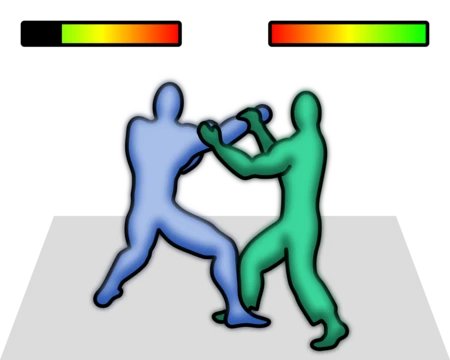
Buriki One
A realistic fighting game with no projectiles.

Buriki One: World Grapple Tournament '99 in Tokyo, commonly shortened to Buriki One (Japanese: 武力 ONE), is a 1999 fighting game developed and published by SNK for arcades. It is the seventh and final game for SNK's Hyper Neo Geo 64 hardware and has never been officially ported to home consoles. The game is notable for its realistic gameplay design, which emphasizes close-quarters grappling and lacks projectile attacks, marking a departure from SNK's previous fighting game IPs.
Quick Facts
- Title
- Buriki One: World Grapple Tournament '99 in Tokyo
- Developer
- SNK
- Director
- Takashi Tsukamoto
- Released
- JP · May 21, 1999
- Genre
- Fighting
- Modes
- Single-player, multiplayer
- Arcade System
- Hyper Neo Geo 64
- Platforms
- Arcade
Facts from the source article.
Lore & Background
Buriki One features 12 martial artists, all original except for Ryo Sakazaki, a guest character from SNK's Art of Fighting series. The story is set in 1999 at the Tokyo Dome, where fighters from around the world compete to prove their martial art is superior. The gameplay uses a two-button movement system and a joystick for attacks of varying strength, with no ranged attacks, keeping combat at close quarters. A fighter can win by knockout, surrender, or judges' decision; falling out of the ring pauses the fight until both return.
Reader's Guide
Buriki One is significant as SNK's most realistic fighting game, using motion capture and a control system designed to emphasize realism. It was primarily designed by Hiroaki Hashimoto, who also served as motion capture artist and modeled the protagonist Gai Tendo. The game was never released in Western regions, but journalists have regarded it as one of SNK's most unique works. Characters Gai Tendo and Silber later appeared as guest fighters in The King of Fighters XI, and Ryo Sakazaki's older persona has been used in other SNK titles as a stronger alter ego. The game's development included research into Muay Thai and sumo, and a fan competition to select 'Buriki Girls' for promotional material.
Did You Know?
- The game's protagonist, Gai Tendo, was modeled after lead designer Hiroaki Hashimoto.
- Ryo Sakazaki's older design was created because Hashimoto disliked his original orange gi.
- The boss character Silber was designed with the concept 'What would happen if a real fighter fought a fighting game character?'
A Wrestling-Inspired Combat System
Buriki One broke sharply from SNK's traditional fighting formula by stripping away projectiles and flashy super moves in favor of a grounded, close-quarters wrestling experience. The control scheme revolves around just two buttons governing lateral movement on a two-dimensional axis: one steps the fighter left, the other right, while double-tapping either triggers a quick dash for evading or closing distance. Pressing both simultaneously raises a guard. All offensive actions flow through the joystick—forward produces a medium strike, up-forward a heavier blow, down-forward the lightest but quickest hit. Layering stick motions unlocks special attacks with greater damage, yet the game deliberately forbids any ranged technique, keeping both players locked in grappling range. Victory comes through a knockout, a forced surrender, or, if the clock expires, a vote by three judges who may cast ballots for either fighter or a non-contributing tie. A tie forces the player to concede or buy a continue. If a fighter is thrown outside the ring, the bout pauses until both return. To reach the finals, a competitor must win three qualifying matches, and only the round's victor advances.
Twelve Disciplines, One Dome
The story places twelve martial artists inside the Tokyo Dome in 1999, each representing a distinct fighting discipline and competing to prove their style is the superior one. The roster spans a wide spectrum of age and background: a seventeen-year-old Okinawan self-taught fighter named Gai Tendo, a thirty-five-year-old super heavyweight boxer from Los Angeles, a thirty-two-year-old French judo director who holds an open-weight gold medal, an eighteen-year-old taekwondo champion currently studying quantum physics in college, a seventeen-year-old Kyoto high-schooler who mastered aikido under his grandfather, a forty-year-old Muay Thai welterweight, a seventy-year-old tai chi master renowned in the Chinese fighting world, a thirty-seven-year-old Dutch professional wrestler, a twenty-seven-year-old freestyle wrestling gold medalist, a twenty-eight-year-old sumo wrestler holding the Sekiwake rank, a thirty-two-year-old karate instructor from the Kyokugen School, and a one-eyed German martial artist named Silber who has been sighted fighting across the globe for three decades without ever entering an official tournament.
Hashimoto's Realism-Driven Vision
The game's creative direction fell primarily to Hiroaki Hashimoto, a motion capture artist who studied martial arts while building most of the fighters. His hands-on research shaped the roster's physicality and the overall emphasis on grounded, believable combat. SNK's own promotional language stressed more realistic fighting and a completely new control system designed from the ground up. That philosophy extended even to the guest character Ryo Sakazaki: rather than importing his established projectile-heavy kit from the Art of Fighting series, Hashimoto reimagined Ryo as a thirty-two-year-old Kyokugen School instructor stripped of any ranged maneuvers, making his gameplay feel like a pure hand-to-hand exchange. Hashimoto also conceived the idea of presenting Ryo in an older, more fearsome guise—a personal creative choice that diverged from the character's usual portrayal. Buriki One became the seventh and final title produced for SNK's short-lived Hyper Neo Geo 64 arcade hardware, and like most games on that platform, it was never officially ported to home consoles.
A Curiosity Beyond the Arcade
Because Buriki One was never released in Western markets and never received a home console port, it has remained something of a cult curiosity rather than a mainstream SNK title. Still, the handful of journalists who did encounter the arcade version consistently singled out its gameplay as one of the company's most distinctive efforts, precisely because it departed so radically from the projectile-and-super-move conventions of SNK's earlier franchises. The game's characters did find a second life in other SNK properties: Gai Tendo and Silber both appeared as guest fighters in The King of Fighters XI, and Ryo's older, more intimidating persona—born from Hashimoto's design choices—has since surfaced in additional SNK titles as a stronger alter ego of the original Art of Fighting protagonist. For players who stumbled upon a Hyper Neo Geo 64 cabinet in a Japanese arcade, Buriki One offered a rare, wrestling-flavored fighting experience that no other SNK game before or after quite matched.
Frequently Asked Questions
What is Buriki One?
Buriki One (shortened from its full title, World Grapple Tournament '99 in Tokyo) is a 1999 arcade fighting game developed and published by SNK. It runs on the Hyper Neo Geo 64 cabinet and centers on close-range grappling combat rather than the projectile-heavy style SNK is typically associated with.
Can I play Buriki One on a home console?
No. The game was released exclusively for SNK's Hyper Neo Geo 64 arcade hardware and has never received an official port to any home console.
What makes Buriki One's gameplay different from other SNK fighters?
The title removes projectile attacks entirely and builds its combat around realistic, close-quarters grappling. This marked a clear departure from the ranged, special-move-heavy design that defined SNK's earlier fighting franchises.
Who designed Buriki One?
Hiroaki Hashimoto served as the lead designer on the project.
Why is Buriki One notable in SNK's hardware history?
It is the seventh and final game ever released for the Hyper Neo Geo 64 system, meaning no subsequent title was ever made for that platform.
More in 3D fighting games 1-24
Spotted an error? Know more?
Reader corrections go straight into our review queue. Suggest an edit · How this site is sourced