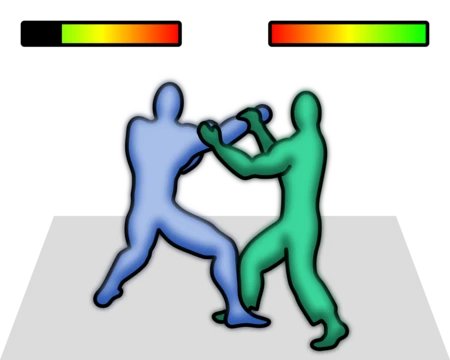
Battle Tryst
Konami's second 3D arcade fighter, never ported to consoles.

Internet Archive Book Images · No restrictions
Battle Tryst (バトルトライスト) is a 3D fighting arcade game released by Konami in 1997. It was the company's second entry in the 3D arcade fighting genre, arriving a year after their earlier title, Fighting Bujutsu. The game ran on Konami's System 573 hardware. Like its predecessor, Battle Tryst never received a home console port.
The controls consist of a three-button layout with an 8-way joystick, similar to Sega's Virtua Fighter series, while its time-release mechanics were borrowed from Namco's Tekken franchise. The opening and character endings feature real Japanese animation, with film director Mamoru Oshii handling the storyboard and Shujiro Hamakawa designing the characters. Planned cameos from Simon and Richter Belmont of Castlevania, as well as Madoka from TwinBee, were ultimately scrapped. The game was showcased at the February 1998 AOU Show.
Quick Facts
- Title
- Battle Tryst
- Developer
- Konami
- Director
- Shujiro Hamakawa
- Producer
- Fumiaki Tanaka
- Designer
- Shujiro Hamakawa (character designer) / Mamoru Oshii (animator)
- Programmer
- Yasuyuki Nakane / Masanori Taniguchi / Tadashi Kitagawa
- Composer
- Hiroshi Tanabe
- Released
- February 1998
- Genre
- Fighting
- Modes
- Up to 2 players simultaneously
- Platforms
- Arcade
- Arcade System
- Konami M2 Hardware
Facts from the source article.
Lore & Background
Battle Tryst uses a three-button 8-way joystick layout similar to Sega's Virtua Fighter series, and its time release system was adopted from Namco's Tekken series. The opening and character endings feature real Japanese animation, with film director Mamoru Oshii handling the storyboard and Shujiro Hamakawa designing the characters. Planned guest characters from the Castlevania series (Simon and Richter Belmont) and the TwinBee series (Madoka) were canceled before release.
Reader's Guide
Battle Tryst is significant as Konami's second foray into 3D arcade fighting games, following Fighting Bujutsu. It was powered by the Konami M2 Hardware, a version of the Panasonic M2. The game features a roster of eight standard fighters—Kika Gryphon, Takeru Yamato, Bites Macintosh, Zankoku, Zhai Zhai, Gary Williams, and Nadjeed Shiee—plus three hidden fighters: Kitajima, Alex, and Elein Shiee (the Fairy character from Konami's Gaiapolis), as well as Pastel (pilot of WinBee from TwinBee). Despite its arcade release, Battle Tryst was never ported to any home console, limiting its legacy to the arcade scene. Its use of professional animation and involvement of Mamoru Oshii highlight Konami's ambition, but the cancellation of crossover characters from Castlevania and TwinBee suggests development challenges. The game remains a footnote in fighting game history, known primarily to collectors and arcade enthusiasts.
Did You Know?
- Battle Tryst was exhibited at the February 1998 AOU Show.
- Mamoru Oshii took charge of the storyboard for the game's animations.
- Simon and Richter Belmont from Castlevania were planned as fighters but canceled.
Development & Konami's 3D Fighting Ambitions
Battle Tryst represents Konami's second foray into the 3D arcade fighting game space, following their 1997 entry Fighting Bujutsu. Developed and published entirely by Konami, the title launched in 1998 on their proprietary Konami M2 Hardware, essentially Konami's in-house adaptation of the Panasonic M2 platform. Despite being a full-fledged arcade release, the game shared a notable fate with its predecessor: it was never ported to any home console, remaining exclusively an arcade experience. This limited availability meant that players outside of Japanese and select international arcades had virtually no opportunity to experience the title beyond its original cabinet. The game was first showcased to the public at the February 1998 AOU Show, giving industry attendees a glimpse of Konami's continued commitment to 3D combat in the arcade space. The fact that Konami pursued a second 3D fighter so quickly after Fighting Bujutsu suggests an internal drive to refine their approach to the genre, even as the broader market was already being dominated by other studios' offerings.
Controls & Gameplay Design
Battle Tryst adopted a three-button layout paired with an eight-way joystick, a control scheme closely mirroring the one players would have encountered in Sega's Virtua Fighter series. This familiar arrangement made the game approachable for anyone who had spent time in front of a Virtua Fighter cabinet, reducing the learning curve for basic directional and button inputs. Beyond the physical layout, the game also incorporated the time-release mechanic popularized by Namco's Tekken series, adding a layer of timing-based depth to its combat system. The combination of these two design influences — Virtua Fighter's accessible stick-and-button feel and Tekken's timing-driven execution — gave Battle Tryst a hybrid identity within the 3D fighting genre. Running on the Konami M2 Hardware, the game was built to deliver smooth 3D combat in an arcade environment, though its exclusive arcade release meant that this particular blend of control philosophies never reached a wider home audience. The result was a title that felt simultaneously familiar to genre veterans and distinct in its own right, a product of Konami studying what competitors were doing and attempting to synthesize those elements into their own vision.
Animation & Creative Vision
One of Battle Tryst's most distinctive features was its use of real Japanese animation for both the opening sequence and the character endings, a production choice that elevated the game's presentation well beyond typical arcade fare. The storyboard for these animated segments was handled by Mamoru Oshii, the acclaimed film director known for his work in anime cinema, lending a level of narrative sophistication rarely seen in fighting game cutscenes. Character design was entrusted to Shujiro Hamakawa, whose visual direction shaped the appearance of the roster. The decision to involve a figure of Oshii's stature suggests that Konami viewed Battle Tryst as more than a simple arcade title; it was an opportunity to blend cinematic storytelling with competitive gameplay. Interestingly, the project originally had broader crossover ambitions: Simon and Richter Belmont from the Castlevania franchise, along with Madoka from Konami's TwinBee series, were all planned to appear as playable fighters. All three characters were ultimately cut, leaving the game's roster to rely on its own original cast and a handful of hidden characters drawn from other Konami properties.
The Roster & Konami Crossover Threads
The playable roster of Battle Tryst blends original characters with a few notable crossovers from across Konami's arcade library. The main lineup includes Kika Gryphon, Takeru Yamato, Bites Macintosh, Zankoku, Zhai Zhai, Gary Williams, and Nadjeed Shiee, a diverse group whose names suggest a mix of cultural and thematic influences. Beyond the primary cast, the game hides several unlockable fighters that serve as Easter eggs for fans of Konami's other titles. Kitajima and Alex appear as hidden characters, while Elein Shiee, also known as Elaine Shea, is the Fairy character originally from Konami's Gaiapolis arcade game. Pastel, the pilot of the WinBee craft from the TwinBee series, also makes a surprise appearance. These hidden inclusions create a web of connections between Konami's various arcade properties, rewarding players who are familiar with the company's broader catalog. The presence of characters from Gaiapolis and TwinBee, both earlier Konami arcade titles, reinforces the sense that Battle Tryst was conceived as part of a larger internal universe, even as its most high-profile planned crossovers with Castlevania and TwinBee's Madoka were ultimately shelved.
Gallery
Frequently Asked Questions
What is Battle Tryst?
Battle Tryst is a 3D arcade fighting game that Konami shipped in 1997 as the sequel to their earlier 3D fighter, Fighting Bujutsu. It was built specifically for Konami's System 573 arcade cabinets.
Was Battle Tryst ever ported to a home console?
No. Like its predecessor Fighting Bujutsu, Battle Tryst remained an arcade-exclusive title and never saw a home-system release.
What control scheme does Battle Tryst use?
Players operate the game with a three-button layout and an 8-way joystick, a setup closely modeled on Sega's Virtua Fighter series. The time-release mechanic, however, was borrowed from Namco's Tekken franchise.
Who are the notable creators behind Battle Tryst?
Mamoru Oshii handled the storyboard and Shujiro Hamakawa designed the characters. The opening sequence and individual character endings were produced as genuine Japanese animation under a film director's supervision.
How does Battle Tryst fit into Konami's arcade-fighting lineup?
It was Konami's second foray into 3D arcade fighting, arriving one year after Fighting Bujutsu. Both titles stayed locked to the arcade and were never adapted for home hardware.
More in 3D fighting games 1-24
Spotted an error? Know more?
Reader corrections go straight into our review queue. Suggest an edit · How this site is sourced