Arms (video game)
A 2017 fighting game with extendable arms and motion controls.

Wikimedia Commons · CC BY-SA 4.0
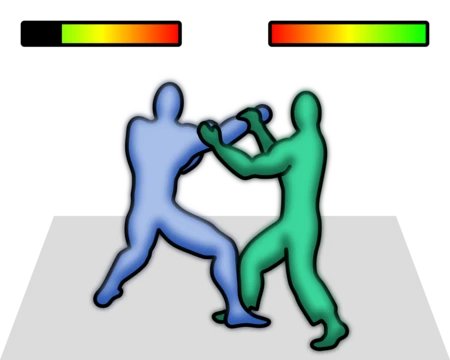
Arms is a fighting game released by Nintendo for the Nintendo Switch in 2017. Instead of traditional close-quarters combat, each fighter uses long-range, extendable arms to punch, throw, block, and dodge opponents in a three-dimensional arena, with up to four players able to join a single match. Critics gave the game generally favorable reviews, and it had sold over two million copies by July 2018.
In gameplay, players choose from a roster of fighters, each with three unique Arms that can be swapped out and customized. Additional Arms from other characters become available through the Get Arms mode. A charged attack meter allows for a powerful "rush attack," and players can also charge punches to boost damage and add elemental effects. Controls support either the Joy-Con motion sensors or standard button inputs. Matches can be free-for-alls with three or four players, or two-on-two battles where teammates are tethered together. Beyond standard fights, modes include Versus, Grand Prix (a ten-match tournament for a championship belt), and Battle modes like volleyball, basketball, target breaking, and survival. Online play offers party lobbies for up to twenty players or one-on-one ranked matches. The game launched with ten fighters, with five more added through post-release updates.
The fifteen playable fighters are: Spring Man, a determined brawler with metallic coil arms; Ribbon Girl, a pop star with ribbon arms; Ninjara, a ninja student with chain arms; Master Mummy, a reanimated heavyweight with bandage arms; Min Min, a martial artist and ramen shop promoter with noodle arms; Mechanica, a teenage inventor who pilots a battle suit; Twintelle, a movie star with hair-based arms; Byte & Barq, a robot police officer and dog duo with clockwork arms; Kid Cobra, a snakeboarder and streamer with snake-like arms; Helix, a green slime creature with DNA-shaped arms; Max Brass, the league champion with belt arms; Lola Pop, a traveling clown with candy arms; Misango, a spiritual warrior with fabric arms; Springtron, a robotic copy of Spring Man with coil arms; Dr. Coyle, the head scientist with copper arms; and Hedlok, a self-aware robot mask that serves as the final boss.
The game was developed by Nintendo's Entertainment Plan division.
Quick Facts
- Title
- Arms
- Developer
- Nintendo EPDAdditional work by Bandai Namco Studios. Nintendo Switch 2 upgrade developed by Panic Button.
- Publisher
- Nintendo
- Director
- Kenta Sato · Masaaki Ishikawa · Shintaro Jikumaru
- Producer
- Kosuke Yabuki
- Designer
- Shintaro Jikumaru
- Programmer
- Kenta Sato
- Artist
- Masaaki Ishikawa
- Composer
- Atsuko Asahi · Yasuaki Iwata
- Platforms
- Nintendo Switch
- Released
- 2017-06-16
- Genre
- Fighting
Facts from the source article.
Lore & Background
Arms was developed by Nintendo's Entertainment Planning & Development division with assistance from Bandai Namco Studios. The game began as an experiment to see if a behind-the-camera perspective could work in a fighting game, leading to the main feature of extendable arms. Early concepts considered featuring staple Nintendo characters like Link and Mario, but the aesthetic of extendable arms clashed with them, so a new cast was created. The possibility of adding characters from Punch-Out!! was also considered but dropped to avoid alienating fans and confusing new players. Character designs started with the arms first, working backwards to decide what type of character would possess them; for example, Helix began with the idea of a fighter whose arms were DNA strands. An early concept had characters using external devices to punch, but this was dropped in favor of extending actual arms. Art director Masaaki Ishikawa said the art style was largely influenced by Dragon Ball and Akira.
Reader's Guide
Arms is notable for its innovative motion-controlled combat system, allowing players to use Joy-Con motion controls or standard button inputs to operate each arm individually. The game features a variety of modes including Versus, Grand Prix, and Battle modes such as volleyball, basketball, target breaking, and survival. Online play includes party match lobbies with up to 20 players and one-on-one ranked matches. The game's fifteen fighters each have unique attributes, abilities, and Arms that can be customized. Post-release updates added new characters, stages, and Arms until December 2017, after which only balance updates were provided. The game's sales of over two million copies by July 2018 and generally favorable critical reception demonstrate its commercial and critical success, though it has been compared to the boxing minigame from Wii Sports. Its development approach—starting with arm concepts and building characters around them—and its free update model following Splatoon's example influenced its reception and legacy.
Did You Know?
- Early development considered featuring Link and Mario, but the extendable arms concept clashed with them.
- A multiplayer demo called the 'Arms Global Testpunch' was available before release with twelve separate hour-long sessions.
Gameplay & Combat System
Arms reimagined the fighting game formula by placing players in a three-dimensional arena where combat unfolds at long range rather than in close quarters. Up to four fighters can clash simultaneously, each wielding extendable, weaponized arms that transform punches, throws, blocks, and dodges into dynamic, spatial maneuvers. The core loop revolves around an attack meter: once fully charged, a player unleashes a high-damage rush attack, while partially charged strikes temporarily boost damage and apply elemental effects. Every fighter begins with three signature Arms, yet the Get Arms mode lets players unlock and equip any Arm in the roster, each carrying its own weight and elemental attribute that shifts how a match plays out. Control options are equally flexible—Joy-Con motion controls allow individual arm manipulation, while the Pro Controller handles standard button inputs. Match structures range from three- and four-way free-for-alls to two-on-two team battles where partners are tethered together, ensuring no two sessions feel identical.
Roster & Character Design
Arms launched with ten playable fighters and expanded to fifteen through post-release downloadable content, each bringing a distinct personality and combat identity to the Grand Prix. Spring Man, the hot-blooded bouncer with metallic coil arms, drives the narrative as he chases the champion belt from Max Brass. Ribbon Girl brings pop-star flair with ribbon arms, while Ninjara treats the tournament as his senior project at Rasen Ninjutsu University. The roster spans wildly different archetypes: Min Min promotes her family's Mintendo Noodle House with noodle arms, Mechanica pilots a Mini-Mecha suit after being born without the ARMS gene, and Twintelle enters to add the belt to her movie-star award shelf. Byte and Barq form a clockwork beach-patrol tag team, Kid Cobra fights to grow his livestream audience, and Helix, a green slime deemed a laboratory failure, competes to prove his worth to Dr. Coyle's team. The five DLC additions—Lola Pop, Misango, Springtron, Dr. Coyle, and Hedlok—extend the roster's range from a candy-armed circus dreamer to a self-aware metallic mask that becomes the game's highest-difficulty final boss.
Development & Creative Vision
Arms was crafted by Nintendo's Entertainment Planning & Development division with support from Bandai Namco Studios, and its origins trace back to a simple creative question: could a behind-the-camera perspective work in a fighting game? That single experiment gave birth to the extendable-arm mechanic, which solved the spatial problem of long-range combat in a 3D space. Producer Yabuki drew a direct parallel to Mario Kart, explaining that the basic structure—something appears in the distance and the player steers in relation to it—formed the backbone of Arms' movement and targeting. The Joy-Con motion-control integration was a natural extension of this philosophy, letting players physically swing each arm independently rather than relying solely on button mashing. The result was a game that felt less like a traditional one-on-one slugfest and more like a spatial, multi-directional sport, where positioning, timing, and arm selection all mattered as much as raw button input. The collaboration with Bandai Namco Studios brought additional polish to the combat feel and visual presentation, helping the unconventional concept land as a cohesive, accessible package for the Switch's launch window.
Modes, Reception & Commercial Performance
Beyond its core fighting loop, Arms offered a breadth of modes that broadened its appeal well past dedicated fighting-game fans. Grand Prix challenged players through ten sequential computer-controlled bouts to claim the championship belt, while Battle mode branched into volleyball, basketball, target-breaking, and survival formats. Online play supported both a party lobby accommodating up to twenty players and one-on-one ranked matches, giving the title a social and competitive layer. Critics responded with generally favorable reviews, praising the game's accessibility and inventive combat, and the commercial numbers confirmed the positive reception: over two million copies had sold by July 2018, a strong showing for a niche genre on a new console. The five post-launch DLC fighters kept the roster fresh and gave returning players new strategic options, while the ability to mix and match Arms across the entire cast ensured that no single character dominated the meta. For a title built on an unconventional premise—long-range, multi-player, 3D arena combat—Arms carved out a distinctive identity within Nintendo's catalog and proved that the Switch could host a genuinely original fighting experience.
Gallery



Frequently Asked Questions
What is Arms (2017 video game)?
Arms is a 3D fighting sports title published by Nintendo for the Switch, where combat centers on long, stretchy appendages rather than short-range strikes. It launched on June 16, 2017, and supports up to four players in a single match.
How does combat work in Arms?
Each fighter wields three swappable, extendable arms that let them punch, throw, block, and dodge across a three-dimensional arena. Players can mix and match Arms from different characters to build custom loadouts.
Who developed Arms?
The game was developed by Nintendo Entertainment Planning & Development in collaboration with Bandai Namco Studios, and published by Nintendo.
How well did Arms sell?
By July 2018, roughly a month after its June 2017 launch, the title had moved over two million copies. Critics generally gave it favorable reviews upon release.
What makes Arms different from other 3D fighters?
Instead of the close-quarters brawling typical of the genre, Arms pushes everything to long range with its stretchy limb mechanics, creating a more spatial, dodge-heavy style of play. The motion-control option on Switch also lets players swing their own arms to execute attacks.
More in 3D fighting games 1-24
Spotted an error? Know more?
Reader corrections go straight into our review queue. Suggest an edit · How this site is sourced