
Mount Nemrut
Mountain summit with colossal statues and a presumed royal tomb.
Last updated
Where it is
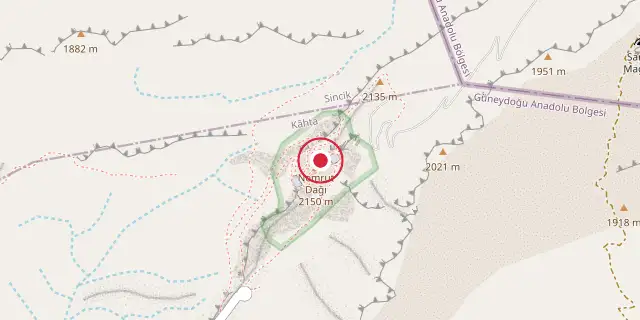
Coordinates: 37°58′52″N 38°44′28″E (37.9810, 38.7410) · Open in OpenStreetMap
Coordinates and connected clubs: the infobox of Wikipedia: Mount Nemrut (CC BY-SA 4.0). Map: drawn by Codexery from OpenStreetMap tiles.
Mount Nemrut (also Nemrud) is a 2,150-metre-high mountain in southeastern Turkey, in the Anti-Taurus range of Adıyaman Province. It is notable for the summit where a number of large statues are erected around what is assumed to be a royal tomb from the 1st century BC. The site was designated a UNESCO World Heritage Site in 1987.
Lore & Background
In 62 BC, King Antiochus I of Commagene built on the mountain top a tomb-sanctuary flanked by huge statues 8–9 metres high of himself, two lions, two eagles, and various composite Greek and Iranian gods, such as Heracles-Artagnes-Ares, Zeus-Oromasdes, and Apollo-Mithras-Helios-Hermes. When constructing this pantheon, Antiochus drew heavily from Parthian and Armenian traditions to reinvigorate the religion of his ancestral dynasty.
The statues were once seated, with names of each god inscribed on them; at some point the heads were removed from their bodies and are now scattered throughout the site. The pattern of damage to the heads suggests deliberate iconoclasm. The statues have not been restored to their original places.
The site also preserves stone slabs with bas-relief figures thought to have formed a large frieze, depicting Antiochus' Greek and Persian ancestors. The same statues and ancestors appear on the tumulus at the site, which is 49 metres tall and 152 metres in diameter.
The tumulus of loose rock may have been devised to protect a tomb from robbers, as any excavation would quickly fill in. The statues appear to have Greek-style faces but Persian clothing and hair-styling. The western terrace contains a large slab with a lion showing an arrangement of stars and the planets Jupiter, Mercury, and Mars, taken to be a chart of the sky on 7 July 62 BCE, possibly indicating when construction began.
Reader's Guide
Mount Nemrut is significant as the site of a hierothesion—a religious sanctuary—built by King Antiochus I of Commagene as part of his political program to revive Persian traditions. The syncretism of its pantheon, combining Greek and Iranian deities, and the lineage of its kings traceable through Greek and Persian legends, evidence the dual origin of Commagene's culture. The site was excavated in 1881 by German engineer Karl Sester, and later archaeologist Theresa Goell dedicated her life to it starting in 1947. Subsequent excavations have failed to reveal Antiochus' tomb, though it is still believed to be his burial site.
Turkish photographer Ara Güler's photo-reportages of Mount Nemrut in the late 1950s are considered among his most significant works. Designated a UNESCO World Heritage Site in 1987, the mountain is a major tourist destination, typically visited from April through October, with access from Adıyaman, Malatya, or Kahta. The monument remains an ambitious construction of the Hellenistic period, its statues still beheaded and unrestored.
More in World Heritage Sites in Turkey
Sources
Compiled from Wikipedia and the sources listed below. Text from Wikipedia is available under CC BY-SA 4.0; this entry is adapted from it.
- Wikipedia: Mount Nemrut (CC BY-SA 4.0).
Spotted an error? Know more?
Reader corrections go straight into our review queue. Suggest an edit · How this site is sourced