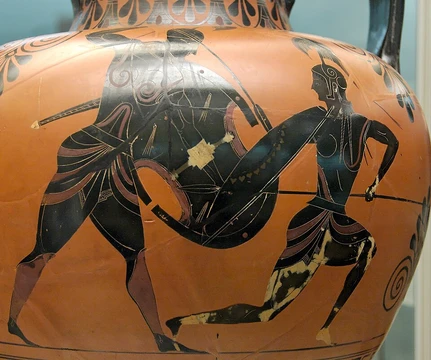
Ares
Greek god of war, courage, and bloodlust.

Ares (Ancient Greek: Ἄρης, Árēs) is the Greek god of war and courage, a member of the Twelve Olympians and the son of Zeus and Hera. The Greeks had mixed feelings about him: he represents the physical bravery needed to win in battle, but he also stands for raw brutality and a thirst for blood. This sets him apart from his sister Athena, who oversees military strategy and leadership. Anything linked to Ares—places, objects, or other gods—takes on a savage, dangerous, or warlike character.
His name traces back to Mycenaean times, but some ancient Greeks thought his violent nature came from his possible origins as a Thracian deity. A few cities in Greece and several in Asia Minor held yearly festivals where they would bind and imprison him as their protector. In parts of Asia Minor, he served as an oracular god. Further away, the Scythians were said to sacrifice one out of every hundred prisoners of war to their version of Ares. The later idea that ancient Spartans offered human sacrifices to him likely stems more from myth, misunderstandings, and his reputation than from actual practice.
Though Ares appears often in stories about love affairs and fathering children, he plays a limited role in Greek mythology. When he does show up, he is usually humiliated. During the Trojan War, Aphrodite, who protected Troy, convinced him to fight on the Trojan side. The Trojans lost, while Athena helped the Greeks win. Most famously, when the craftsman-god Hephaestus found out that his wife Aphrodite was having an affair with Ares, he trapped the lovers in a net and exposed them to mockery from the other gods.
In Roman religion, Ares’ closest counterpart is Mars, who held a more important and respected place as the ancestral protector of Rome and its people. When Latin literature was Hellenized, Roman writers retold Ares’ myths under the name Mars, and in later Western art and literature, the two figures became nearly impossible to tell apart.
The name Ares is traditionally linked to the Greek word *arē* (Ionic form of *ara*), meaning “bane, ruin, curse, or imprecation.” Walter Burkert notes that Ares seems to be an ancient abstract noun for “throng of battle, war.” R. S. P. Beekes suggests the name may have a Pre-Greek origin. The earliest known form is the Mycenaean Greek *a-re*, written in Linear B script.
The epithet *Areios* (“warlike”) was often added to other gods when they took on a warrior role or got involved in war: Zeus Areios, Athena Areia, and even Aphrodite Areia (“Aphrodite within Ares” or “feminine Ares”), who was warlike, fully armed, and partnered with Athena in Sparta, and was represented at the temple of Aphrodite Urania on Kythira. In the *Iliad*, the word *ares* is used as a common noun meaning “battle.” In the Classical period, Ares was also called Enyalios, a name that appears on a Mycenaean tablet as *e-nu-wa-ri-jo*. Enyalios was sometimes identified with Ares and sometimes treated as a separate war god with his own cult, even in the same town; Burkert calls them “doubles almost.”
Epithets for Ares include: *aatos* or *atos polemoio* (insatiate at war), *alloprosallos* (leaning first to one side, then to the other), *andreifontēs* (man-slaying), *apotimos* (dishonoured, used by Sophocles), *brotoloigos* (plague of man), *enyalios* (warlike), *Thēritas* (at Sparta, a form of Thersites meaning audacious), *mainomenos* (malignant), *miaifonos* (blood-stained), and *tykton kakon* (complete evil).
In mainland Greece and the Peloponnese, only a few places had a formal temple and cult for Ares. Pausanias mentions an altar to Ares at Olympia and notes that a Temple of Ares was moved to the Athenian agora during Augustus’ reign and rededicated as a Roman temple to Mars Ultor. The Areopagus (“mount of Ares”), a natural rock outcrop in Athens away from the Acropolis, was supposedly where Ares was tried and acquitted by the gods for killing Poseidon’s son Halirrhothius, who had raped Ares’ daughter Alcippe. This name was later used for a court that met there to investigate and try potential treason cases.
Numismatist M. Jessop Price says Ares “typified the traditional Spartan character,” but he had no important cult in Sparta and never appears on Spartan coins. Pausanias gives two examples of his cult there, both alongside or “within” a warlike Aphrodite on the Spartan acropolis. Gonzalez, in his 2005 survey of Ares’ cults in Asia Minor, observes that cults to Ares on the Greek mainland may have been more common than some sources suggest. Wars between Greek states were constant, and war and warriors provided Ares’ tribute, feeding his endless appetite for battle.
Ares’ attributes are tools of war: a helmet, shield, and sword or spear. Libanius “makes the apple sacred to Ares” but offers no further explanation or connection to any myth. Apples are one of Aphrodite’s sacred or symbolic fruits. Littlewood follows Artemidorus’ claim that dreaming of sour apples predicts conflict, and lists Ares alongside Eris and the mythological “Apples of Discord.”
Gods were immortal but could be bound and restrained, both in myth and in cult practice. An archaic Spartan statue of Ares in chains stood in the temple of Enyalios (sometimes seen as Ares’ son, sometimes as Ares himself). Pausanias said this meant the spirit of war and victory should be kept in the city. The Spartans also ritually bound images of other deities, including Aphrodite and Artemis (compare Ares and Aphrodite bound by Hephaestus), and chained statues of Artemis and Dionysos existed elsewhere.
- field
- War and courage
- nationality
- Greek
- known_for
- God of war, son of Zeus and Hera, lover of Aphrodite
- cult_centers
- Sparta, Athens, Asia Minor
- attributes
- Helmet, shield, sword or spear
Lore & Background
Ares is the Greek god of war and courage, one of the Twelve Olympians, and the son of Zeus and Hera. His name originates from Mycenaean Greek, and its etymology is traditionally linked to the Greek word for “bane” or “ruin,” though some scholars suggest a Pre-Greek origin. He embodies the physical valor necessary for success in war but also personifies sheer brutality and bloodlust, contrasting with his sister Athena, who represents military strategy and generalship. An association with Ares endows places, objects, and other deities with a savage, dangerous, or militarized quality. His attributes are instruments of war: a helmet, shield, and sword or spear. In the Classical period, he is given the epithet Enyalios, a name that appears in Mycenaean texts and sometimes denotes a separate war god. Other epithets include “man-slaying,” “plague of man,” and “blood-stained.” His reputation for savagery led some to believe he originated as a Thracian deity. In mainland Greece and the Peloponnese, few formal temples to Ares existed; Pausanias notes an altar at Olympia and a temple moved to the Athenian agora under Augustus. The Areopagus in Athens was named for the site where Ares was tried for killing Poseidon’s son Halirrhothius. Some Greek and Asian Minor cities held annual festivals to bind and detain him as their protector. In parts of Asia Minor, he was an oracular deity. The Scythians ritually killed one in a hundred prisoners as an offering to their equivalent of Ares. His Roman counterpart is Mars, who held a more dignified role as ancestral protector of the Roman state.
Reader's Guide
Ares's significance lies in his embodiment of the brutal, chaotic aspects of war, contrasting with Athena's strategic warfare. His cult was limited in mainland Greece, with few formal temples, though he was more prominent in Asia Minor as an oracular deity. The Spartans associated him with their martial character but had no important cult to him; they ritually bound a statue of Ares in chains to keep the spirit of war within the city. His Roman counterpart Mars was given a more dignified role as ancestral protector of Rome. During the Hellenization of Latin literature, the myths of Ares were reinterpreted under the name of Mars, and in later Western art and literature the two figures became virtually indistinguishable. Ares's attributes—helmet, shield, and sword or spear—are instruments of war, and his epithets include 'man-slaying,' 'plague of man,' and 'complete evil.'
Did You Know?
- The earliest attested form of the name Ares is the Mycenaean Greek 'a-re', written in Linear B syllabic script.
- In the Iliad, the word 'ares' is used as a common noun synonymous with 'battle'.
- Some cities in Asia Minor held annual festivals to bind and detain a statue of Ares as their protector.
- The Scythians were said to ritually kill one in a hundred prisoners of war as an offering to their equivalent of Ares.
Identity and the Duality of War
Ares occupies a unique and often uncomfortable position among the Twelve Olympians. As the son of Zeus and Hera, he carries full divine legitimacy, yet many ancient Greeks felt deeply ambivalent about him. He represents the raw physical courage that makes military success possible, but he equally embodies unthinking savagery and bloodlust. This duality is sharpened by his contrast with his sister Athena, who governs the strategic and commanding dimensions of warfare. Where Athena brings order to battle, Ares brings chaos. His very name, traced back to Mycenaean Linear B inscriptions, has been linked by scholars to the Greek word for bane or curse, and Walter Burkert suggests it may originally have been an abstract noun meaning a throng of battle. In the Iliad, the word ares functions simply as a common noun for combat itself. His epithets—man-slaying, blood-stained, plague of mankind, complete evil—paint a portrait of a deity whose worship was tinged with fear rather than reverence, and whose association with any place or object lent it a savage, militarized quality.
Cult, Chained Statues, and Containment Rituals
The worship of Ares reveals a fascinating tension between his terrifying nature and the practical need communities felt to contain him. On the Greek mainland, formal temples dedicated to him were surprisingly few. Pausanias records an altar at Olympia and a temple in the Athenian agora, later rededicated as a Roman temple to Mars Ultor during Augustus's reign. The Areopagus, a rocky outcrop in Athens, bore his name from the mythic trial in which the gods acquitted him of killing Poseidon's son. In Sparta, where he supposedly typified the city's martial character, he had no significant independent cult and never appeared on their coinage. His most striking cultic expression was the chained statue. An archaic image in the temple of Enyalios depicted him bound, a ritual meant to keep the spirit of war within the city's walls. Similar bound statues were prescribed by oracles for cities in Pamphylia, Lycia, and Cilicia—regions perpetually threatened by pirates—who were instructed to set up a bloody, man-slaying Ares and ritually fetter him with iron chains during annual festivals, treating him as a supplicant on trial before Dike and Hermes.
A God of Humiliation in Myth
Despite his status as an Olympian, Ares plays a remarkably limited and often undignified role in Greek myth. When he does appear in literary narratives, he is frequently the object of humiliation rather than the agent of heroism. During the Trojan War, Aphrodite persuades him to champion the Trojan cause, yet the Trojans are ultimately defeated while his sister Athena guides the Greeks to victory. His most famous mythic episode is one of public embarrassment: Hephaestus, discovering his wife Aphrodite's affair with Ares, constructs an inescapable net that traps the two lovers in flagrante delicto. He then summons the other gods to witness their naked exposure, turning the god of war into a spectacle of collective ridicule. Literary sources reference numerous love affairs and offspring, yet these remain largely allusive rather than fully developed narratives. His epithets in classical literature—dishonoured, malignant, leaning first to one side then the other—reinforce the impression of a deity whose stories emphasize instability, shame, and the messy, unglamorous reality of combat rather than any noble martial ideal.
Mars and the Merging of Two War Gods
The relationship between Ares and the Roman god Mars illustrates how cultural translation can reshape a deity's entire significance. In Roman religion, Mars occupied a far more elevated and dignified position than his Greek counterpart ever did. He served as the ancestral protector of the Roman people and the state itself, a role that placed him well above the ambivalent, often reviled figure Ares was in Greek tradition. During the process of Hellenizing Latin literature, Roman writers began reinterpreting Ares's myths under the name Mars, effectively grafting Greek narrative material onto a Roman divine framework. Over time, in the broader currents of Western art and literature, the mythologies of the two figures became virtually indistinguishable. The result is that much of what later Western audiences recognize as Mars is actually Ares's story—the trapped lovers, the Trojan War involvement, the epithets of blood and slaughter—transplanted into a Roman identity that originally had little use for the Greek god's reputation for savagery. This merger demonstrates how the prestige of a culture's own deity can absorb and transform a foreign counterpart's character entirely.
Common Misconceptions (Editorial)
Some people assume Ares was a universally revered war god among the ancient Greeks, but the facts show many Greeks were ambivalent toward him, and he was often humiliated in myths. Another common misconception is that Ares was a master of military strategy; in fact, his sister Athena was associated with generalship and strategy, while Ares embodied physical valor, brutality, and bloodlust. It is also incorrect to think Ares only appears invincible in mythology, as he was famously trapped in a net with Aphrodite by Hephaestus and exposed to ridicule by the other gods.
Why It Matters (Editorial)
Ares endures as a figure because he represents the raw, unvarnished violence and courage that underlie human conflict—qualities that societies both rely on and fear. His ambivalent reception by the Greeks mirrors our own ongoing struggle to reconcile the necessity of war with its brutal consequences, making him a timeless symbol of that tension.
Frequently Asked Questions
Who is Ares?
Ares is the Greek god of war and courage, one of the Twelve Olympians, and the son of Zeus and Hera. He is also well known as the lover of Aphrodite.
What are Ares's powers and role?
He governs the raw, physical violence and bloodlust of combat, standing in contrast to Athena's focus on strategy and command. His typical attributes are a helmet, shield, and a sword or spear, and his major cult sites were in Sparta, Athens, and Asia Minor.
How does Ares's story end?
In the Iliad, he is struck by Diomedes' stone and later wounded by Athena, forcing him to retreat from the battlefield, but he never dies. As an immortal Olympian, he has no true ending and remains a feared presence throughout Greek myth.
Why is Ares important in Greek mythology?
He embodies the necessary but deeply feared side of warfare—brute force and fearless courage—making him central to how the Greeks conceptualized conflict. His name was often applied to places, objects, or other deities to signal something savage, dangerous, or militarized.
What's the difference between Ares and Athena?
Ares represents the chaotic, bloodthirsty fury of battle, while Athena stands for disciplined strategy and wise generalship. Most Greeks revered Athena far more, seeing Ares' war as glorification of slaughter rather than purposeful conflict.
More in Greek Myths 1-22
Spotted an error? Know more?
This is a living reference — every entry is fact-audited, and reader corrections feed straight into our audit queue. Suggest an edit · See this site's audit record