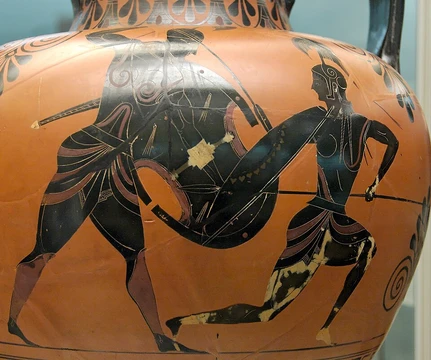
Heracles
Divine hero, son of Zeus, known for the twelve Labours.

Heracles (Ancient Greek: Ἡρακλῆς, meaning "glory/fame of Hera") was originally named Alcaeus or Alcides. He was a divine hero in Greek mythology, the son of Zeus and Alcmene, and raised by Amphitryon as his foster son. A descendant of Perseus—himself a son of Zeus—Heracles was considered the greatest of all Greek heroes. He was the ancestor of royal clans called the Heracleidae and defended the Olympian order against chthonic monsters. In Rome and the modern West, he is known as Hercules, a name with which later Roman emperors, especially Commodus and Maximian, often identified.
The most famous stories about Heracles are the twelve Labours of Hercules. During the Hellenistic age, Alexandrian poets gave his mythology a highly poetic and tragic tone. His figure, which originally borrowed from Near Eastern motifs like the lion-fight, became widely known. Unlike other Greek heroes, no tomb was ever identified as his, because Heracles was both hero and god—what Pindar called *heros theos*. At the same festival, sacrifices were made to him first as a hero (with a chthonic libation) and then as a god (on an altar), making him the closest Greek equivalent to a demigod. Walter Burkert traced the core of his story to Neolithic hunter culture and shamanistic traditions of crossing into the underworld. It is possible that the myths were based on a real person or several people whose deeds grew exaggerated over time.
Heracles’s role as a culture hero, including his death, was accepted into the Olympian Pantheon during Classical times. This created a problem in Homer’s *Odyssey*, Book XI (the Nekuia), where Odysseus meets Heracles in Hades. Ancient critics noticed an awkward aside in which Heracles recognizes Odysseus, and some modern scholars believe those lines were added later. As Friedrich Solmsen noted, once people knew Heracles had been admitted to Olympus, they would not accept his presence in the underworld; the interpolated verses represent a compromise between conflicting views of him.
The ancient Greeks celebrated the festival of the Heracleia on the second day of the month Metageitnion (late July or early August), commemorating his death. An Egyptian Temple of Heracles in the Bahariya Oasis dates to 21 BCE. Attempts to link a site at Ras ir-Raħeb in Malta with a temple to Heracles, based on Ptolemy’s descriptions, remain inconclusive. Several ancient cities were named Heraclea in his honor. A tiny island near Lemnos was called Neai (from the Greek for “I dive/swim”) because Heracles swam there. According to legend, Herculaneum in Italy was founded by him.
Many city-states had two separate sanctuaries for Heracles: one recognizing him as a god, the other as a hero. Sacrifice was made to him in both roles within the same festival. This ambiguity helped spread his cult, especially when historians like Herodotus and artists (such as painters under Peisistratos) depicted him entering Olympus. Some sources explain that his cult persisted because of his ascent to heaven and his suffering, which inspired festivals, rituals, and mysteries. The pattern involved grief and mourning before joy in the mysteries. Like Apollo’s cult, Heracles’s absorbed local figures of similar nature. He was invoked as a patron for men, especially young ones, and was considered the ideal in warfare, presiding over gymnasiums and military training for ephebes.
Royal houses, such as that of Macedonia, claimed descent from Heracles for divine protection and to legitimize their actions. The earliest evidence of his popular worship comes from a 6th-century BCE inscription at Phaleron. After the 4th century BCE, Heracles became identified with the Phoenician god Melqart. The Oitaeans called him Cornopion because he rid them of locusts (cornopes), while the citizens of Erythrae at Mima called him Ipoctonus for destroying vine-eating wasps (ips). Near Bura in Achaea, a statue of Heracles stood on the River Buraicus, and an oracle in a cave nearby: consultants prayed before the statue, then threw four marked dice from a mound onto a table, and an artwork in the cave explained the results. Because of this, Heracles had the epithet Buraicus. Pausanias recorded that at Thebes there was a statue of Heracles called Nose-docker (Rhinocoloustes), because, according to ancient Thebans, he cut off the noses of heralds sent from Orchomenus to demand tribute.
- born
- Alcaeus or Alcides
- field
- Greek mythology
- nationality
- Greek
- known_for
- Twelve Labours of Hercules; greatest of Greek heroes; ancestor of Heracleidae
Lore & Background
Many popular stories were told of his life, the most famous being the twelve Labours of Hercules. Alexandrian poets of the Hellenistic age drew his mythology into a high poetic and tragic atmosphere. His figure initially drew on Near Eastern motifs such as the lion-fight. Heracles was the greatest of Hellenic chthonic heroes, but unlike other Greek heroes, no tomb was identified as his. He was both hero and god, as Pindar says heros theos; at the same festival sacrifice was made to him, first as a hero, with a chthonic libation, and then as a god, upon an altar. The core of the story of Heracles has been identified by Walter Burkert as originating in Neolithic hunter culture and traditions of shamanistic crossings into the netherworld. It is possible that the myths surrounding Heracles were based on the life of a real person or several people whose accomplishments became exaggerated with time. Heracles's role as a culture hero, whose death could be a subject of mythic telling, was accepted into the Olympian Pantheon during Classical times. This created an awkwardness in the encounter with Odysseus in the episode of Odyssey XI, called the Nekuia, where Odysseus encounters Heracles in Hades. Ancient critics were aware of the problem of the aside that interrupts the vivid and complete description, in which Heracles recognizes Odysseus and hails him, and some modern critics deny that the verse's beginning was part of the original composition. The interpolated verses represent a compromise between conflicting representations of Heracles.
Reader's Guide
Heracles's significance lies in his unique status as both hero and god, embodying the closest Greek approach to a 'demi-god'. His cult was widespread, with the ancient Greeks celebrating the festival of the Heracleia on the second day of the month of Metageitnion. Several poleis provided two separate sanctuaries for Heracles, one recognizing him as a god, the other only as a hero. Sacrifice was made to him as a hero and as a god within the same festival. This ambiguity helped create the Heracles cult, especially when historians and artists encouraged worship. Some sources explained that the Greek hero cult of Heracles persisted because of the hero's ascent to heaven and his suffering, which became the basis for festivals, ritual, rites, and the organization of mysteries. He was constantly invoked as a patron for men, especially the young ones, and was considered the ideal in warfare, presiding over gymnasiums and the ephebes. The royal house of Macedonia claimed lineal descent from the hero for purposes of divine protection and legitimator of actions. The earliest evidence of his worship in popular cult was in the 6th century BCE via an ancient inscription from Phaleron. After the 4th century BCE, Heracles became identified with the Phoenician God Melqart. His iconographic attributes are the lion skin and the club. He used his wits on several occasions when his strength did not suffice, and together with Hermes he was the patron and protector of gymnasia and palaestrae. By conquering dangerous archaic forces he is said to have 'made the world safe for mankind' and to be its benefactor.
Did You Know?
- Heracles was both hero and god; at the same festival sacrifice was made to him first as a hero, then as a god.
- No tomb was identified as his, unlike other Greek heroes.
- The earliest evidence of his worship in popular cult was a 6th century BCE inscription from Phaleron.
- After the 4th century BCE, Heracles became identified with the Phoenician God Melqart.
Common Misconceptions (Editorial)
Some people assume Heracles was purely a mortal hero, but he was both hero and god; Pindar calls him *heros theos*, and sacrifices were made to him first as a hero with a chthonic libation and then as a god upon an altar. Another common misconception is that Heracles was always known by that name—he was actually born Alcaeus or Alcides, and in Rome and the modern West he is called Hercules. It is also sometimes believed that his myths are purely Greek in origin, but his figure initially drew on Near Eastern motifs such as the lion-fight, and after the 4th century BCE he became identified with the Phoenician god Melqart.
Why It Matters (Editorial)
Heracles endures because his story encapsulates the human struggle between mortality and divinity, strength and vulnerability, labor and redemption. His twelve labors provide a timeless metaphor for overcoming impossible challenges, while his dual nature as both hero and god reflects ancient and modern fascination with figures who bridge the human and the divine.
Spotted an error? Know more?
This is a living reference — every entry is fact-audited, and reader corrections feed straight into our audit queue. Suggest an edit · See this site's audit record