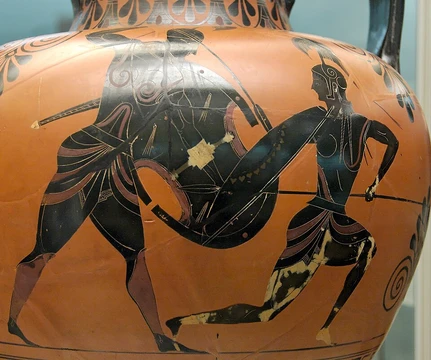
Zeus
King of the gods, sky and thunder deity.

Zeus is the supreme deity of the Greek pantheon, a sky and thunder god who rules as king of the gods on Mount Olympus. He is the child of Cronus and Rhea. In most traditions, his wife is Hera, with whom he fathered Ares, Eileithyia, Hebe, and Hephaestus. At the oracle of Dodona, his consort was said to be Dione, by whom the *Iliad* states he fathered Aphrodite. According to the *Theogony*, his first wife was Metis, mother of Athena. Zeus was infamous for his many erotic escapades, which produced numerous divine and heroic offspring, including Apollo, Artemis, Hermes, Persephone, Dionysus, Perseus, Heracles, Helen of Troy, Minos, and the Muses. He was respected as a sky father and chief of the gods, assigning roles to others; even gods not his natural children addressed him as Father, and all rose in his presence. He was equated with many foreign weather gods, and the saying that Zeus is king in heaven was common to all men. His symbols include the thunderbolt and the eagle. Beyond his Indo-European inheritance, the classical “cloud-gatherer” also derives iconographic traits from ancient Near Eastern cultures, such as the scepter. In Rome, he was identified with Jupiter. His name in Greek is Zeus, inflected as Zēna, Dios, and Dií. The earliest attested forms are Mycenaean Greek *di-we* and *di-wo* in Linear B. Zeus is the Greek continuation of *Dyēus, the Proto-Indo-European god of the daytime sky, also called “Sky Father.” This name appears in the Rigveda (Dyaus), Latin (Jupiter), Albanian (Zot), and Messapic, all deriving from the root *dyeu- (“to shine,” “sky,” “god”). Zeus is the only Olympic deity with such a transparent Indo-European etymology. Plato offered a folk etymology linking Zeus to “cause of life,” but this is unsupported by modern scholarship. Diodorus Siculus wrote that Zeus was also called Zen because humans believed he was the cause of life, while Lactantius argued the name came from his being the first to live among Cronus’s children. Zeus was called by numerous epithets, some surviving names of local gods consolidated into his myth.
- born
- Various locations claimed: Lyctus in Crete (Hesiod), Lydia (Eumelos), Arcadia (Callimachus), Mount Ida or Dicte (Diodorus Siculus), Dicte (Apollodorus)
- field
- Sky and thunder god, king of the gods
- nationality
- Greek
- known_for
- Supreme deity of the Greek pantheon, ruler of Mount Olympus, father of many gods and heroes
Quick Facts
- God Of
- King of the gods
- Abode
- Mount Olympus
- Symbol
- Thunderbolt, eagle
- Parents
- Cronus and Rhea
- Siblings
- Hestia, Hades, Hera, Poseidon, and Demeter
- Children
- See · Offspring
- Roman Equivalent
- Jupiter
- Spouse
- Hera
Facts from the source article.
Lore & Background
Zeus is the child of Cronus and Rhea. In most traditions, he is married to Hera, by whom he is usually said to have fathered Ares, Eileithyia, Hebe, and Hephaestus. At the oracle of Dodona, his consort was said to be Dione, by whom the Iliad states that he fathered Aphrodite. According to the Theogony, Zeus's first wife was Metis, by whom he had Athena. Zeus was also infamous for his erotic escapades, resulting in many divine and heroic offspring, including Apollo, Artemis, Hermes, Persephone, Dionysus, Perseus, Heracles, Helen of Troy, Minos, and the Muses. In Hesiod's Theogony, Cronus swallowed each child at birth, but Rhea saved Zeus by giving Cronus a stone wrapped in swaddling clothes. She gave birth to Zeus in Lyctus, Crete, and handed him to Gaia, who took him to a cave on Mount Aegaeon (Aegeum) to be raised. Other sources give different birthplaces; the source does not specify a single standard location.
Reader's Guide
Zeus was the supreme deity of the Greek pantheon, ruling as king of the gods on Mount Olympus. As a sky and thunder god, he was respected as a sky father who assigned roles to the other gods, who addressed him as Father and rose in his presence. His primary symbols included the thunderbolt and the eagle, and he was also associated with the scepter, a trait derived from ancient Near Eastern cultures. Zeus was the child of Cronus and Rhea; to prevent a prophecy that one of his children would overthrow him, Cronus swallowed each newborn, but Rhea saved Zeus by hiding him in a cave on Crete and giving Cronus a stone wrapped in swaddling clothes instead. Zeus was married to Hera, with whom he fathered Ares, Eileithyia, Hebe, and Hephaestus. He also had other consorts: with Dione he fathered Aphrodite, and with his first wife Metis he fathered Athena. Zeus was infamous for his many erotic escapades, which produced numerous divine and heroic offspring, including Apollo, Artemis, Hermes, Persephone, Dionysus, Perseus, Heracles, Helen of Troy, Minos, and the Muses. His name derives from the Proto-Indo-European god *Dyēus, meaning "sky father," and is cognate with the Roman Jupiter, Vedic Dyaus, and Albanian Zot. In ancient Rome, Zeus was identified with Jupiter.
Did You Know?
- Zeus's name in the nominative is Zeús, and it is the Greek continuation of *Dyēus, the Proto-Indo-European god of the daytime sky.
- Plato gave a folk etymology of Zeus meaning 'cause of life always to all things,' but this is not supported by modern scholarship.
- Zeus was called by numerous epithets, some of which are the surviving names of local gods consolidated into his myth.
Divine Lineage & Progeny
Zeus occupies the apex of the Greek pantheon as the offspring of Cronus and Rhea, the youngest of six siblings. His parentage places him at the center of a cosmic succession: his father had devoured each child upon birth, fearing a prophecy that one of his own children was destined to overthrow him. Zeus's survival—achieved through Rhea's substitution of a wrapped stone—set the stage for his eventual rule over Mount Olympus. As king of the gods, he fathered an extraordinary constellation of divine and heroic children across multiple unions. With Hera, the most commonly cited mother, he produced Ares, Eileithyia, Hebe, and Hephaestus. His first wife Metis bore Athena, while Dione, his consort at the oracle of Dodona, is credited in the Iliad with mothering Aphrodite. Beyond these canonical pairings, Zeus's numerous erotic encounters generated a sprawling lineage that includes Apollo, Artemis, Hermes, Persephone, Dionysus, Perseus, Heracles, Helen of Troy, Minos, and the Muses—making him the progenitor of nearly every major figure in Greek myth.
Sovereignty & the Sky Father
Zeus stands as the undisputed sovereign of the Greek divine order, reigning from Mount Olympus as a sky and thunder god whose authority extends over every other deity. His role as sky father is not merely titular; he actively assigns functions and roles to the gods under his command, and even deities who are not his blood address him as Father and rise before him. This universal acknowledgment of his kingship transcends Greek borders. Pausanias observed that declaring Zeus the king of heaven was a sentiment shared by all peoples, reflecting how the god was equated with foreign weather deities across the ancient world. His iconography reinforces this cosmic authority: the thunderbolt and the eagle serve as his primary symbols, while the classical epithet cloud-gatherer and the scepter he carries draw from both Indo-European heritage and the artistic traditions of the ancient Near East. In the Roman religious framework, Zeus was directly identified with Jupiter, ensuring his sovereignty was recognized across the Mediterranean's two great civilizations.
The Name Across Cultures
The name Zeus carries one of the most transparent linguistic lineages in the entire Olympic pantheon. It descends directly from the Proto-Indo-European root *dyeu-, meaning to shine and, in its derivatives, sky, heaven, god. The full reconstructed name, Sky Father, appears in the Rigveda as Dyaus Pita, in Latin as the vocative form embedded in Iuppiter, and in Albanian as Zoj-z and Messapic as Zis. The earliest Greek attestations survive in Mycenaean Linear B script as di-we in the dative and di-wo in the genitive, confirming the god's presence in Bronze Age religious practice. In Greek, Albanian, and Messapic, the original consonant cluster underwent affrication to produce the familiar Z sound. Plato offered a folk etymology in the Cratylus, linking Zeus to the idea of being the cause of life always to all things through wordplay on his alternate titles Zen and Dia, though modern scholarship does not support this reading. Diodorus Siculus and Lactantius each proposed their own explanations for the dual names Zeus and Zen, tying them to the god's role as life-giver or as the first surviving child of Cronus.
Birth & Hidden Infancy
The circumstances of Zeus's birth are among the most dramatic episodes in Greek mythology. According to Hesiod's Theogony, Cronus, having received a prophecy from Gaia and Uranus that one of his own children was destined to overthrow him, swallowed each newborn immediately. Rhea, overwhelmed by relentless sorrow, sought her parents' counsel and was directed to Lyctus in Crete, where she gave birth to Zeus and handed the infant to Gaia for safekeeping on Mount Aegaeon. To Cronus, she presented a stone bound in infant's wrappings, which he swallowed without suspicion. Other ancient authors placed the birth elsewhere: Eumelos of Corinth pointed to Lydia, Callimachus to Arcadia, and both Diodorus Siculus and Apollodorus to a cave in Dicte. Pausanias lamented that it would be impossible to count all the communities claiming Zeus as their native son. His infancy was guarded by the Kouretes, who beat spears against shields to mask his cries, while nymphs nursed him on the milk of the she-goat Amalthea—a detail preserved across multiple sources.
Common Misconceptions (Editorial)
- A common misconception is that Zeus was always worshiped as king of the gods from the very beginning. In fact, according to Hesiod's Theogony, he was the sixth child of Cronus and Rhea, and his birth required being hidden and raised in secret to survive his father's prophecy-driven infanticide. - Some assume Zeus's myth is purely Greek and local, but his name has a transparent Indo-European etymology, continuing the Proto-Indo-European god *Dyēus, linking him to a far older and broader religious tradition.
Why It Matters (Editorial)
Zeus endures as a cultural shorthand for supreme authority, justice, and unpredictable power—a figure who embodies both cosmic order and chaotic human flaws. His myths explore timeless themes of legitimacy, succession, and the messy intersection of divine rule with mortal affairs, making him a lasting touchstone for understanding how ancient peoples made sense of power and the natural world.
Frequently Asked Questions
Who is Zeus in Greek mythology?
Zeus is the head of the Greek god-family, a deity associated with the sky and thunder who sits as king atop Mount Olympus. He is the youngest son of the Titan Cronus and his wife Rhea, and in most tellings he is wed to Hera.
What powers and domains does Zeus hold?
Zeus commands the sky, lightning, and thunder, making him the god of weather and the natural order above. As king of the Olympian gods, he also oversees justice, law, and the proper functioning of the cosmic hierarchy.
How did Zeus become king of the gods?
Zeus was hidden as an infant by his mother Rhea to escape his father Cronus, who devoured his own children. Once grown, Zeus forced Cronus to regurgitate his siblings, then led them in the Titanomachy, a war that ended with the Titans' defeat and Zeus taking the throne.
Who are Zeus's most famous children?
With Hera he is credited with fathering Ares, Hephaestus, Hebe, and Eileithyia, while his numerous affairs produced offspring like Apollo, Artemis, Hermes, Athena, Perseus, Heracles, Dionysus, Persephone, Helen, Minos, and the Muses. This sprawling family tree connects Zeus to nearly every major narrative in the Greek tradition.
Why is Zeus central to Greek mythology?
As the supreme authority of the pantheon, Zeus drives most divine and heroic stories, whether dispensing justice, intervening in mortal affairs, or fathering key figures. His rise frames the shift from the older Titan order to the Olympian age, making him the anchor of the entire mythological system.
More in Greek Myths 1-22
Spotted an error? Know more?
This is a living reference — every entry is fact-audited, and reader corrections feed straight into our audit queue. Suggest an edit · See this site's audit record