Pacific War
The largest theater of World War II, fought across the Pacific and Asia.

Ensign Emment Regan · Public domain
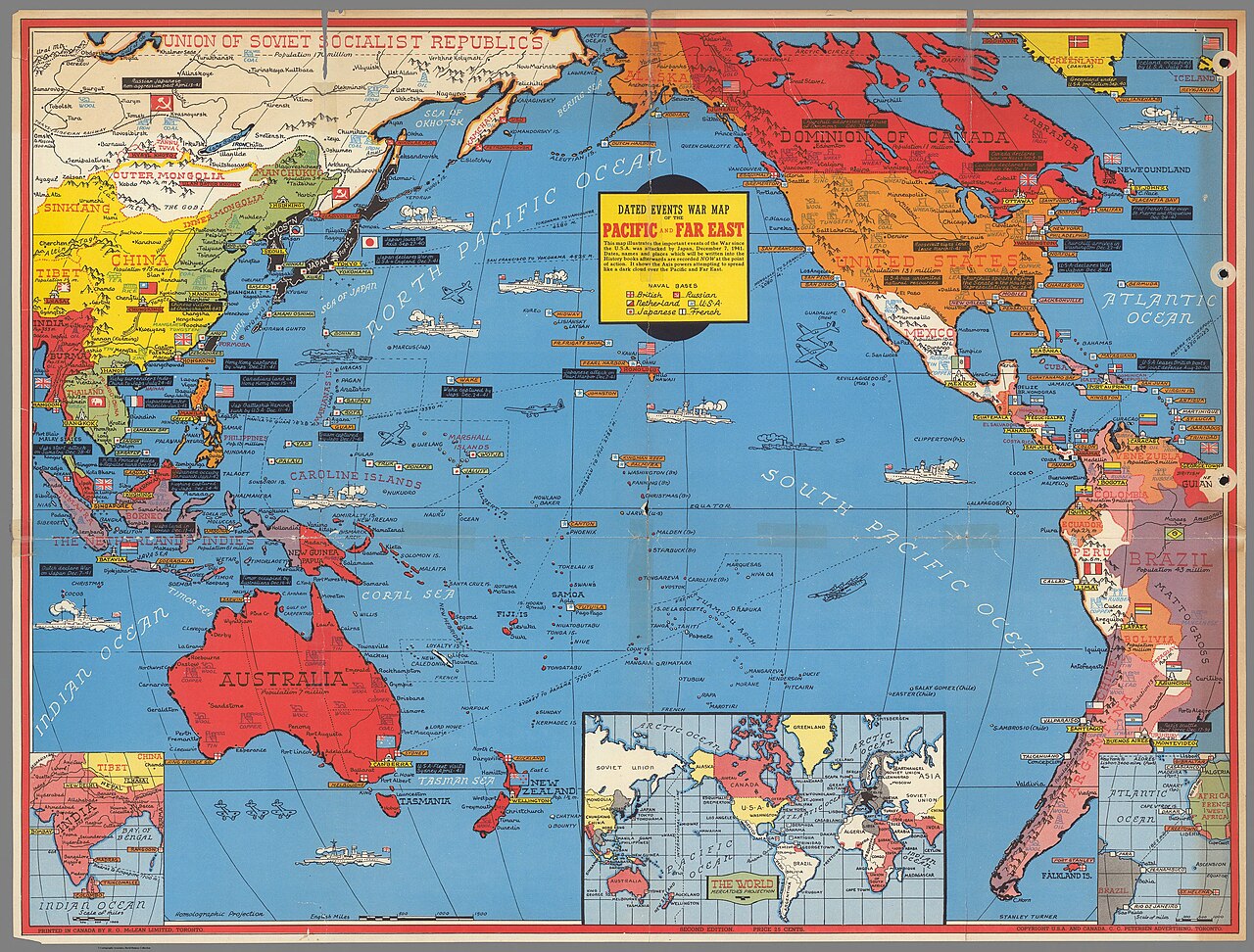
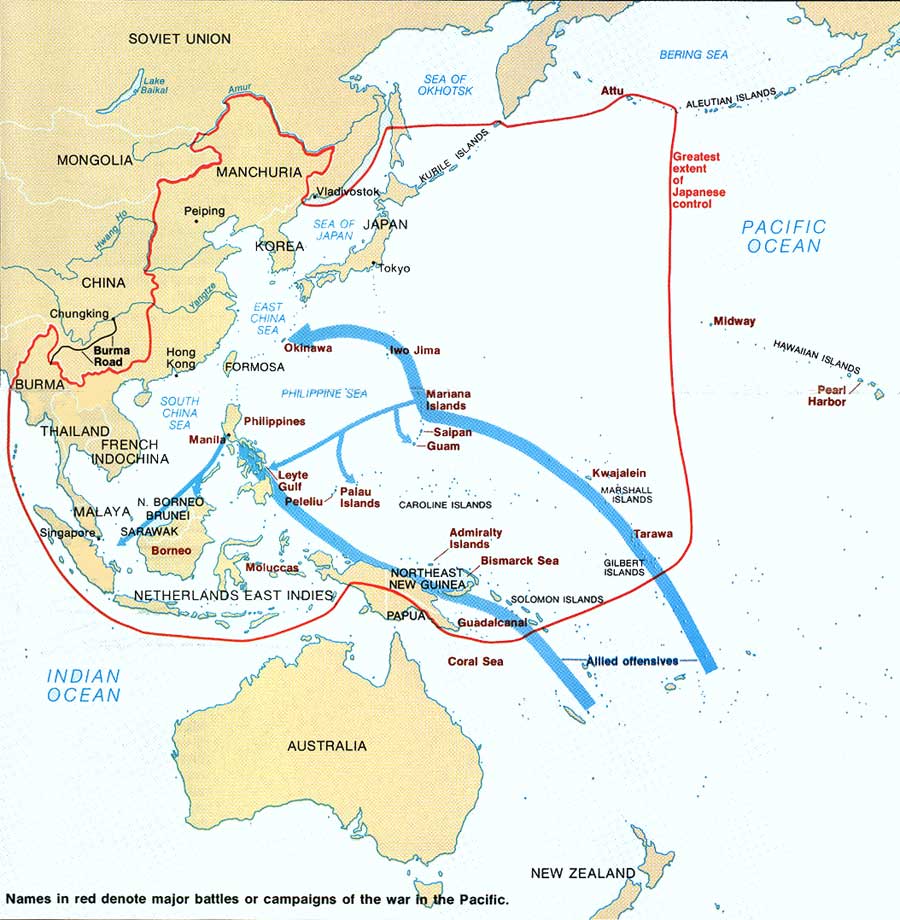
The Pacific War, also known as the Asia–Pacific War or the Pacific Theater, was the World War II conflict between Japan and the Allied powers. It spanned East and Southeast Asia, the Pacific and Indian Oceans, and Oceania, making it the war’s largest geographic theater. This theater included the Pacific Ocean and South West Pacific areas, the Second Sino-Japanese War, and the brief Soviet–Japanese War, and it featured some of history’s biggest naval battles. While Japan and China had been fighting since 1937—with hostilities tracing back to Japan’s 1931 invasion of Manchuria—the Pacific War is generally considered to have started in 1941, when the United States and United Kingdom entered the fight.
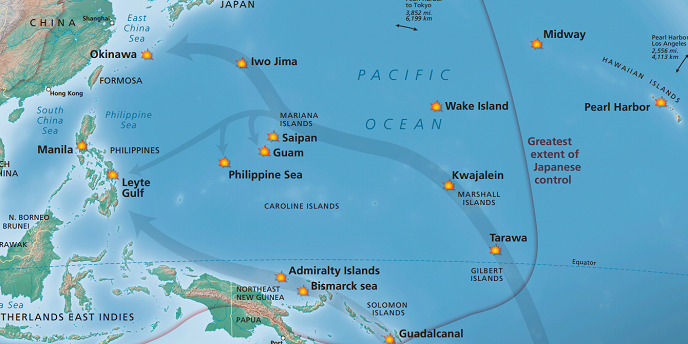
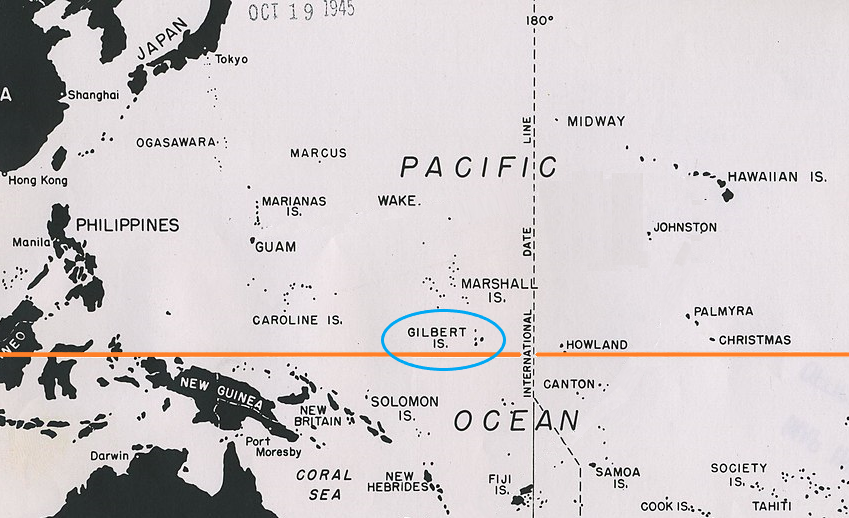
Japan took control of French Indochina in 1940 and fully occupied it by July 1941. On December 7–8, 1941, Japan struck the U.S. naval base at Pearl Harbor in Hawaii, along with American-held Philippines, Guam, and Wake Island, and British colonies Malaya, Singapore, and Hong Kong, followed by a formal declaration of war. Over the next six months, Japan achieved major successes, allying with Thailand and seizing those territories (except Hawaii) as well as Borneo, New Britain, the Dutch East Indies, Burma, the Solomon and Gilbert Islands, and parts of New Guinea. In May 1942, carrier forces clashed at the Battle of the Coral Sea, turning back a Japanese invasion aimed at Port Moresby. The following month, Japan invaded the Aleutian Islands but suffered a decisive defeat at the Battle of Midway—a key turning point—after which Japan struggled to replace lost ships and planes while U.S. production surged.
Allied offensives began in August 1942 with campaigns on Guadalcanal and New Guinea. Operation Cartwheel, launched in June 1943, neutralized the major Japanese base at Rabaul on New Britain by early 1944. Elsewhere, the Allies retook the Aleutian Islands by August 1943 and conducted the Gilbert and Marshall Islands campaign from November 1943 to February 1944. The Battle of the Philippine Sea in June 1944 heavily damaged the Japanese fleet. The Allied campaign to retake the Philippines started in October 1944, leading to the Battle of Leyte Gulf, after which Japan could no longer fight surface battles and turned to kamikaze attacks. The remainder of the war followed an Allied island-hopping strategy, with invasions of the Mariana and Palau Islands, Iwo Jima, and Okinawa from June 1944 to June 1945. This allowed a blockade of Japan’s home islands and a strategic bombing campaign that caused widespread urban destruction.
In China, Japan made large gains during Operation Ichi-Go from April to December 1944. In Burma, Japan’s offensive into India was reversed by July 1944, and the Allies liberated Burma by May 1945. From the start, the Allies prioritized a “Europe first” strategy, focusing on defeating Germany. After Germany’s surrender in May 1945, Allied forces shifted to the Pacific for Operation Downfall, the planned invasion of Japan. This invasion became unnecessary after the U.S. atomic bombings of Hiroshima and Nagasaki on August 6 and 9, 1945, and the Soviet invasion of Manchuria on August 9. Japan surrendered unconditionally on August 15 and signed a formal surrender document on September 2, ending World War II. Japan lost its former Asian and Pacific possessions and was occupied by the Allies until 1952.
During the war, Allied countries often did not separate the Pacific War from World War II, or simply called it the War against Japan. In the United States, “Pacific theater” was common, with the China Burma India theater considered separate from the Asiatic-Pacific theater. Japan used the name “Greater East Asia War” (Dai Tō-A Sensō), chosen by cabinet decision on December 10, 1941, to cover both the war with Western Allies and the ongoing war in China. Announced on December 12, it was explained as Asian nations achieving independence from Western powers through the Greater East Asia Co-Prosperity Sphere. Japanese officials folded the “Japan–China Incident” (Nisshi Jihen) into this larger war. During the Occupation of Japan (1945–1952), these terms were banned from official documents, though informal use continued. The war became officially known as the Pacific War (Taiheiyō Sensō). The term “Fifteen Years’ War” (Jūgonen Sensō) is also used, referring to the period from the 1931 Mukden incident through 1945.
Major Allied participants included China, the United States, and the British Empire. China had been at war with Japan since 1937. The U.S. and its territories, including the Philippine Commonwealth, entered after the Pearl Harbor attack in 1941, which was followed by Japan’s declarations of war on Australia, Canada, New Zealand, the United Kingdom, and the Dutch government-in-exile (which controlled the Dutch East Indies). All were members of the Pacific War Council. From 1944, the French commando group Corps Léger d’Intervention conducted resistance operations in Indochina. Pro-Allied guerrilla groups in Asia included the Hukbalahap, the Korean Liberation Army, the Free Thai Movement, the Việt Minh, the Khmer Issarak, and the Malayan Peoples’ Anti-Japanese Army. The Soviet Union fought two short, undeclared border conflicts with Japan in 1938 and 1939, then remained neutral.
- field
- World War II theater
- known_for
- Largest geographic theater of World War II, including the Battle of Midway and the atomic bombings
- major_participants
- Japan, United States, China, British Empire, Soviet Union
Lore & Background
The Pacific War was geographically the largest theater of World War II, encompassing the Pacific and Indian Oceans, East and Southeast Asia, and Oceania. Its appearance was defined by a vast, sprawling conflict that included some of the largest naval battles in history, fought across island chains, atolls, and open ocean. The range of the war extended from the Aleutian Islands in the north to the Solomon and Gilbert Islands in the south, and from the Hawaiian Islands in the east to Burma and the Indian frontier in the west. Key habitats included tropical jungles, coral atolls, and urban centers, with major campaigns fought on islands such as Guadalcanal, New Guinea, Iwo Jima, and Okinawa. Defining characteristics included the initial rapid Japanese expansion after the attack on Pearl Harbor, capturing Borneo, the Dutch East Indies, Burma, and parts of New Guinea within six months. A major turning point was the Battle of Midway, after which Japan struggled to replace lost ships and aircraft while U.S. production surged. The war was marked by Allied island-hopping strategy, massive carrier battles like the Battle of the Philippine Sea, and the eventual use of kamikaze attacks after the Battle of Leyte Gulf. The conflict concluded with the U.S. atomic bombings of Hiroshima and Nagasaki and the Soviet invasion of Manchuria, leading to Japan’s unconditional surrender.
Reader's Guide
The Pacific War was the largest geographical theater of World War II, encompassing the Pacific and Indian Oceans, East and Southeast Asia, and Oceania. It included the Pacific Ocean theater, the South West Pacific theater, the Second Sino-Japanese War, and the brief Soviet–Japanese War, and featured some of the largest naval battles in history. The conflict began with Japan’s invasion of French Indochina in 1940, followed by its full control of that territory in July 1941. On 7–8 December 1941, Japan launched simultaneous attacks on the American naval base at Pearl Harbor, U.S.-held Philippines, Guam, and Wake Island, as well as British colonies including Malaya, Singapore, and Hong Kong, followed by a formal declaration of war. Over the next six months, Japan allied with Thailand and captured these territories along with Borneo, New Britain, the Dutch East Indies, Burma, the Solomon and Gilbert Islands, and parts of New Guinea. The Battle of the Coral Sea in May 1942 forced a Japanese invasion force to retreat from Port Moresby. In June 1942, Japan invaded the Aleutian Islands but was defeated at the Battle of Midway, a key turning point after which Japan struggled to replace lost ships and aircraft while U.S. production surged. Major Allied offensives began in August 1942 with the Guadalcanal and New Guinea campaigns, followed by Operation Cartwheel from June 1943, which neutralized the Japanese base at Rabaul by early 1944. Allied forces recaptured the Aleutians by August 1943 and launched the Gilbert and Marshall Islands campaign from November 1943 to February 1944. The Battle of the Philippine Sea in June 1944 heavily damaged the Japanese fleet, and the Allied recapture of the Philippines in October 1944 led to the Battle of Leyte Gulf, after which Japan resorted to kamikaze attacks. The remainder of the war featured an Allied island-hopping strategy, with invasions of the Mariana and Palau Islands, Iwo Jima, and Okinawa from June 1944 to June 1945, enabling a blockade of Japan and a strategic bombing campaign causing widespread urban destruction. In China, Japan made large gains during Operation Ichi-Go from April to December 1944, while in Burma, a Japanese offensive into India was reversed by July 1944, leading to Burma’s liberation by May 1945. The Allies prioritized defeating Germany under a “Europe first” strategy; after Germany’s surrender in May
Did You Know?
- Despite being a European colony, Macau was a rare unoccupied territory in the region—Portuguese Timor was invaded and occupied by Japan from February 1942 to 1945, New Caledonia was under Free French control (not neutral
The Nitrate Dispute and Economic Roots
Chile demanded international arbitration, but President Hilarión Daza dismissed the complaint as a domestic matter. Formal declarations of war followed within weeks. Beneath this flashpoint lay deeper currents: a long-standing rivalry between Chile and Peru for regional dominance, competing commercial interests in the saltpeter trade, and stark contrasts between Chile's relative political stability and the chronic volatility of its neighbors. The Atacama's vast deposits of sodium nitrate and guano, recognized by European markets since the 1840s as essential for fertilizer and gunpowder, had transformed a barren stretch of coastline into a prize every nation coveted.
Naval Struggle and the Land Campaign
The conflict unfolded across multiple theaters: the open Pacific, the Atacama Desert, the Peruvian deserts, and the mountainous interior of Peru. For the first five months, the war was essentially a naval contest. Chile's primary objective was to secure a reliable maritime supply line so that its troops, operating in what is the driest desert on Earth, could receive ammunition, food, and reinforcements. Once that sea corridor was established, the character of the fighting shifted decisively to the ground. Chilean armies then pressed forward against the combined Bolivian-Peruvian forces, and the balance of power tilted sharply in Santiago's favor. What followed was a grinding guerrilla resistance by scattered remnants and irregular units of the Peruvian army, but these could not halt the growing momentum of war-exhausted Peruvian political factions already negotiating a settlement involving territorial cessions. The entire campaign underscored Chile's clear military and technological edge over its adversaries.
Territorial Reckoning and the Loss of the Coast
The war's aftermath redrew the map of western South America in ways that persist to this day. The consequence was profound and irreversible: Bolivia was transformed from a coastal nation into a permanently landlocked state. The conflict has accumulated a remarkable array of names—Saltpeter War, Ten Cents War, Nitrate War, Second Pacific War—each reflecting a different nation's perspective on what was at stake. It is important to distinguish this war from the pre-Columbian Saltpeter War in what is now Mexico and from the Chincha Islands War, sometimes called the Guano War.
Roots in Uncertain Borders and Regional Rivalry
When South American nations gained independence from Spain and Portugal in the nineteenth century, the drawing of precise frontiers—especially in remote, sparsely settled regions—remained a persistent source of friction. The Bolivia-Chile dispute over the coastal strip between the 23rd and 24th parallels was one of several such border conflicts that simmered across the continent. That arrangement lasted barely eight years before it collapsed under mutual discontent. Meanwhile, the demographic reality had already shifted: since the Chilean silver rush of the 1830s, Chilean settlers and enterprises had steadily expanded through the Atacama, and in the Peruvian region of Tarapacá, Peruvians found themselves outnumbered by both Chilean and Bolivian residents. Together, these layers of legal ambiguity, economic competition, and demographic shift set the stage for a single tax dispute to ignite a war.
Gallery
Frequently Asked Questions
What is the Pacific War?
The Pacific War was the major World War II theater pitting Japan against Allied nations across East and Southeast Asia, the Pacific, the Indian Ocean, and Oceania. It is also commonly called the Asia–Pacific War or the Pacific Theater.
Who were the main participants in the Pacific War?
Japan stood as the principal Axis power, while the Allied side included the United States, China, the British Empire, and the Soviet Union. These nations contested control over the vast Pacific and Asian regions for the duration of the conflict.
Why is the Battle of Midway considered a turning point?
Fought in 1942, the Battle of Midway was a decisive naval engagement that halted Japan's forward offensive and shifted strategic initiative to the Allies. It is widely regarded as the moment the Pacific War's momentum reversed.
How did the Pacific War end?
The conflict concluded in August 1945 when the United States detonated atomic bombs over Hiroshima and Nagasaki, leading Japan to surrender. This brought an end to what had been the geographically largest theater of World War II.
Why is the Pacific War called the largest theater of WWII?
It covered the widest geographic span of any front, stretching from East and Southeast Asia across the entire Pacific to the Indian Ocean and Oceania. The theater also hosted some of the largest naval engagements in recorded history.
More in Wars & Conflicts 1-20
Spotted an error? Know more?
This is a living reference — every entry is fact-audited, and reader corrections feed straight into our audit queue. Suggest an edit · See this site's audit record