Napoleonic Wars
Global conflicts fought by coalitions against Napoleonic France.

Ruedi33a · CC BY-SA 4.0
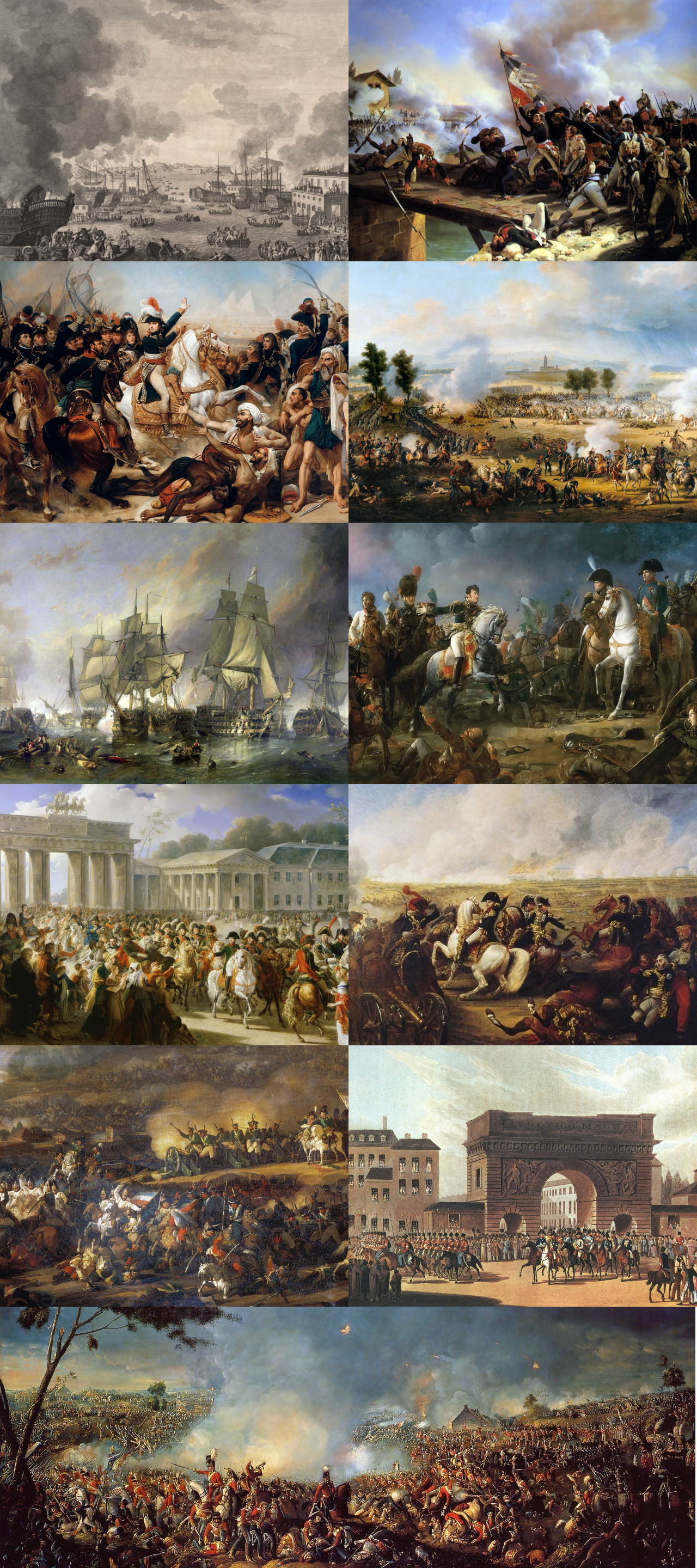
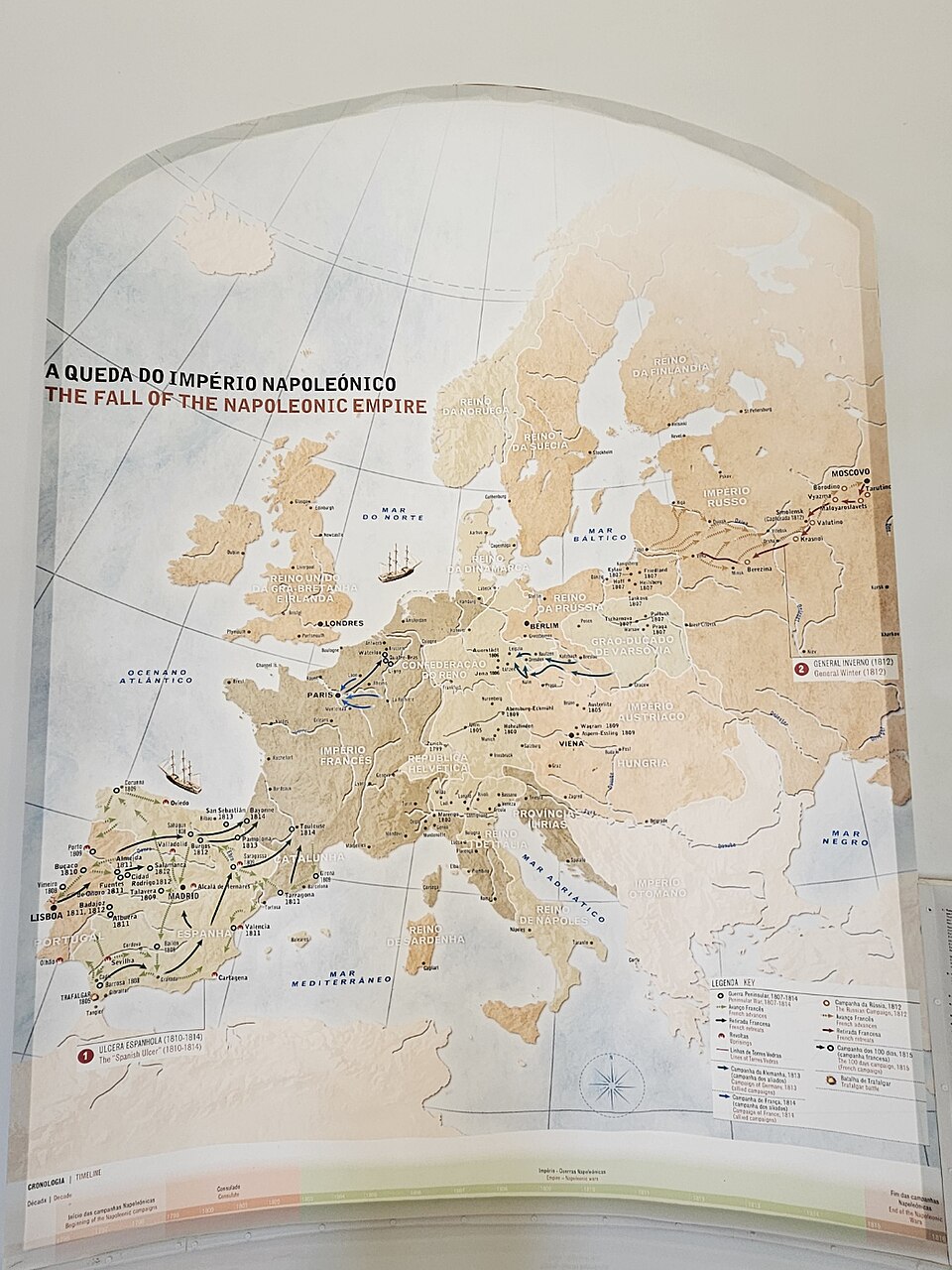
The Napoleonic Wars were a series of global conflicts fought between 1803 and 1815, involving shifting coalitions of European powers against France. The wars stemmed from the political upheaval of the French Revolution and the preceding French Revolutionary Wars, and they resulted in a period of French dominance over continental Europe. These conflicts are typically divided into seven distinct campaigns: five named after the coalitions that opposed Napoleon—the Third, Fourth, Fifth, Sixth, and Seventh Coalitions—alongside the Peninsular War and the French invasion of Russia. The first stage began when Britain declared war on France in May 1803. After minor skirmishes, Britain formed the Third Coalition with Austria, Russia, and smaller states in 1805. Napoleon crushed the allied Russo-Austrian forces at Ulm and Austerlitz, leading to the dissolution of the Holy Roman Empire and forcing Austria to sue for peace. Britain and Russia remained at war. Prussia, alarmed by French expansion, joined Britain and Russia in the Fourth Coalition in 1806. Napoleon defeated the Prussians at Jena-Auerstedt and the Russians at Friedland, securing an uneasy peace by mid-1807, leaving Britain as France’s sole major continental enemy. Britain, unable to challenge French land dominance, achieved naval supremacy after victories such as Trafalgar. To economically isolate Britain, Napoleon imposed the Continental System and invaded Portugal, Britain’s last continental ally, in 1807. He then deposed the Spanish royal family, installing his brother Joseph as king in 1808, sparking Spanish resistance. Spain, Britain, and Portugal fought France in the Peninsular War. This diversion encouraged Austria to form the Fifth Coalition in 1809, but despite a victory at Aspern-Essling, Austria was defeated at Wagram and forced into a harsh peace. Russia’s violation of the Continental System prompted Napoleon’s disastrous invasion in 1812, which ended in catastrophic retreat. Encouraged, Austria, Prussia, and others joined Russia, Britain, and Spain in the Sixth Coalition, defeating Napoleon at Leipzig in 1813. Allied forces invaded France from east and west, capturing Paris in March 1814, forcing Napoleon’s abdication and exile to Elba. He escaped in 1815, reassumed power for roughly one hundred days, and was defeated by the Seventh Coalition at Waterloo, then exiled to Saint Helena. The wars i
- field
- Global military conflicts
- known_for
- French domination of Continental Europe, introduction of mass conscription and guerrilla warfare, spread of nationalism and liberalism
Verified Timeline
Lore & Background
The Napoleonic Wars were a series of global conflicts fought between 1803 and 1815, involving shifting European coalitions opposed to French dominance under Napoleon, first as First Consul of the French Republic and later as Emperor. The wars arose from political upheavals of the French Revolution and the preceding Revolutionary Wars, leading to a period of French control over much of Continental Europe. The conflicts are categorized into seven distinct campaigns: five named after the coalitions arrayed against France (Third through Seventh), plus the Peninsular War and the French invasion of Russia. The wars began when Britain declared war on France in May 1803. After initial minor actions, Britain allied with Austria, Russia, and smaller states to form the Third Coalition in 1805. Napoleon’s decisive victories at Ulm and Austerlitz forced Austria to sue for peace and dissolved the Holy Roman Empire, though Britain and Russia remained hostile. Prussia then joined Britain and Russia in the Fourth Coalition, but Napoleon defeated Prussian forces at Jena-Auerstedt and Russian forces at Friedland, leading to an uneasy continental peace in 1807. Britain, unable to challenge French land power, secured naval supremacy after victories such as Trafalgar. To economically isolate Britain, Napoleon imposed the Continental System and invaded Portugal, the last British ally on the continent. After occupying Lisbon, he turned on Spain, deposing its royal family and installing his brother Joseph as king, sparking the Peninsular War. This diversion encouraged Austria to form the Fifth Coalition in 1809, but despite a victory at Aspern-Essling, Austria was defeated at Wagram and forced into a harsh peace. Russia’s violation of the Continental System prompted Napoleon’s disastrous 1812 invasion, which ended in the near-destruction of his army. This defeat encouraged Austria, Prussia, and other states to join Russia, Britain, and Spain in the Sixth Coalition, which defeated Napoleon at Leipzig in 1813. Coalition forces invaded France from east and west, captured Paris in March 1814, forced Napoleon’s abdication, and exiled him to Elba. He escaped in February 1815, briefly regained power, but was defeated by the Seventh Coalition at Waterloo in June and exiled to Saint Helena, where he died in 1821. The wars introduced mass conscription and guerrilla warfare, spread the Napoleo
Reader's Guide
The Napoleonic Wars had profound consequences on history. New methods of warfare were introduced, including mass conscription and guerrilla warfare. Politically, the wars greatly influenced Europe through advancements in civil law brought about by the Napoleonic Code, which was largely retained where it was adopted, and the spread of nationalism and liberalism. Independence movements emerged in Spanish America as a direct consequence of the wars, leading to the decline of the Spanish and Portuguese Empires. France's defeat led to the rise of Britain as the world's foremost naval and economic power, a status it would hold for the remainder of the century.
Did You Know?
- The wars are categorised as six conflicts, five named after the coalitions that fought Napoleon, plus one named for its theatre.
The Architecture of Two Decades of War
At their core, these conflicts pitted France—first as a revolutionary republic, then as an empire under Napoleon Bonaparte—against successive military alliances of continental monarchies. Within this broader sweep, historians identify seven distinct Coalition Wars, each marked by a new alliance of great powers forming to contain French expansion. Together, these seven engagements form the most prominent subset of a two-decade struggle that reshaped the political map of Europe.
Naming the Storm: The Origins of a Term
The phrase "Coalition Wars" did not emerge as a neutral academic label; it was born in the heat of political debate.
The Shifting Alliances of Europe's Powers
The coalitions that opposed France were never static blocs. The principal architects—Great Britain, Russia, Austria, and Prussia—did not all participate in every single alliance, and their involvement fluctuated across the seven wars. Smaller states, including Spain, Naples, Piedmont-Sardinia, the Dutch Republic, the Ottoman Empire, Portugal, Sweden, Denmark-Norway, and numerous German and Italian territories, joined at various points. The first five coalitions shared a common fate: they fractured when one or more of their members were defeated by France and compelled to withdraw, sometimes even switching sides to become French allies. The pattern changed with the Sixth and Seventh Coalitions. In their wake, the surviving powers gathered at the Congress of Vienna to establish a new balance of power, effectively ending the era of continuous coalition warfare that had defined European politics for over two decades.
Beyond the Coalition Label: Conflicts That Defied Simple Categorization
This distinction matters because it reveals how the era's conflicts cannot be reduced to a single narrative of France versus a united Europe.
Gallery

Frequently Asked Questions
What are the Napoleonic Wars?
The Napoleonic Wars were a series of global military conflicts in which successive European coalitions took up arms against Napoleonic France. They dominated the early nineteenth century and fundamentally reshaped the political landscape of the continent.
What individual conflicts make up the Napoleonic Wars?
The wars are traditionally divided into six distinct conflicts: the Wars of the Third, Fourth, Fifth, Sixth, and Seventh Coalitions, plus the Peninsular War. Each round represented a fresh alliance of European powers uniting to challenge French control.
Why are the Napoleonic Wars historically significant?
They are credited with introducing mass conscription and guerrilla warfare as major military doctrines, while simultaneously accelerating the spread of nationalism and liberal political thought across Europe. The conflicts also ended the era of French domination over the continent.
What military advantages did Napoleonic France hold over its coalitions?
France leveraged the levée en masse system to field enormous conscript armies and pursued aggressive, mobility-based offensive operations. These tactics forced every opposing coalition to rethink its own recruitment, logistics, and battlefield strategy.
How does the Napoleonic Wars arc conclude?
The final War of the Seventh Coalition ended with Napoleon's decisive defeat and his removal from power. The subsequent Congress of Vienna settlement restored a balance of power in Europe and closed the era of French continental hegemony.
More in Wars & Conflicts 1-20
Spotted an error? Know more?
This is a living reference — every entry is fact-audited, and reader corrections feed straight into our audit queue. Suggest an edit · See this site's audit record