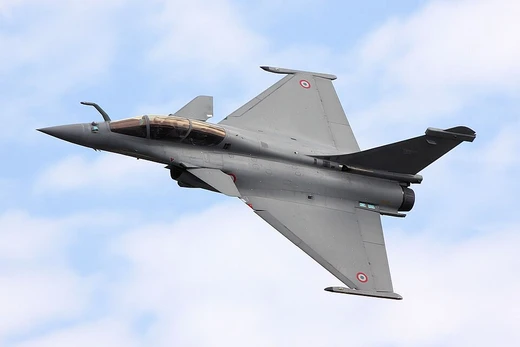
Su-27
Soviet heavy fighter designed to counter US fourth-generation jets.

The Sukhoi Su-27, known to NATO as the Flanker, is a Soviet twin-engine fighter built for supersonic speed and supermaneuverability. It was designed to go head-to-head with large American fourth-generation jets like the F-14 Tomcat and F-15 Eagle, offering a 3,530-kilometer range, heavy weapons, advanced electronics, and high agility. Its main job was air superiority, but later versions could handle nearly any aerial combat role. It was meant to work alongside the lighter MiG-29.
The Su-27 entered Soviet service in 1985. Its primary mission was long-range air defense against U.S. bombers like the B-1B and B-52, protecting Soviet coasts from carrier-based aircraft, and escorting Soviet heavy bombers such as the Tu-95, Tu-22M, and Tu-160.
The design grew into a whole family: the Su-30, a two-seat all-weather fighter for both air-to-air and ground attack; the Su-33, a carrier-based fleet defender; the Su-34, a side-by-side two-seat strike fighter; and the Su-35, an upgraded air superiority and multirole fighter. A thrust-vectoring prototype, the Su-37, was also built. China produced a licensed copy, the Shenyang J-11.
Development began in 1969, when the Soviet Union learned of the U.S. "F-X" program that led to the F-15. Soviet leaders saw that this new American fighter would outclass existing Soviet designs. They needed a balanced fighter with agility and advanced systems. The General Staff issued a requirement for an "Advanced Frontline Fighter" (PFI), with ambitious goals: long range, good performance from rough runways, excellent agility, Mach 2+ speed, and heavy armament. The aerodynamic work was mostly done by TsAGI with Sukhoi.
The PFI spec was too costly and demanding for a single aircraft in the needed numbers, so it was split into two: a lightweight version (LPFI) became the MiG-29, a short-range tactical fighter, and a heavy version (TPFI) went to Sukhoi, eventually producing the Su-27 and its derivatives.
Sukhoi’s design, updated as they learned more about the F-15, became the T-10, first flown on 20 May 1977. It had a large clipped wing, two separate podded engines, and twin tails. The tunnel between the engines, like on the F-14, acted as extra lift and hid weapons from radar. The T-10 used an "integral scheme" developed by Sukhoi, TsAGI, and SibNIA, aiming for optimal performance with 3-5% longitudinal instability in subsonic flight and fly-by-wire controls for future heavy fighters. Stability issues, like those seen in the YF-22 and JAS-39 Gripen, were fixed by limiting load factor and angle of attack during FBW development. Controlled high-angle-of-attack maneuverability—supermaneuverability—was emphasized after a 1980s study showed its value in close combat.
The first prototypes were T-10-1 and T-10-2, powered by Lyulka AL-21 turbojets with ogival wings. The aerodynamic layout proved unsatisfactory, confirmed by T-10-1’s first flight on 20 May 1977. It finished trials in November 1983 and went to the Soviet Air Force Museum in late 1985. T-10-2 first flew on 16 May 1978, but crashed on 7 July 1978, killing the pilot after exceeding G limits and breaking up when the stick was pulled back. Western intelligence initially called these "Ram-K," spotting them at Zhukovsky’s Ramenskoye airfield; they later got the NATO name "Flanker-A." A second batch—T-10-3 and T-10-4—was built by KnAAPO starting in 1978, fitted with the intended Lyulka AL-31 turbofan and redesigned nacelles. T-10-3 first flew on 23 August 1979 after engine delays, and in 1982-83 it did land-based STOBAR tests for naval aviation. T-10-4 tested avionics and armament with the Mech radar. Tests with T-10-4 and later T-10-10 revealed serious radar flaws. A third batch of AL-21-powered aircraft—T-10-5, T-10-6, T-10-9, T-10-10, T-10-11—was built for avionics tests. T-10-6 was destroyed in a ground fire in October 1980 from a leaking fuel line. T-10-10 and T-10-11 tested radar, weapons control, and targeting. These prototypes showed that avionics weight, AL-31 fuel consumption, and aerodynamics fell short of requirements.
- Type
- Twin-engine supersonic supermaneuverable fighter
- National origin
- Soviet Union
- Design bureau
- Sukhoi
- Primary role
- Air superiority and long-range air defence
- NATO reporting name
- Flanker
Lore & Background
The Sukhoi Su-27 is a large, twin-engine, supersonic fighter with a distinctive appearance featuring a broad, clipped wing, two separate podded engines, and a twin tail. A notable aerodynamic feature is the tunnel between the engines, which acts as an additional lifting surface and conceals armament from radar. The aircraft was designed for long-range air superiority, intended to compete directly with American fourth-generation fighters like the F-14 Tomcat and F-15 Eagle, emphasizing range, heavy ordnance, sophisticated avionics, and high maneuverability. Its primary roles included long-range air defense against American bombers such as the B-1B Lancer and B-52 Stratofortress, protecting the Soviet coast from aircraft carriers, and providing long-range fighter escort for Soviet heavy bombers like the Tu-95 and Tu-160. The Su-27 entered service with the Soviet Air Forces in 1985. The design evolved from the earlier T-10 prototype, which first flew in 1977. The T-10 was influenced by a new aerodynamic scheme called the 'integral scheme,' which aimed for optimal performance with longitudinal instability and fly-by-wire controls. Controlled high angle of attack maneuverability, known as supermaneuverability, was emphasized after studies showed its effectiveness in close combat. The Su-27 family includes the Su-30, a two-seat dual-role fighter; the Su-33, a naval fleet defense interceptor; the Su-34, a side-by-side two-seat strike variant; and the Su-35, an improved multirole fighter. A thrust-vectoring version, the Su-37, was also created. The Shenyang J-11 is a Chinese license-built version.
Reader's Guide
The Su-27 was designed for long-range air defence against American bombers such as the B-1B and B-52, and for escorting Soviet heavy bombers. Its development involved extensive cooperation with TsAGI and SibNIA, emphasizing supermaneuverability through controlled high angle-of-attack flight. The aircraft set world time-to-height records with the stripped-down P-42 variant. The Su-27 family expanded to include multirole, naval, and strike variants, and its Chinese license-built version, the J-11, extended its global influence. The Su-27's integral aerodynamic scheme and fly-by-wire system influenced later fighter designs.
Did You Know?
- The Su-27 was designed as a complement to the Mikoyan MiG-29.
- The P-42 variant set world time-to-height records after being stripped of armament and radar.
- The Su-27 was license-built in China as the Shenyang J-11.
Common Misconceptions (Editorial)
Some people mistakenly believe the Su-27 was designed as a replacement for the MiG-29, but it was actually developed as a complement to it. Another common misconception is that the Su-27 was entirely a Chinese design; however, it was originally a Soviet design by Sukhoi and only later license-built in China as the Shenyang J-11.
Why It Matters (Editorial)
The Su-27 is more than a single fighter—it is the founding platform of a prolific family of aircraft that continues to serve as the backbone of multiple air forces worldwide. Its combination of range, maneuverability, and adaptability ensures its enduring relevance in modern aerial combat.
Frequently Asked Questions
What is Su-27's primary role?
The Su-27 was built as a long-range air superiority and air-defence fighter, specifically to match large American fourth-generation jets like the F-14 Tomcat and F-15 Eagle.
What aircraft grew out of the Su-27 family?
The Su-27 served as the basis for a wide family of variants, including the Su-30, Su-33, Su-34, Su-35, and Su-37. China also produced a licensed version as the Shenyang J-11.
Why is Su-27 important in aviation history?
It represented the Soviet Union's answer to Western heavy fighters and established the Sukhoi design bureau's reputation for supermaneuverable, twin-engine combat aircraft. Its design philosophy influenced an entire generation of successor jets across multiple countries.
More in Warplanes 1-22
Spotted an error? Know more?
This is a living reference — every entry is fact-audited, and reader corrections feed straight into our audit queue. Suggest an edit · See this site's audit record