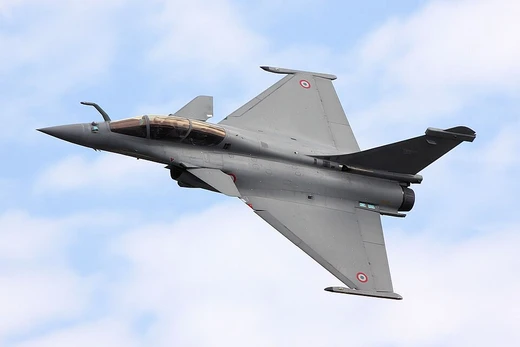
AH-64 Apache
American twin-turboshaft attack helicopter introduced in 1986.

The AH-64 Apache is an American twin-turboshaft attack helicopter featuring a tailwheel-type landing gear and a tandem cockpit for two crew members. Its nose-mounted sensors provide target acquisition and night vision capabilities. Armament includes a M230 chain gun under the forward fuselage and four hardpoints on stub-wing pylons, typically carrying AGM-114 Hellfire missiles and Hydra 70 rocket pods. Redundant systems enhance survivability in combat. The helicopter originated as the Model 77 for the U.S. Army’s Advanced Attack Helicopter program, intended to replace the AH-1 Cobra. The prototype YAH-64 first flew on 30 September 1975. The Army selected it over the Bell YAH-63 in 1976, citing its damage-tolerant four-blade rotor and the YAH-63’s landing gear instability. Full production was approved in 1982. Hughes Helicopters was acquired by McDonnell Douglas in 1984, which continued development; production later passed to Boeing Defense, Space & Security. The AH-64 entered U.S. Army service in April 1986. The advanced AH-64D Apache Longbow was delivered in March 1997. As of March 2024, over 2,700 Apaches have been delivered to the U.S. Army and 18 international partners. The helicopter has been built under license in the United Kingdom as the AgustaWestland Apache. American AH-64s have served in Panama, the Persian Gulf, Kosovo, Afghanistan, Iraq, and Iran. Israel has used the Apache in Lebanon and Gaza. British and Dutch Apaches deployed to Afghanistan and Iraq from 2001 and 2003.
- Introduced
- April 1986
- Manufacturer
- Hughes Helicopters / McDonnell Douglas / Boeing
- Nationality
- American
- Primary operator
- U.S. Army
- Crew
- 2 (tandem cockpit)
Lore & Background
The AH-64 Apache is an American twin-turboshaft attack helicopter featuring a tailwheel-type landing gear and a tandem cockpit for a crew of two. Its nose-mounted sensors enable target acquisition and night vision. Armament includes a 30 mm M230 chain gun under the forward fuselage and four hardpoints on stub-wing pylons, typically carrying AGM-114 Hellfire missiles and Hydra 70 rocket pods. Redundant systems enhance survivability against combat damage. The helicopter originated as the Hughes Model 77 for the U.S. Army’s Advanced Attack Helicopter program, intended to replace the AH-1 Cobra. The prototype YAH-64 first flew on 30 September 1975, and after evaluation, the Army selected it over the Bell YAH-63 in 1976, citing its more damage-tolerant four-blade main rotor and the instability of the YAH-63’s tricycle landing gear. Full production was approved in 1982, and the AH-64A entered U.S. Army service in April 1986. The advanced AH-64D Apache Longbow variant was delivered in March 1997. Production continues under Boeing Defense, Space & Security, with over 2,700 Apaches delivered to the U.S. Army and 18 international partners as of March 2024. The helicopter has been built under license in the United Kingdom as the AgustaWestland Apache. American AH-64s have served in conflicts including Panama, the Persian Gulf, Kosovo, Afghanistan, Iraq, and Iran. Israel has used the Apache in Lebanon and the Gaza Strip.
Reader's Guide
The AH-64 Apache is a twin-turboshaft attack helicopter with a tandem cockpit for two crew members, a tailwheel landing gear, and nose-mounted sensors for target acquisition and night vision. It carries a M230 chain gun under its forward fuselage and four hardpoints on stub-wing pylons, typically armed with AGM-114 Hellfire missiles and Hydra 70 rocket pods. Its redundant systems allow it to survive combat damage. The Apache originated from Hughes Helicopters' Model 77, developed for the U.S. Army's Advanced Attack Helicopter program to replace the AH-1 Cobra. The prototype YAH-64 first flew in September 1975, and after evaluation, the Army selected it over Bell's YAH-63, partly due to its damage-tolerant four-blade rotor. Production began in 1982, and the helicopter entered U.S. Army service in April 1986. The advanced AH-64D Apache Longbow, delivered in March 1997, offered significantly increased survivability and lethality. Over 2,700 Apaches have been delivered to the U.S. Army and 18 international partners, including Greece, Japan, Israel, the Netherlands, Singapore, and the United Arab Emirates. It has been built under license in the United Kingdom as the AgustaWestland Apache. American Apaches have served in conflicts in Panama, the Persian Gulf, Kosovo, Afghanistan, Iraq, and Iran, while Israeli Apaches have fought in Lebanon and the Gaza Strip, and British and Dutch Apaches were deployed to Afghanistan and Iraq. The helicopter's role as a primary attack platform is defined by its anti-armor capability, nap-of-the-earth maneuverability, and widespread combat service across multiple nations.
Did You Know?
- The Apache was named after the Apache tribe, following the tradition of naming Army helicopters after Native American tribes.
- The AH-64D Apache Longbow demonstrated a sevenfold increase in survivability and fourfold increase in lethality compared to the AH-64A during testing.
Common Misconceptions (Editorial)
Some believe the AH-64 Apache was originally developed by Boeing, but the facts show it was developed by Hughes Helicopters. Others think it entered service later than the 1980s, but it actually entered service in April 1986.
Why It Matters (Editorial)
The AH-64 Apache endures as a symbol of modern aerial combat capability, having proven its effectiveness across decades of conflict from Panama to Iraq and Afghanistan. Its continuous upgrades and international adoption underscore its lasting value as a precision attack platform that shapes ground warfare.
Frequently Asked Questions
What is AH-64 Apache's role?
The Apache is purpose-built for ground-attack missions, hunting enemy armor, vehicles, and fortified positions in close air support. Its tandem cockpit seats the pilot and weapons officer one behind the other, optimizing the narrow fuselage for firepower and survivability.
When did AH-64 Apache enter service?
After a long development stretch, the Apache was formally introduced into U.S. Army service in April 1986. It has since flown combat operations in Panama, Iraq, and Afghanistan, cementing its reputation as a battle-proven platform.
Who built AH-64 Apache?
Hughes Helicopters originally designed and built the type, and production later passed to McDonnell Douglas and then to Boeing, which continues to support and upgrade the fleet. The helicopter remains an American-made system operated by the U.S. Army and a number of allied nations.
Why is AH-64 Apache important?
As the longest-serving dedicated attack helicopter in active Western arsenals, the Apache has shaped how modern armies integrate rotary-wing firepower into combined-arms operations. Its decades of combat service across multiple theaters have made it a defining icon of military aviation.
More in Warplanes 1-22
Spotted an error? Know more?
This is a living reference — every entry is fact-audited, and reader corrections feed straight into our audit queue. Suggest an edit · See this site's audit record