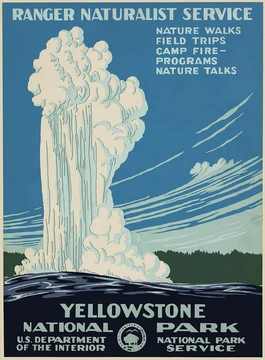
Yosemite
A landmark national park in California's Sierra Nevada.

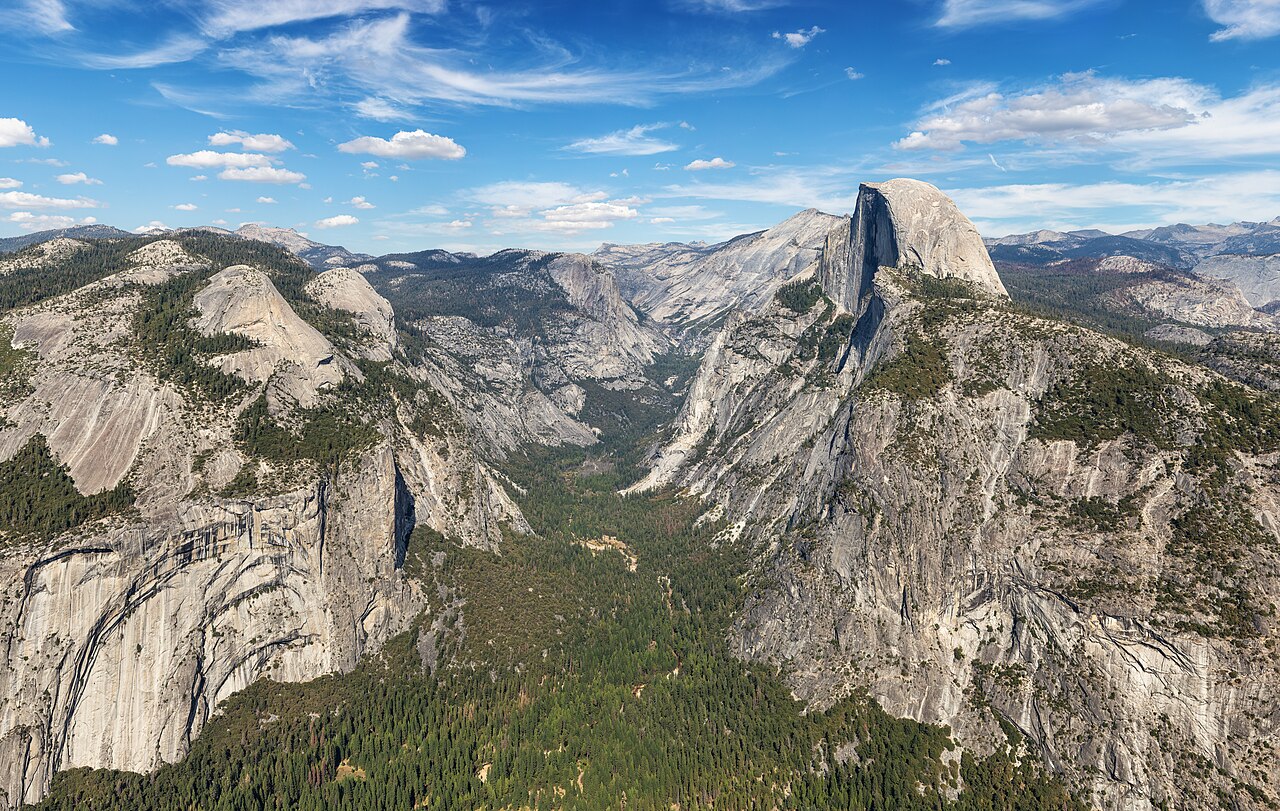
Brocken Inaglory · CC BY-SA 3.0
Yosemite National Park, located in California, is bordered by the Sierra National Forest to the southeast and the Stanislaus National Forest to the northwest. Managed by the National Park Service, it spans four counties, with its center in Tuolumne and Mariposa, and extends north and east into Mono County and south into Madera. Designated a World Heritage Site in 1984, the park is globally renowned for its granite cliffs, waterfalls, clear streams, groves of giant sequoia, lakes, mountains, meadows, glaciers, and biological diversity. Nearly 95 percent of the park is designated wilderness, making it one of the largest and least fragmented habitat blocks in the Sierra Nevada mountain range. Its geology is dominated by granite and remnants of older rock; around 10 million years ago, the Sierra Nevada was uplifted and tilted, steepening stream and river beds to form deep, narrow canyons. About one million years ago, glaciers formed at higher elevations and moved downslope, carving the U-shaped Yosemite Valley. Humans may have first entered the area 10,000 to 8,000 years ago, with Native Americans inhabiting the region for nearly 4,000 years. European Americans entered by 1833, and the first well-documented entrance into Yosemite Valley occurred in 1851 when the Mariposa Battalion, commissioned by Governor McDougal and led by James D. Savage, attacked the Ahwahneechee people there. Yosemite was pivotal to the national park concept; Galen Clark and others lobbied to protect the valley, leading President Abraham Lincoln to sign the Yosemite Grant of 1864, declaring it federally preserved land. In 1890, John Muir’s efforts convinced Congress to establish Yosemite Valley and its surroundings as a National Park, helping create the National Park System. The park draws about four million visitors annually, with most spending time in the valley; it set a visitation record in 2016, surpassing five million visitors for the first time.
- location
- California, United States
- visitors_annual
- about four million
- managed_by
- National Park Service
Quick Facts
- Iucn Category
- II
- Location
- Tuolumne, Mariposa, Mono and Madera Counties, California, United States
- Nearest City
- Mariposa, California
- Established
- 1890-10-01
- Area
- 1187 mi2
- Visitation Num
- 4,278,413
- Visitation Year
- 2025
- Governing Body
- National Park Service
- Mapframe
- yes
- Mapframe-Zoom
- 8
Facts from the source article.
Lore & Background
Yosemite National Park, located in California, is bordered by the Sierra National Forest to the southeast and the Stanislaus National Forest to the northwest. Spanning nearly 1,200 square miles across four counties, the park is managed by the National Park Service and was designated a World Heritage Site in 1984. Its defining characteristics include immense granite cliffs, powerful waterfalls, clear streams, groves of giant sequoia, alpine lakes, mountains, meadows, and glaciers, alongside remarkable biological diversity. Almost all of the park is designated wilderness, making it one of the largest and least fragmented habitat blocks in the Sierra Nevada. The landscape was shaped by the uplift and tilting of the Sierra Nevada around ten million years ago, which steepened riverbeds and carved deep canyons; later, glaciers sculpted the U-shaped Yosemite Valley. The park’s geology is dominated by granite with remnants of older rock. Humans have been present for thousands of years, with the Ahwahneechee people inhabiting the region for nearly four millennia before European American contact. The name Yosemite comes from the Miwok term for the Ahwahneechee, meaning “they are killers,” though it is often mistaken for a word meaning “grizzly bear.” The park draws millions of visitors annually, most of whom concentrate in the small Yosemite Valley.
Reader's Guide
Yosemite’s significance is rooted in its foundational role in the national park movement, beginning with the Yosemite Grant of 1864, which preserved the area as federally protected land, and later through efforts that led to its establishment as a national park in 1890, helping to shape the broader National Park System. The park’s ecology is marked by exceptional biological diversity, including groves of giant sequoia, meadows, lakes, and glaciers, with nearly all of its area designated as wilderness, forming one of the largest and least fragmented habitat blocks in the Sierra Nevada. Its geology results from ancient uplift and tilting of the Sierra Nevada, which steepened streams and carved deep canyons, followed by glacial activity that sculpted the iconic U-shaped Yosemite Valley. Human history spans thousands of years, with the Ahwahneechee people as the primary inhabitants, later impacted by the California Gold Rush and the Mariposa War, part of the broader California genocide, which led to the displacement and decline of the native population. Today, the park draws around four million visitors annually, most concentrated in Yosemite Valley, with a record of over five million in a single year.
Did You Know?
- The word Yosemite is derived from the Miwok term yohhe'meti, meaning 'they are killers,' and is often confused with a similar Miwok term for 'grizzly bear.'
Geological Origins & the Shaping of the Valley
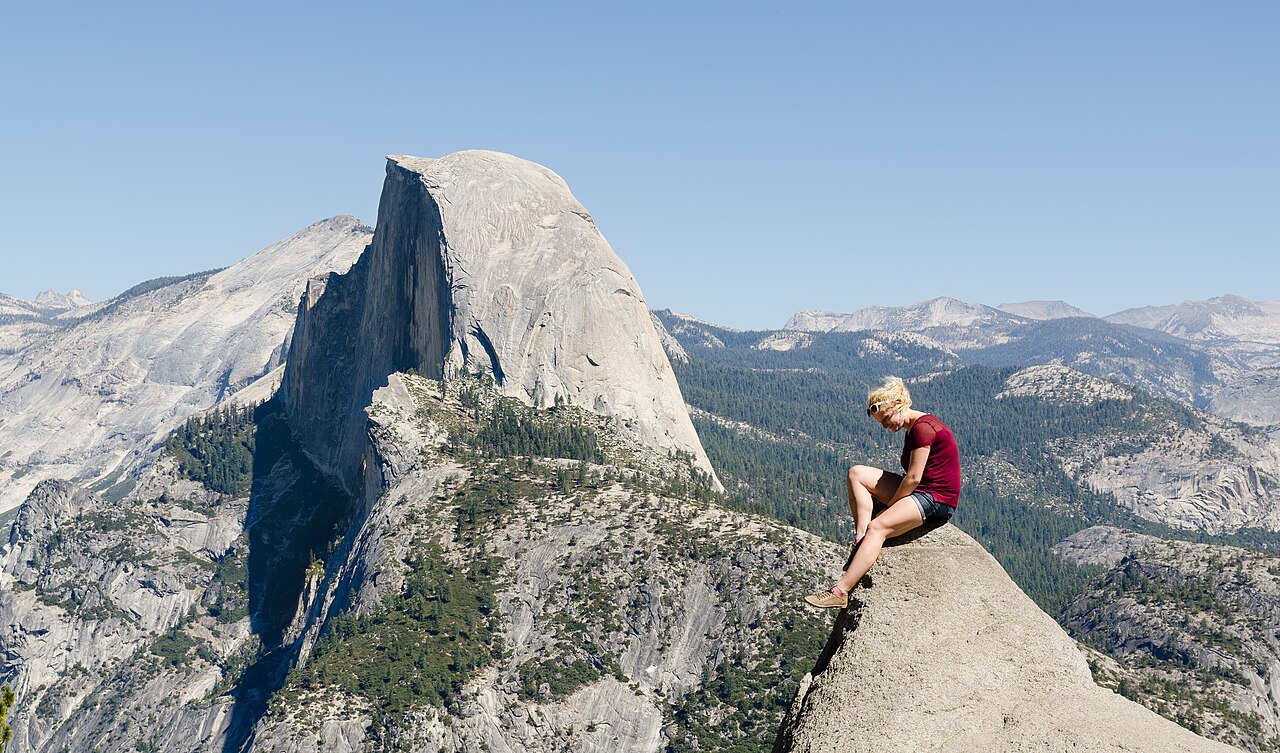
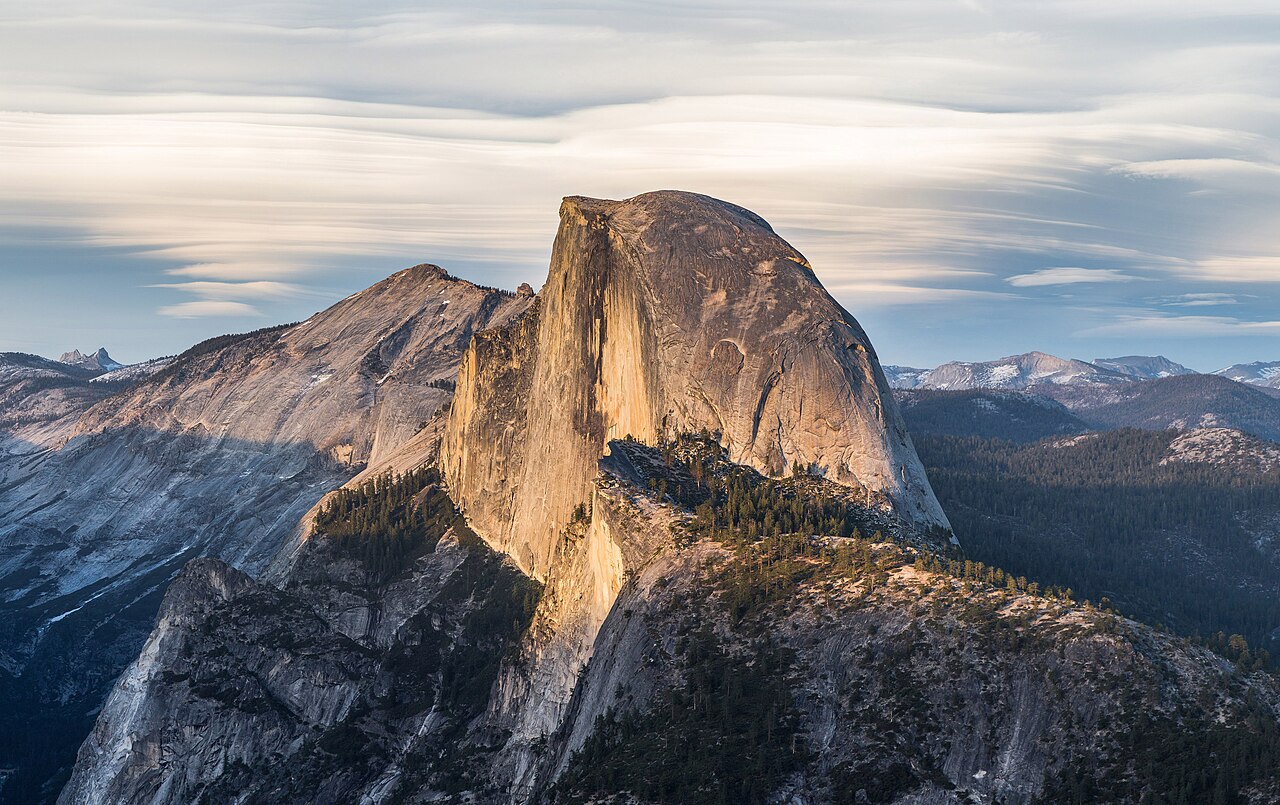
The landscape of Yosemite is the product of deep geological time. Roughly ten million years ago, the Sierra Nevada range was uplifted and tilted, a tectonic event that steepened the beds of streams and rivers and carved out the deep, narrow canyons that define the region today. The park's bedrock is dominated by granite, with remnants of older rock formations still visible in the terrain. About a million years later, glaciers formed at higher elevations and began their slow descent, cutting and sculpting the iconic U-shaped profile of Yosemite Valley. The result is a terrain of towering granite cliffs, rushing waterfalls, clear streams, alpine lakes, meadows, and lingering glaciers. Nearly 95 percent of the park's 1,187 square miles is designated wilderness, making it one of the largest and least fragmented habitat blocks across the Sierra Nevada. The park spans four California counties—Tuolumne and Mariposa at its center, with extensions into Mono to the north and east and Madera to the south—and is bordered by the Sierra and Stanislaus National Forests.
Indigenous Inhabitants & the Mariposa War
The Ahwahneechee—meaning 'dwellers' in Ahwahnee—were the sole tribe within the park's boundaries, part of the broader Southern Sierra Miwok people related to the Northern Paiute and Mono. For nearly four thousand years they sustained themselves on acorns, seeds, salmon, and deer. After his trading post was attacked, James Savage rallied miners and was appointed U.S. Army Major, leading the Mariposa Battalion. Most escaped or were released. Survivors were absorbed into the Paiute tribe.
Preservation & the Birth of the National Park Idea
Yosemite's story is inseparable from the very concept of a national park. In the decades following European American arrival, figures like Galen Clark lobbied fiercely to shield Yosemite Valley from commercial development. That act was a landmark moment in the broader push to set aside wild places for public benefit. In 1890, naturalist John Muir mounted a successful campaign to persuade Congress to formally establish Yosemite as a National Park, encompassing the valley and its surrounding areas. This legislation helped lay the groundwork for what would become the entire National Park System. Today, the park draws roughly four million visitors each year, with most spending their time within the valley's compact seven square miles.
The Name, the People, and Cultural Layers
The name 'Yosemite' carries a layered and often misunderstood history. In Miwok, the word derives from yohhe'meti, meaning 'they are killers'—a term the Miwok used to describe the Ahwahneechee, the resident indigenous tribe. The Ahwahneechee themselves called their homeland Ahwahnee, meaning 'big mouth.' The Miwok term for 'Yosemite' is phonetically close to a similar Miwok word for 'grizzly bear,' a confusion that persists to this day and remains a common misconception among visitors. The region's cultural identity was never monolithic. While the Ahwahneechee were the only tribe living within the park's boundaries, neighboring groups such as the Central Sierra Miwoks and the Yokuts—both from the San Joaquin Valley and central California—regularly visited to trade and intermarry. This blending of cultures helped preserve Indigenous presence in the area even after early American settlement and urban development threatened their survival. The toponym thus encapsulates not just a place, but the complex web of relationships, conflicts, and identities that shaped the Sierra Nevada long before it became a national park.
Common Misconceptions (Editorial)
A common misconception is that the name "Yosemite" means "grizzly bear." In fact, the word derives from the Miwok term *yohhe'meti*, meaning "they are killers," referring to the Ahwahneechee people; the confusion arises because a similar Miwok term does mean "grizzly bear."
Why It Matters (Editorial)
Yosemite matters not only as a breathtaking landscape of granite cliffs and giant sequoias but also as a site of contested history. Its name, rooted in conflict and a failed translation, reminds us that even natural wonders are embedded in human stories of displacement and cultural misunderstanding that continue to shape how we understand protected lands today.
Gallery
Frequently Asked Questions
What is Yosemite?
Yosemite is a protected wilderness area nestled in California's Sierra Nevada mountains, celebrated for its sheer granite walls, thundering waterfalls, and ancient sequoia groves. It covers roughly 1,187 square miles and welcomes about four million visitors every year.
What role does Yosemite play in the national park system?
Yosemite is widely regarded as the site that helped define the very idea of a national park in the United States. Its early public protection set a precedent that shaped how the country would preserve wildlands for generations to come.
Who manages Yosemite?
The National Park Service, a federal agency, is responsible for overseeing all operations within the park. That includes trail upkeep, wildlife protection, and visitor services across the entire 1,187-square-mile area.
More in US National Parks 1-22
Spotted an error? Know more?
This is a living reference — every entry is fact-audited, and reader corrections feed straight into our audit queue. Suggest an edit · See this site's audit record