Arches
National park protecting the world's highest density of natural arches.

John Samuel · CC BY-SA 4.0
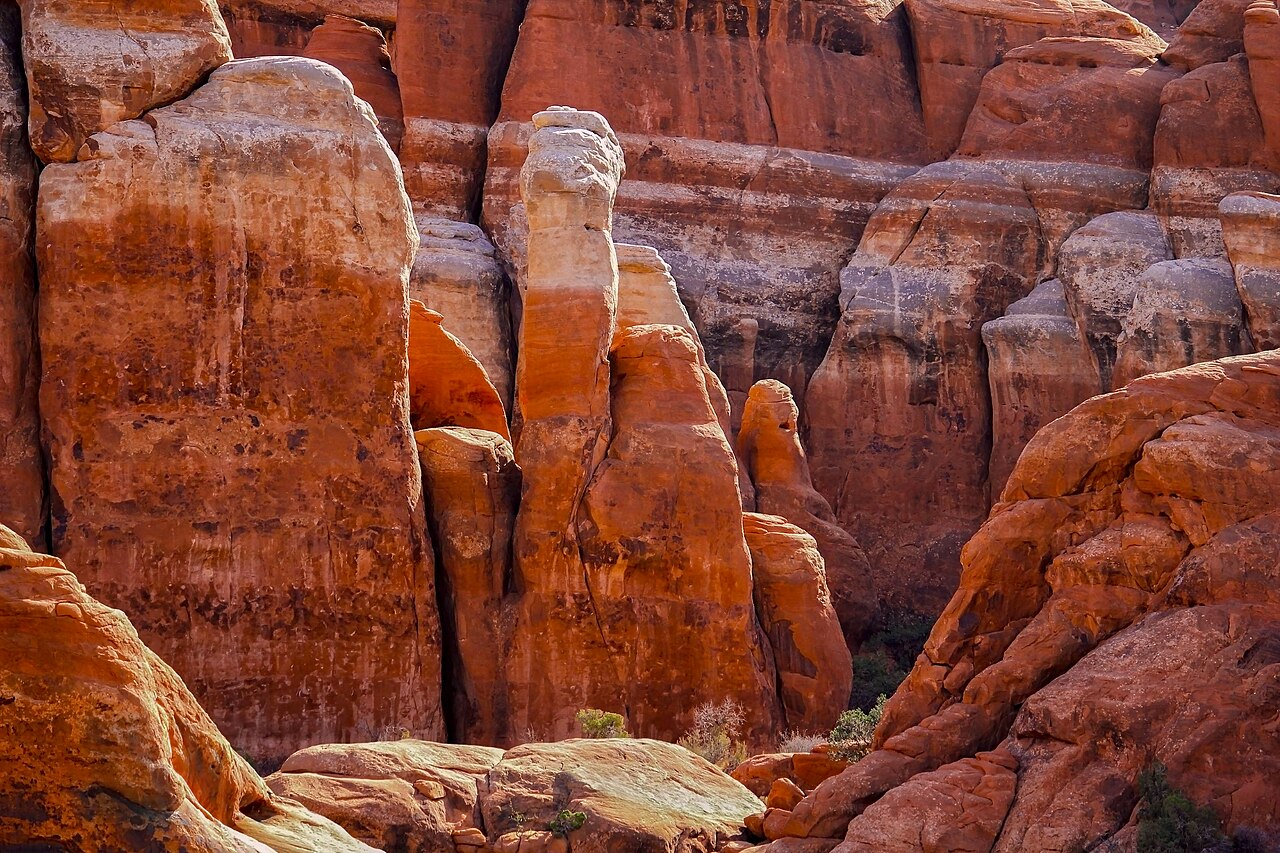
Arches National Park lies on the Colorado Plateau in eastern Utah, just north of Moab and adjacent to the Colorado River. Its landscape of high desert is underlain by a massive underground salt bed, deposited around 300 million years ago when an ancient sea evaporated. This salt layer is the fundamental cause of the park’s extraordinary geology. Over millions of years, debris from the Uncompahgre Uplift covered the salt, followed by the deposition of the Navajo Sandstone during the Early Jurassic and the Entrada Sandstone around 140 million years ago. The weight of over 5,000 feet of younger sediments caused the salt to liquefy and thrust upward, creating salt domes and linear uplifts. Faulting and subsidence tilted rock layers, and subsequent erosion removed most of the overlying cover. Today, the park’s visible formations are primarily the salmon-colored Entrada Sandstone, in which most arches form, and the buff Navajo Sandstone. Water seeping into cracks froze, expanding and breaking off rock; wind then cleared the debris, leaving free-standing fins. Continued attack by wind and water on these fins, particularly at weak points, caused chunks to fall, creating the park’s famous arches. The park also contains spires, balanced rocks, and eroded monoliths. Originally designated a national monument on April 12, 1929, it was redesignated a national park on November 12, 1971. The park’s fragile high-desert ecosystem is threatened by foot traffic, which damages the soil crust composed of cyanobacteria, algae, fungi, and lichens.
- location
- Eastern Utah, adjacent to the Colorado River, 4 mi (6 km) north of Moab
- visitors_2021
- More than 1.8 million
- visitors_2024
- Just under 1.5 million
Lore & Background
Over millions of years, debris eroded from the Uncompahgre Uplift covered an underground salt bed deposited in the Paradox Basin when an ancient sea evaporated. Later, desert conditions deposited the vast Navajo Sandstone, followed by the Entrada Sandstone from stream and windblown sediments. The weight of overlying sediments, thousands of feet thick in places, caused the salt to liquefy and thrust up rock layers, forming salt anticlines and faults. Erosion removed younger rock layers, leaving the salmon-colored Entrada Sandstone and buff-colored Navajo Sandstone visible. Water seeped into surface cracks, joints, and folds; ice formed, expanded, and broke off rock, while winds cleaned out loose particles, leaving free-standing fins. Wind and water attacked these fins until some collapsed and others, with the right hardness and balance, became arches. The arches develop mostly within the Entrada formation at points of intense fracturing localization, where weaker lower rock layers dissolve first, creating openings, and gravity causes stronger upper layers to fall piece by piece into an arch shape. The park’s high desert terrain is fragile, with soil crust composed of cyanobacteria, algae, fungi, and lichens that are easily damaged by foot traffic due to scarce rainfall, lack of deep freezing, and slow recovery.
Reader's Guide
Arches National Park protects an extraordinary concentration of natural sandstone arches, the highest density found anywhere in the world, alongside spires, balanced rocks, and eroded monoliths. These formations result from a deep underground salt bed, deposited when an ancient sea evaporated, which later liquefied under the weight of overlying sediments, thrusting rock layers upward. Erosion then removed younger rock, exposing the salmon-colored Entrada Sandstone where most arches form and the buff Navajo Sandstone. Water seeping into cracks froze, expanding and breaking off rock; wind cleared the debris, leaving free-standing fins. In some fins, the cementing material gave way, and falling chunks created arch-shaped openings. The park’s high-desert ecosystem is fragile: the soil crust, composed of cyanobacteria, algae, fungi, and lichens, has low resistance to foot traffic and recovers slowly due to scarce rainfall, lack of deep freezing, and minimal plant litter. Over a million visitors annually threaten this crust. Arches continue to form and collapse over millennia, shaped by ongoing erosion and fracturing.
Did You Know?
- The park contains more than 2,000 natural sandstone arches, the highest density of natural arches in the world.
The Salt-Bed Engine
This evaporite layer, thousands of feet thick in places, has been the driving force behind every arch, spire, balanced rock, and sandstone fin in the region. As sediments eroded from the Uncompahgre Uplift and blanketed the salt over millions of years, the immense weight caused the salt to liquefy and push rock layers upward into domes and linear anticlines. Once erosion stripped away the younger cover, water and ice worked into cracks and joints, while wind swept away loose debris. Fins of Entrada Sandstone stood free, and where carbonic acid dissolved the calcium carbonate cement holding grains together, weaker lower layers gave way. Gravity then dropped chunks of the stronger upper rock, leaving the graceful arches that give the park its name.
From Monument to Park
The park's foundational purpose, as articulated in its National Park Service charter, is to safeguard extraordinary examples of geologic features—arches, natural bridges, windows, spires, and balanced rocks—along with other resources of geologic, historic, and scientific interest. Beyond preservation, the document commits the park to offering visitors the chance to experience these formations within their majestic natural settings. Administered by the National Park Service, the park sits in eastern Utah, just four miles north of Moab and adjacent to the Colorado River. Its collection of more than 2,000 natural sandstone arches, headlined by the iconic Delicate Arch, represents the highest density of natural arches found anywhere on Earth, a distinction that underscores why the area warranted protection in the first place.
A Landscape Under Pressure
Despite its rugged, enduring appearance, Arches National Park harbors an ecosystem of remarkable fragility. The park's soil surface is coated with a biological crust of cyanobacteria, algae, fungi, and lichens that colonize the dusty high-desert ground. This living layer is the primary defense against erosion, yet it is extraordinarily vulnerable. The semiarid climate—less than ten inches of rain per year on average—means recovery from damage is glacially slow. The absence of deep freezing, the scarcity of plant litter, and the unpredictable nature of rainfall all compound the problem, leaving soils with low resistance to compressional forces like foot traffic. Scientists monitor the health of these crusts using tools such as the cytophobic soil crust index, water-infiltration measurements, and statistical t-tests comparing disturbed and undisturbed plots, all in an effort to quantify damage and guide conservation strategies for this delicate desert floor.
The High Desert Stage
These layers sit in a clean, layer-cake sequence across most of the park, with isolated remnants of even younger Cretaceous Mancos Shale poking through. Every arch in the park is carved from Entrada Sandstone, though the specific path each one took to its final shape varies, shaped by localized fracturing, weak points, and the relentless patience of water and wind.
Common Misconceptions (Editorial)
Some people think Arches National Park is named for having the most arches in the world, but the facts confirm it contains more than 2,000 natural sandstone arches and is specifically noted as having the highest density of natural arches in the world—not simply the highest total count. Others may assume park visitation is always rising, but recorded data shows visitors dropped from more than 1.8 million in 2021 to just under 1.5 million in 2024.
Why It Matters (Editorial)
Arches National Park endures as a powerful reminder of how slow, relentless natural forces—salt liquefaction, erosion, ice, and wind—can sculpt landscapes of breathtaking beauty over millions of years. Its delicate stone spans, including the iconic Delicate Arch, connect visitors to deep geological time and inspire wonder in an era when such wild places grow ever more precious.
Gallery
Frequently Asked Questions
Where is Arches National Park located?
Arches sits in eastern Utah, just four miles north of Moab, with the Colorado River running along its boundary. The park is managed by the National Park Service.
How many natural arches does Arches National Park contain?
The park holds more than 2,000 sandstone arches, making it the spot with the highest density of natural arches anywhere on Earth.
What is the most iconic arch at Arches?
Delicate Arch is the park's signature landmark and the formation most visitors photograph. Its slender, free-standing silhouette has become a widely recognized symbol of Utah.
More in US National Parks 1-22
Spotted an error? Know more?
This is a living reference — every entry is fact-audited, and reader corrections feed straight into our audit queue. Suggest an edit · See this site's audit record