
Ancient Greek medicine
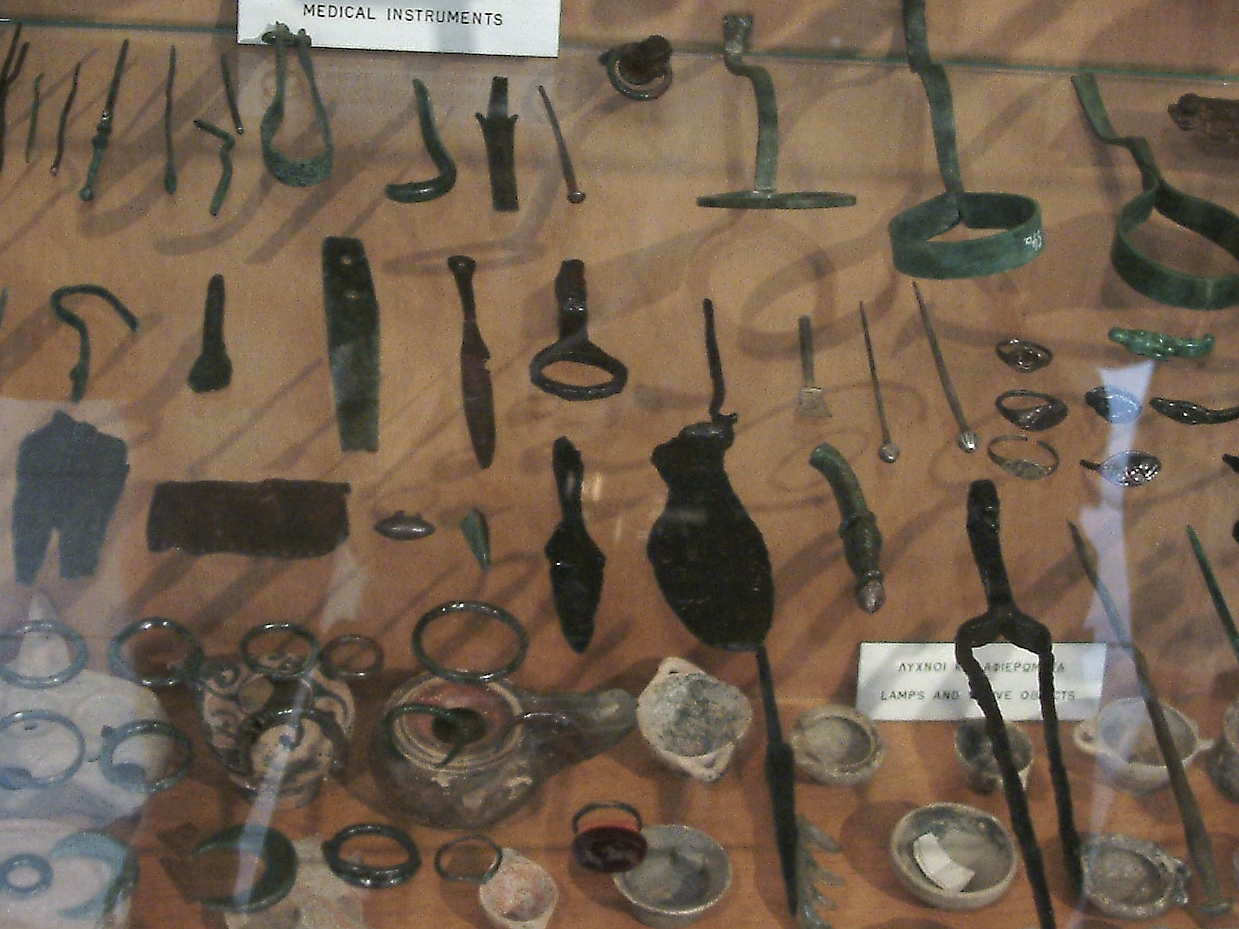
Ancient Greek medicine blended spiritual and physical theories of health.

Arjuno3 · CC BY-SA 4.0
Ancient Greek medicine combined evolving theories and practices, shaped by new ideas and experiments. The Greek word for medicine was *iatrikē* (ἰατρική). Health was seen as influenced by a mix of spiritual and physical factors: the humors, where someone lived, their social standing, diet, injuries, beliefs, and state of mind. At first, the Greeks thought illnesses were divine punishments and healing a gift from the gods. But as theories were tested against symptoms and results, these purely spiritual ideas gave way to a physical understanding based on cause and effect.
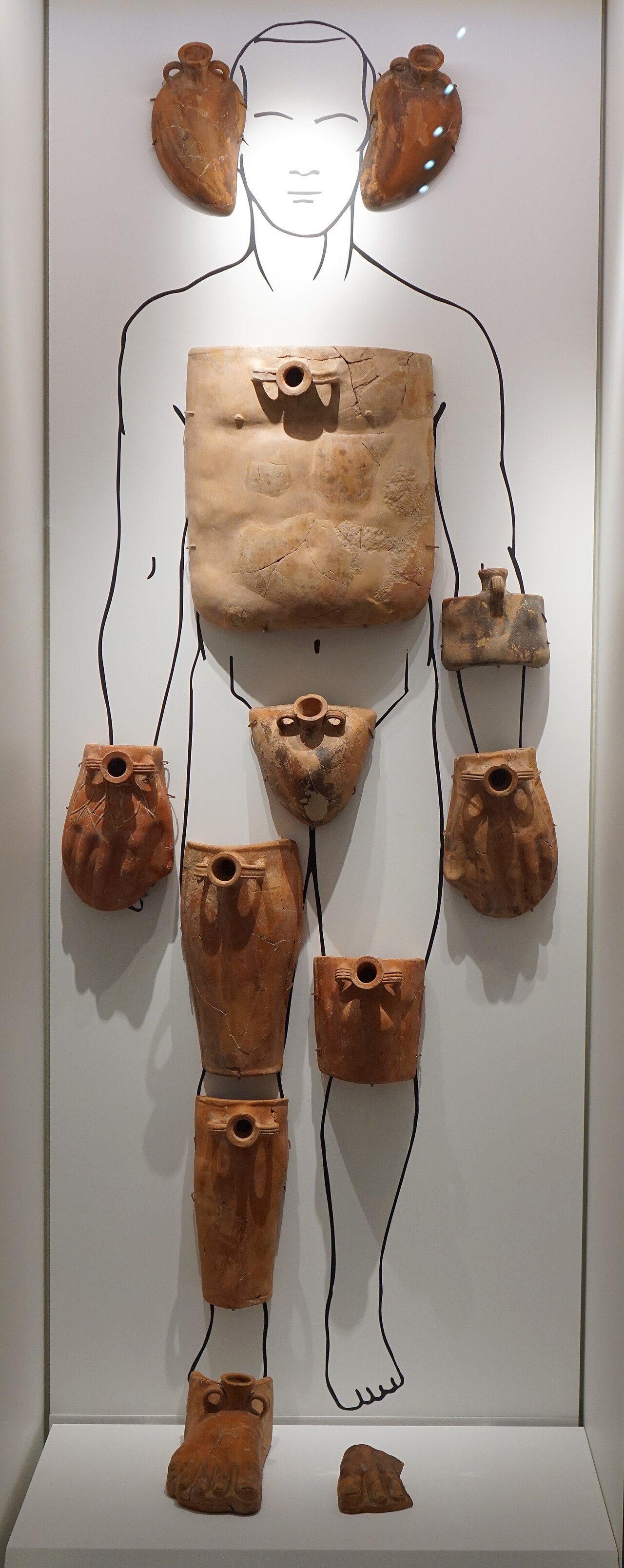
**Asclepieia** Asclepius, mythically the son of Apollo, was considered the first physician. Temples dedicated to him, called Asclepieia, served as centers for medical advice, prognosis, and healing. Patients entered a dream-like sleep called *enkoimesis*, similar to anesthesia, where they either received guidance from the god in a dream or were surgically treated. These spaces were carefully controlled for healing. For instance, the Temple of Asclepius in Pergamum had a spring flowing into an underground room; people drank and bathed in its waters, believed to have medicinal properties. Mud baths and teas like chamomile (for calming) or peppermint (for headaches) were used—remedies still common today. Patients slept in the facilities, and doctors interpreted their dreams and reviewed symptoms. Dogs were sometimes brought in to lick open wounds to aid healing. At the Asclepieion of Epidaurus, three large marble boards from around 350 BC record the names, complaints, and cures of about 70 patients. Some surgical cures listed, such as draining an abdominal abscess or removing foreign material, appear realistic, likely performed while patients were in *enkoimesis* induced by soporifics like opium. The Rod of Asclepius—a single snake with no wings—remains a universal medical symbol, often confused with the Caduceus (two snakes and wings, associated with Hermes).
**Neurology in Ancient Greece** Though neurology wasn’t a formal field until the 17th century, foundational ideas appear in ancient Greek writings like the *Iliad* and *Odyssey*. Homer describes head injuries in battle, noting that brain damage causes confusion and disorientation—for example, when an arrow sinks into a horse’s brain, causing it to writhe and throw the chariot into chaos. The word *enkephalos* (brain) appears in both
- field
- Medicine
- nationality
- Ancient Greek
- known_for
- Humoral theory, Hippocratic Corpus, Asclepieia, early neurological observations
Lore & Background
Asclepius was espoused as the first physician, and myth placed him as the son of Apollo. Temples dedicated to the healer-god Asclepius, known as Asclepieia, functioned as centers of medical advice, prognosis, and healing. At these shrines, patients would enter a dream-like state of induced sleep known as 'enkoimesis', in which they either received guidance from the deity in a dream or were cured by surgery. The Temple of Asclepius in Pergamum had a spring that flowed down into an underground room; people would drink the waters and bathe in them because they were believed to have medicinal properties. Mud baths and hot teas such as chamomile were used to calm them or peppermint tea to soothe their headaches. Patients were encouraged to sleep in the facilities, and their dreams were interpreted by doctors. Dogs would occasionally be brought in to lick open wounds for assistance in healing. In the Asclepieion of Epidaurus, three large marble boards dated to 350 BC preserve the names, case histories, complaints, and cures of about 70 patients.
Reader's Guide
Ancient Greek medicine began to revolve around the theory of humors, which states that good health comes from a perfect balance of blood, phlegm, yellow bile, and black bile. Poor health resulted from improper balance of these humors. Hippocrates, known as the 'Father of Modern Medicine', established a medical school at Cos and is the most important figure in ancient Greek medicine. He and his students documented numerous illnesses in the Hippocratic Corpus and developed the Hippocratic Oath for physicians, which is still in use today. They also created medical terminology including acute, chronic, epidemic, exacerbation, and relapse. The contributions to ancient Greek medicine of Hippocrates, Socrates and others had a lasting influence on Islamic medicine and medieval European medicine until many of their findings eventually became obsolete in the 14th century. The Rod of Asclepius, a symbol of one snake with no wings, remains a universal symbol for medicine to this day, though it is frequently confused with the Caduceus of Hermes.
Did You Know?
- The Greek term for medicine was iatrikē (Ancient Greek: ἰατρική).
- At Asclepieia, patients entered a dream-like state called 'enkoimesis' for healing or surgery.
- The Hippocratic Corpus includes the treatise 'the Sacred Disease', which argued biological medicines would not work if diseases were supernatural.
- The Rod of Asclepius, a symbol of medicine, features one snake with no wings, unlike the Caduceus with two snakes and wings.
Greek Roots of the Humoral Framework
The intellectual bedrock of what would become Unani medicine was laid in ancient Greece, where Hippocrates (c. 460–380 BCE) constructed a diagnostic framework centered on four internal humours: blood, phlegm, yellow bile, and black bile. His central insight was that disease arose not from external supernatural forces but from an imbalance within the body's own composition. Centuries later, Galen of Pergamon (born c. 129 CE) expanded this architecture, introducing the concept of pneuma (breath) and articulating what he called the Four Faculties of a living organism. Together, these two physicians established a theoretical diagnostic structure that would outlive their own civilization. The Hellenistic character of the system persists in its continued reliance on the classical four-humour model, even as the tradition later absorbed influences from Indian and Chinese medical traditions. The very name "Unani" traces back to Iōnía, the coastal region on the eastern Aegean whose Ionian people became the primary Arabic and Persian reference for Greek civilization as a whole, known as Yūnānistan.
The Islamic Golden Age Synthesis
Between the 8th and 14th centuries, the Greco-Arabic medical tradition underwent a transformative expansion under Islamic patronage. Caliphs Harun Rashid and Al-Mansur commissioned the translation of Greek and Sanskrit medical works through the Bayt al-Hikma, the House of Wisdom in Baghdad. Al-Razi (c. 854–925 CE) drew upon this translated corpus to produce the Kitab al-Hawi, a medical encyclopedia of enormous scope that included the first recorded clinical distinction between smallpox and measles. Ibn Sina, known in the West as Avicenna (980–1037 CE), then synthesized the accumulated knowledge into the Kitab al-Qanun fi al-tibb, a five-volume work completed in Hamadan, the city where he would die that same year. This text served as a foundational medical reference in both Arab and European institutions for centuries. Ibn Rushd (Averroes, 1126–1198 CE) further extended the tradition westward into Al-Andalus through his Colliget, a theoretical framework that broadened the system's geographic and intellectual reach.
Mughal Patronage and Cultural Fusion
Unani medicine reached the Indian subcontinent by the 12th century, carried by Muslim scholars, and its influence deepened under the Delhi Sultanate and later the Mughal Empire. A significant wave of Unani Hakims fled to India after the Mongol invasions of Persia and Central Asia, some securing positions as court physicians. Mughal emperors Akbar, Shah Jahan, and Aurangzeb each commissioned translations of Persian medical texts, enriching the empire's medical knowledge. A landmark document, the Ilajat-I Dara Shikohi, compiled by Nur al-Din Shirazi, stands as one of the largest Persian medical manuals ever produced in Mughal India, weaving together Muslim and Indian medical arts into a single vast overview. By the 18th century, the system had acquired a distinctly Indian character: its pharmacopoeia incorporated local herbs and minerals, and medical knowledge began passing through family lineages into vernacular literature. The tradition had become a living hybrid, no longer purely Greek in provenance.
Colonial Marginalization and Institutional Revival
Under British colonial rule, Western medicine—locally called "doctory"—was systematically prioritized, and traditional systems like Unani Tibb faced institutional suppression. Unani reformists responded by arguing for the system's legitimacy as a distinct form of knowledge while simultaneously advocating for the adoption of the scientific method in Unani research. In 1883, Hakim Abdul Majeed founded the Madrasa Tibbia in New Delhi (now Tibbia College) as a direct institutional counter to colonial suppression. His successor, Hakim Ajmal Khan (1868–1927), expanded the institution and used it as a platform to resist a proposed British ban on indigenous medicine. After independence in 1947, the Indian government formally recognized Unani and other traditional systems. The Majeedi family, particularly Hakim Abdul Hameed (1908–1999), modernized the Unani drug industry and established the Institute of History of Medicine and Medical Research in 1962, which evolved into Jamia Hamdard in 1989. The 1970 Indian Medicine Central Council Act and the 1978 CCRUM further embedded Unani within the national health infrastructure, culminating in the 2014 elevation of AYUSH to a full ministry.
Gallery

Frequently Asked Questions
What is Ancient Greek medicine?
Ancient Greek medicine refers to the evolving system of health theory and practice developed in the Greek world, blending spiritual beliefs with increasingly physical explanations for illness. The Greeks called it *iatrikē* (ἰατρική), and it encompassed everything from humoral balance to diet, environment, and mental state as factors in a person's well-being.
What are the most famous contributions of Ancient Greek medicine?
Its hallmark achievements include the humoral theory of bodily balance, the Hippocratic Corpus as a foundational medical text, the establishment of Asclepieia as dedicated healing sanctuaries, and some of the earliest recorded neurological observations.
How did Ancient Greek medicine shift from spiritual to physical explanations?
Early Greek healers attributed disease to divine punishment and viewed recovery as a gift from the gods. Over time, practitioners tested their theories against actual symptoms and outcomes, gradually replacing purely mystical ideas with a cause-and-effect framework rooted in observable physical processes.
What role did the Asclepieia play in Ancient Greek medicine?
Asclepieia were sanctuary-healing sites where patients could seek both spiritual and practical care, representing a bridge between religious ritual and emerging empirical treatment. They served as early institutional settings where healing was organized and observed.
Why is Ancient Greek medicine considered important in the history of alternative and traditional healing?
It laid the conceptual groundwork for Western medicine by introducing systematic observation, documented case reasoning, and the idea that health depends on multiple interacting factors rather than a single divine will. Many of its core ideas—humoral balance, lifestyle influences, and the separation of healing from pure myth—still echo in modern complementary and alternative approaches.
More in Traditional & Alternative Medicine 1-24
Spotted an error? Know more?
This is a living reference — every entry is fact-audited, and reader corrections feed straight into our audit queue. Suggest an edit · See this site's audit record