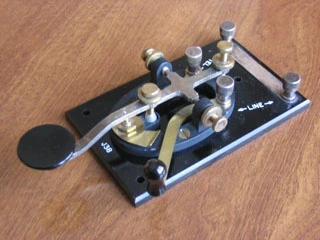
Walter P. Phillips
Creator of the Phillips Code, including POTUS and SCOTUS.
Walter P. Phillips was an American journalist, telegrapher, and inventor who compiled and expanded the Phillips Code, a brevity code used to speed the transmission of news dispatches. The code included the abbreviations POTUS for president of the United States and SCOTUS for Supreme Court of the United States.
Quick Facts
- Birth Name
- Walter Polk Phillips
- Birth Date
- 1846-06-14
- Birth Place
- Grafton, Massachusetts, US
- Death Date
- 1920-01-31
- Death Place
- Vineyard Haven, Massachusetts,Disputed, some sources report Oak Bluffs US
- Occupation
- Journalist · telegrapher · inventor
- Known For
- His Phillips Code which included abbreviations POTUS and SCOTUS
- Spouse
- Francena A. Capron · April 15, 1866 · 1914
- Children
- 1
Facts from the source article.
Lore & Background
Phillips began his career as a messenger for the American Telephone and Telegraph Company in Providence, Rhode Island, in 1861. He became known as an expert telegrapher, winning contests for speed and accuracy; in one contest he transcribed more than 2,700 words in one hour, earning a personal letter from Samuel Morse. He later worked for Western Union and then entered journalism, becoming managing editor of the Providence Morning Herald and later editor of the Providence Morning Star. In 1872 he founded the Attleborough Chronicle, which he sold a year later. Moving to New York City, he worked as a reporter for The New York Sun before joining the Associated Press in 1875.
While at the Associated Press, Phillips created what became known as the Phillips Code, a system of abbreviations for frequently used words in news dispatches. He described the code as putting down the collective experience of generations of telegraph operators. The code quickly became standard among newspaper telegraphers. In 1876, under the pen name John Oakum, he published a work of humor and social commentary titled Oakum Pickings. He later ran the Associated Press's Washington, D.C. bureau and then returned to New York to take charge of the United Press, where he was called one of the leading news gatherers of the country.
Reader's Guide
The Phillips Code was significant because it addressed the practical need for speed in telegraphic news transmission. By standardizing abbreviations for common terms, it allowed telegraphers to send and receive messages more rapidly, reducing costs and improving efficiency. Its adoption by newspapers made it a de facto standard for press reporting during the late 19th and early 20th centuries. The code's legacy includes the enduring abbreviations POTUS and SCOTUS, which remain in use today. Phillips's work reflected the convergence of journalism and telegraphy, and his code influenced later shorthand and brevity systems. After his death, a controversy arose when his will left $100,000 to his secretary Frances Wood, who had also read to him and helped him stay informed.
Did You Know?
- Phillips left school at age twelve to work on a farm.
- He won a telegraphy contest by accurately transcribing more than 2,700 words in one hour.
- He published a book of humor and social commentary under the pen name John Oakum.
More in Telegraph Keys and Codes 1-24
Spotted an error? Know more?
Reader corrections go straight into our review queue. Suggest an edit · How this site is sourced