Electrical telegraph
First electrical telecommunications system, used from the 1840s.
Electrical telegraphy allowed people to send messages over long distances by transmitting electrical signals through wires. It was in widespread use from the 1840s until near the end of the 1900s. As the first electrical system for telecommunications, it was also the most common of the early telegraph systems designed to transmit text faster than physical delivery. This technology is often regarded as the earliest form of electrical engineering.
A telegraph network consisted of two or more separate stations, known as telegraph offices, linked by wires that were usually strung overhead on utility poles. Although many different electrical telegraph systems were invented, the ones that became widely adopted fell into two main types. The first type was the needle telegraph. In these systems, an electric current traveling along the line created an electromagnetic force that moved a needle-shaped pointer over a printed list, indicating a specific item—such as a letter of the alphabet. Early needle telegraphs used multiple needles, which required several wires between stations. The first commercial needle telegraph, and the most widely used of its kind, was the Cooke and Wheatstone telegraph, invented in 1837. The second type was the armature system. Here, the current activated a telegraph sounder that produced a click, and communication relied on sending clicks in coded rhythmic patterns. The classic example of this type was the Morse system and its associated code, both invented by Samuel Morse in 1838. In 1865, a modified version of Morse's code, originally developed for German railways, became the international standard.
Railway companies used electrical telegraphs for train control signals, which helped prevent collisions. This was based on the signalling block system, where signal boxes along the line communicated with neighboring boxes using single-stroke bells and three-position needle telegraph instruments.
During the 1840s, the electrical telegraph replaced optical telegraph systems like semaphores as the standard way to send urgent messages. By the second half of the century, most developed nations had commercial telegraph networks with local offices in cities and towns. The public could send messages—called telegrams—to anyone in the country for a fee.
- First commercial system
- Cooke and Wheatstone telegraph, invented in 1837
- Archetype of armature systems
- Morse system and code, invented by Samuel Morse in 1838
- International standard
- Morse system became standard in 1865, using a modified code developed for German railways
- First submarine cable
- 1850
- Early teleprinter
- Hughes telegraph (1855) built by Siemens and Halske
Lore & Background
Electrical telegraphy consisted of two or more geographically separated stations, called telegraph offices, connected by wires usually supported overhead on utility poles. Many systems were invented, but those that became widespread fit into two broad categories. First are needle telegraphs, where electric current moves a needle-shaped pointer over a printed list to indicate a specific item. Early needle models used multiple needles, requiring multiple wires. The first commercial needle system and most widely used of its type was the Cooke and Wheatstone telegraph, invented in 1837. The second category are armature systems, where current activates a telegraph sounder that makes a click; communication relies on sending clicks in coded rhythmic patterns. The archetype was the Morse system and its code, both invented by Samuel Morse in 1838. In 1865, the Morse system became the international standard, using a modified form of Morse's code developed for German railways.
Electrical telegraphs were used by emerging railway companies to provide signals for train control systems, minimizing collision chances. This was built around the signalling block system, where signal boxes communicate with neighbouring boxes by telegraphic sounding of single-stroke bells and three-position needle telegraph instruments. In the 1840s, the electrical telegraph superseded optical telegraph systems such as semaphores, becoming the standard way to send urgent messages. By the latter half of the century, most developed nations had commercial telegraph networks with local offices in most cities and towns, allowing the public to send messages (telegrams) addressed to any person in the country, for a fee.
Reader's Guide
Beginning in 1850, submarine telegraph cables allowed the first rapid communication between people on different continents. The telegraph's nearly-instant transmission of messages across continents and between continents had widespread social and economic impacts. The electric telegraph led to Guglielmo Marconi's invention of wireless telegraphy, the first means of radiowave telecommunication, which he began in 1894. In the early 20th century, manual operation of telegraph machines was slowly replaced by teleprinter networks. Increasing use of the telephone pushed telegraphy into only a few specialist uses; its use by the general public dwindled to greetings for special occasions. The rise of the Internet and email in the 1990s largely made dedicated telegraphy networks obsolete.
Did You Know?
- The first commercial needle telegraph system was the Cooke and Wheatstone telegraph, invented in 1837.
- The Morse system became the international standard for telegraphy in 1865.
- Submarine telegraph cables began operation in 1850, enabling rapid intercontinental communication.
- The Hughes telegraph, an early teleprinter, was built by Siemens and Halske in 1855.
Origins and the Enduring Straight Key
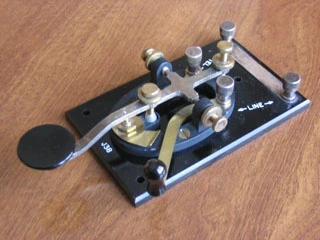
The telegraph key traces its lineage back to Alfred Vail, a collaborator of Samuel Morse, who crafted the very first version of this specialized electrical switch. Over more than 150 years, the fundamental concept—a simple bar with a knob on top and an electrical contact beneath—has remained remarkably consistent, even as countless variations emerged across numerous countries. The straight key, the type most audiences recognize from period films and television, operates on a straightforward principle: pressing the bar down against spring tension closes an electrical circuit, while releasing it opens the circuit. What distinguishes one key from another is often cultural rather than functional. American keys traditionally featured short, flat-topped knobs paired with narrow, frequently curved bars, whereas European counterparts favored tall, ball-shaped knobs atop thick bars. Operators on each side of the Atlantic hold deeply partisan views about their preferred style, a rivalry that persists to this day. The enduring simplicity of the design has also spawned an avid community of key collectors who seek out the many variations produced over the decades.
The Railroad Shorting Bar and Wiring Philosophy
A distinctive feature of American railroad telegraph keys was the inclusion of a shorting bar, a component rooted in the continent's particular approach to line wiring. In North American railroad systems, signal power was supplied from batteries located only in telegraph offices at one or both ends of a line, rather than each individual station maintaining its own battery bank as was common in Europe. The shorting bar served a critical function: when an operator was not actively sending, it completed the electrical path through the station to the next and all subsequent stations, ensuring their sounders could still respond to signals traveling down the line. Without it, a message from a central office would simply stop at the first idle station. Although the shorting bar occasionally appears on later keys as a nod to tradition, it serves no practical purpose in radio telegraphy. The one exception is as a convenience for producing a steady signal while tuning a transmitter—a task that, without the shorting bar, would otherwise require the inelegant solution of plopping a book on top of the key to free both hands for adjusting the transmitter.
The Sideswiper Revolution and the Semi-Automatic Bug
From the earliest days of telegraphy, operators and inventors sought alternatives to the basic up-and-down key. The first widely accepted alternative was the sideswiper, also known by colorful names like the sidewinder, cootie key, or bushwhacker. This design replaced the vertical pounding motion with a side-to-side swing: contacts on both the left and right allowed the operator to produce a dit or dah by swinging the spring-loaded lever in either direction, while a series of dits could be sent by thrashing the arm back and forth. The motivation was twofold—increasing sending speed and, more critically, alleviating the repetitive stress injury telegraphers called glass arm. The side-to-side motion recruited different muscles and reduced the strain that plagued straight-key operators. Building on this principle, the semi-automatic key, popularly called the bug after the Vibroplex brand, introduced a simple clockwork mechanism that rocked a horizontal pendulum against a contact point, producing uniformly timed dits with minimal hand motion. Skilled operators could exceed 40 words per minute with a bug, and the consistent rhythm it maintained was essential for reliable decoding at the receiving end.
The Human Toll and the Art of Fist
The physical demands of operating a telegraph key were not merely an inconvenience; they could end a career. In the early days of telegraphy, a number of professional telegraphers developed a repetitive stress injury known as glass arm, or telegrapher's paralysis, caused by the rapid pumping action required to send a string of dots on a straight key. The condition could sometimes be mitigated by increasing the side play of the key through loosening the adjustable trunnion screws, but the more reliable solutions were good manual technique or switching to a side-to-side key design. Beyond the medical concerns, the act of sending Morse code was as much an art as a science. Each operator developed a distinctive rhythm or swing in their transmission, a quality known in the trade as fist. The alternating action of a sideswiper, for instance, produced a noticeably different rhythm than the vertical pounding of a straight key. Transmission speeds themselves varied enormously, from roughly 5 words per minute for novice operators to about 30 words per minute for skilled straight-key senders, and beyond 40 words per minute for those using semi-automatic bugs. The operator's skill, consistency, and physical comfort were inextricably linked.
Frequently Asked Questions
What is the electrical telegraph in simple terms?
It is the first electrical system ever built to transmit text messages over long distances by sending signals through wires. It operated as the dominant long-distance messaging technology from the 1840s all the way until the late 1900s.
Who invented the first commercial telegraph system?
Cooke and Wheatstone built the first commercial telegraph in 1837, while Samuel Morse developed his armature-based system and code the following year in 1838. Morse's design eventually became the international standard by 1865.
How long was the electrical telegraph actually in widespread use?
It served as the go-to method for fast long-distance text transmission from the 1840s until near the very end of the twentieth century. That gives it roughly a century and a half of continuous, widespread service.
Why do fans and historians call the electrical telegraph so important?
It is widely regarded as the earliest practical form of electrical engineering, since it was the first time electrical signals were used to carry human language over distance. Every later telecommunications technology traces its lineage back to this basic wire-and-signal concept.
What was the first major milestone beyond land-based telegraph lines?
The first submarine cable was laid in 1850, extending the network under the sea for the first time. Around the same era, Hughes's 1855 teleprinter built by Siemens and Halske introduced the early concept of a teleprinter for printing received messages.
More in Telegraph Keys and Codes 1-24
Spotted an error? Know more?
Reader corrections go straight into our review queue. Suggest an edit · How this site is sourced