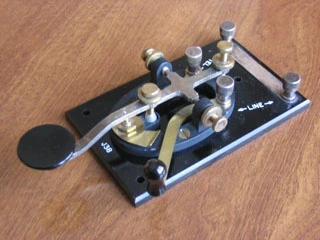
Teleprinter
Electromechanical device for typed message transmission.
A teleprinter (teletypewriter, teletype or TTY) is an electromechanical device used to send and receive typed messages through various communications channels, in both point-to-point and point-to-multipoint configurations. Initially used in telegraphy, teleprinters automated much of the work of Morse code operators and eventually largely replaced them with typists and machines communicating faster via Baudot code.
- First landline operation
- 1849, between Philadelphia and New York City
- Early inventor
- Royal Earl House (1846 printing telegraph)
- Key code developer
- Émile Baudot (1874 five-unit code)
- Start-stop synchronizing method
- Howard Krum (patented 1900s)
- First commercial teletypewriter system
- 1910, Morkrum Company on Postal Telegraph Company lines between Boston and New York City
- Notable early model
- Morkrum Printing Telegraph (1908, field tested with Alton Railroad)
Lore & Background
The teleprinter evolved through a series of inventions by numerous individuals on both sides of the Atlantic, including Samuel Morse, William Fothergill Cooke, Charles Wheatstone, Alexander Bain, Royal Earl House, David Edward Hughes, Émile Baudot, Donald Murray, Charles L. Krum, Edward Kleinschmidt and Frederick G. Creed. Early developments began in 1835 with Morse's recording telegraph, and by 1846 Royal Earl House patented a printing telegraph linking two 28-key piano-style keyboards, capable of transmitting around 40 words per minute. In 1855, David Edward Hughes introduced an improved machine, and within two years several small telegraph companies united to form Western Union to carry on the Hughes system.
In 1874, Émile Baudot designed a system using a five-unit code, adopted by the British Post Office on a simplex circuit between London and Paris in 1897. Donald Murray modified Baudot's code in 1901, introducing a keyboard perforator and paper tape, and designed the code to minimize wear on machinery. In the United States, Charles L. Krum and his son Howard Krum developed the start-stop synchronizing method, which made practical teleprinters possible. The Morkrum Company produced a working teleprinter in 1908, and in 1910 installed the first commercial teletypewriter system between Boston and New York City.
Reader's Guide
Teleprinters were invented to send and receive messages without requiring operators trained in Morse code, replacing two trained Morse code operators with a single keyboard operator. With the development of early computers in the 1950s, teleprinters were adapted to allow typed data to be sent to a computer and responses printed. Some models could create punched tape for data storage and read back such tape for local printing or transmission. A teleprinter attached to a modem could communicate through telephone lines, a configuration often used to connect to remote computers in time-sharing environments.
Teleprinters have largely been replaced by fully electronic computer terminals with monitors, though the term 'TTY' is still occasionally used, such as in Unix systems. They remain widely used in the aviation industry (see AFTN and airline teletype system), and variants called Telecommunications Devices for the Deaf (TDDs) are used by the hard-of-hearing for typed communications over ordinary telephone lines.
Did You Know?
- The first commercial teletypewriter system was installed in 1910 between Boston and New York City by the Morkrum Company.
- Émile Baudot designed a five-unit code in 1874 that was adopted for use on a London–Paris circuit in 1897.
- Donald Murray introduced control characters such as Carriage Return and Line Feed in his 1901 modification of Baudot's code.
- Teleprinters are still used in aviation and as TDDs for the hard-of-hearing.
From Telegraph Keys to Printing Wheels
The story of the teleprinter begins in the mid-1830s, when Samuel Morse devised a recording telegraph that used an electromagnet to move a marker and capture breaks in electrical current. Just two years later, William Fothergill Cooke and Charles Wheatstone secured a British patent describing a type-printing telegraph that employed a rotating brass daisy-wheel with steel type at its petal tips, struck by an electric hammer to imprint Roman letters through carbon paper onto a moving tape. In 1841, Alexander Bain introduced an electromagnetic printing machine driven by weight-powered clockwork, using centrifugal governors to keep sending and receiving elements synchronized, with the type-wheel printing signals in a spiral on a rotating drum. Royal Earl House pushed the concept further in 1846 by linking two 28-key piano-style keyboards over a wire, each key triggering a corresponding letter on a 56-character typewheel at the distant end. His synchronous system could transmit roughly 40 instantly readable words per minute and print up to 2,000 words per hour. By 1849, the first landline teleprinter circuit connected Philadelphia and New York, and David Edward Hughes's 1855 improvements helped consolidate the industry into Western Union Telegraph Co.
The Encoding Revolution: Baudot, Murray, and the End of Morse
The shift from skilled Morse operators to automated typing was driven largely by advances in character encoding. In 1874, French engineer Émile Baudot designed a five-unit code that became widely deployed in France starting in 1877. The British Post Office adopted the Baudot system in 1897 for a simplex circuit linking London and Paris, and later expanded its use across duplex Inland Telegraph Services. Interestingly, Finnish inventor Kaj Himberg had experimented with a six-unit code teleprinter as early as 1875, producing 64 possible combinations, but his design proved too cumbersome for practical use, and no more than a single unit was ever built. The most consequential refinement came in 1901, when Donald Murray, originally from New Zealand, modified Baudot's code to pair with a typewriter-like keyboard. Murray's system introduced a keyboard perforator that let an operator punch paper tape, a tape transmitter for sending the message, and at the receiving end a printing mechanism plus a reperforator for making perforated copies. Because the operator's hand movements no longer mapped directly to transmitted bits, Murray was free to design the code around minimizing mechanical wear rather than operator fatigue, fundamentally changing how teleprinters were built and used.
Bridging into the Computer Age
When early computers emerged in the 1950s, teleprinters found a second life as the primary human interface to these new machines. Operators could type data directly into a teleprinter, which would transmit it to the computer, and the machine's responses would be printed back out on paper. Several teleprinter models went further, incorporating the ability to create punched tape for data storage—whether from locally typed input or from data received over a remote line—and to read that tape back for local printing or retransmission. This made the teleprinter a versatile node in an early data pipeline, capable of both input and archival. Perhaps the most transformative adaptation was pairing a teleprinter with a modem so it could communicate over ordinary telephone lines. This configuration became the standard way to connect teleprinters to remote computers, especially in time-sharing environments where multiple users shared a single mainframe. The teleprinter thus served as the bridge between the world of electromechanical telegraphy and the emerging digital computing era, giving typists a direct channel into a machine that had previously been accessible only to specialists.
Enduring Legacy: Aviation, Accessibility, and the TTY Name
Although fully electronic computer terminals with monitors have largely displaced the electromechanical teleprinter from general office and computing use, the technology and its name persist in several important niches. In the aviation industry, teleprinters remain widely deployed for air traffic and airline communications, operating under systems such as AFTN and dedicated airline teletype networks that handle point-to-point and point-to-multipoint message traffic. In the accessibility world, a variant known as a Telecommunications Device for the Deaf (TDD) allows hard-of-hearing individuals to conduct typed conversations over ordinary telephone lines, preserving the teleprinter's core function of converting keystrokes into transmitted characters and back. Even in computing culture, the abbreviation TTY survives as a shorthand for terminal devices, particularly within Unix operating systems where it designates text-based input and output interfaces. These surviving applications demonstrate that the teleprinter's fundamental concept—reliable, typed, character-by-character communication over a wire—remains relevant long after the machines that first embodied it have been retired from mainstream service.
Frequently Asked Questions
Who is Teleprinter?
Teleprinter, also called teletypewriter or TTY, is an electromechanical machine built to transmit and receive typed text over wired communication lines. It could operate in a simple two-party link or in a multi-point network setup.
What are Teleprinter's powers or role?
Its core ability was to automate the exchange of typed messages, taking over the manual keying work that Morse operators previously performed by hand. It encoded text using Émile Baudot's five-unit code and communicated at speeds well beyond what a human operator could sustain.
Why is Teleprinter important to the telegraph canon?
It represented the decisive shift from purely manual code operation to automated typed-message transmission, making long-distance text far quicker and less error-prone. Its development drew on contributions from Royal Earl House, Émile Baudot, and Howard Krum across roughly six decades of innovation.
When and where did Teleprinter first appear in the field?
The earliest landline teleprinter service ran in 1849 on the Philadelphia-to-New York route, building on Royal Earl House's 1846 printing-telegraph prototype. The first fully commercial teletypewriter system went live in 1910, operated by the Morkrum Company over Postal Telegraph lines between Boston and New York City.
More in Telegraph Keys and Codes 1-24
Spotted an error? Know more?
Reader corrections go straight into our review queue. Suggest an edit · How this site is sourced