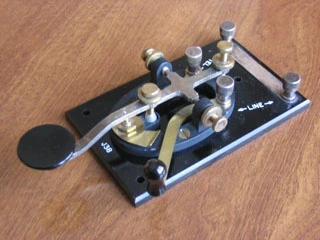
Order of Railroad Telegraphers
Union of railroad telegraphers ensuring safe train operations.
The Order of Railroad Telegraphers (ORT) was a labor union in the United States, founded in the late 1800s to represent telegraph operators employed by railroads.
Telegraph lines in the U.S. were often built alongside railroad tracks, but the first use of the telegraph for train routing came in 1851, when Charles Minot, superintendent of the Erie Railroad, employed it. The practice spread through the 1860s and 1870s. Telegraphers were stationed at depots along the line, receiving train orders from a central dispatcher and reporting train movements. These written orders were handed up to passing train crews.
This system made single-track railroads much more efficient. A dispatcher would designate one train as “superior,” giving it the right of way, while the “inferior” train would pull onto a siding until the superior train passed. Depot operators tracked train arrival times at each station—a process called “OSing” the train—and relayed that information to other operators and the dispatcher. They also set track switches to guide the inferior train onto the siding.
Accurate tracking of train movements was vital before the establishment of time zones, when local “sun time” could differ at each station. A mistake in calculating when two trains on a single track would meet could cause a disaster. In this way, railroad telegraphers functioned much like modern air traffic controllers, keeping trains safe and on schedule.
Telegraphers began forming labor organizations in the 1860s, such as the National Telegraphic Union and the Telegraphers’ Protective League, aiming for professionalism, higher wages, and better conditions. After a failed strike by the Brotherhood of Telegraphers (affiliated with the Knights of Labor) in 1883, railroad operators saw themselves as distinct from commercial telegraphers, who worked in offices handling commodities reports, news, and personal messages.
On June 9, 1886, a meeting of telegraphers from major U.S. railroads took place in Cedar Rapids, Iowa. Organized by Ambrose D. Thurston, publisher of the trade journal Railroad Telegrapher in Vinton, Iowa, the group formed the Order of Railway Telegraphers of North America. Membership was limited to those who were or had been employed as railroad telegraphers.
Quick Facts
- Founded
- June 9, 1886
- Founder
- Ambrose D. Thurston
- Founding location
- Cedar Rapids, Iowa
- Original name
- Order of Railway Telegraphers of North America
- Name changed
- 1891
Facts from the source article.
Lore & Background
The ORT was formed at a meeting of telegraphers representing major U.S. railroads in Cedar Rapids, Iowa, on June 9, 1886, organized by Ambrose D. Thurston, publisher of the trade journal Railroad Telegrapher. Initially conceived as a fraternal organization rather than a trade union, its constitution forbade strikes except in extreme conditions. By March 1887, the union had attracted 2250 members, growing to 9000 by March 1889.
In the early 1890s, members demanded a more assertive role in negotiating wages and working conditions. In 1891, the constitution was changed to make the ORT a 'protective' organization with the right to call strikes, and the name was changed from 'Order of Railway Telegraphers' to 'Order of Railroad Telegraphers.' This led to a period of disorganized wildcat strikes. During the prosperous years of 1890–92, the railroads recognized the union and signed agreements with lines including the Atlantic & Pacific, Denver & Rio Grande, Union Pacific, Missouri Pacific, Baltimore and Ohio, and Chesapeake and Ohio.
The Panic of 1893 severely impacted the railroad industry, causing membership to drop from 18,000 in 1893 to only 5000 in 1895. A strike against the Lehigh Valley Railroad in November 1893 was settled through mediation, considered a significant victory. The ORT refused to sanction a sympathy strike with the Pullman Strike of 1894, leading many members to join the American Railway Union. The ORT organized into system divisions in the late 1890s, added a Mutual Benefit Department in 1898, and admitted switch levermen as members in 1897. It supported a strike against the Canadian Pacific Railway in 1896, gaining recognition in Canada and beginning to organize in Mexico. Headquarters moved from Vinton, Iowa, to Peoria, Illinois, in 1895, then to St. Louis, Missouri, in 1899, when it joined the American Federation of Labor. By 1901, membership had doubled to 10,000.
Reader's Guide
The Order of Railroad Telegraphers was notable for its role in transforming railroad safety and efficiency through the use of telegraphy for train dispatching. Telegraphers stationed at depots received train orders from a central dispatcher, wrote them out on paper, and 'handed up' the orders to passing train crews. This system allowed two trains traveling in opposite directions on a single track to use the track simultaneously, with the dispatcher designating one train as 'superior' and the other as 'inferior,' which would pull into a siding. Local operators tracked train arrival times—a process called 'OSing' the train—and set track switches for meets. This function was especially critical before the establishment of time zones, when local 'sun time' differed at each station, and a miscalculation of meet times could cause disaster. The ORT's legacy includes its acceptance of women telegraphers as members from the beginning, with a dedicated column in the Railroad Telegrapher addressing their concerns. Women like Hattie Todd Pickard and Katherine B. Davidson held leadership positions within the union. The ORT's international expansion into Canada and Mexico, and its eventual affiliation with the American Federation of Labor, underscored its significance as a labor organization that helped professionalize and protect railroad telegraphers during a formative era of American railroading.
Did You Know?
- The ORT was originally formed as a fraternal organization, not a trade union, and its first constitution forbade strikes except in extreme conditions.
- Telegraphers would 'OS' trains by recording arrival times at each station, a critical task before standardized time zones.
- The ORT accepted women telegraphers as members from its founding, and Hattie Todd Pickard served as Assistant Chief of Overland Division No. 196.
Frequently Asked Questions
What was the Order of Railroad Telegraphers's original name?
It launched under the title "Order of Railway Telegraphers of North America" in 1886. The group shortened and rebranded itself to the current "Order of Railroad Telegraphers" name in 1891.
What role did ORT members play in railroad operations?
ORT members were the telegraphers stationed at depots along the line, receiving written train orders from a central dispatcher and reporting each train's movements. Their work kept the telegraph-based routing system—first used for train control in 1851 on the Erie Railroad—running safely.
More in Telegraph Keys and Codes 1-24
Spotted an error? Know more?
Reader corrections go straight into our review queue. Suggest an edit · How this site is sourced