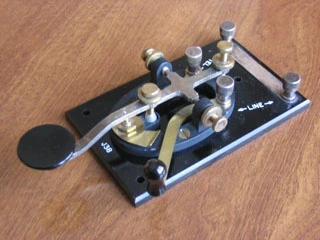
Cooke and Wheatstone telegraph
First commercial electrical telegraph, using needles to indicate letters.
The Cooke and Wheatstone telegraph was an early electrical telegraph system dating from the 1830s, invented by English inventor William Fothergill Cooke and English scientist Charles Wheatstone. It was a form of needle telegraph and the first telegraph system to be put into commercial service. The receiver consisted of a number of needles that could be moved by electromagnetic coils to point to letters on a board, a feature liked by early users who were unwilling to learn codes and employers who did not want to invest in staff training.
Quick Facts
- Inventors
- William Fothergill Cooke and Charles Wheatstone
- First commercial installation
- 1838 on the Great Western Railway, Paddington to West Drayton
- Initial system
- Five-needle, six-wire
- Later successful system
- One-needle system
- Last service
- Some one-needle sets remained in service into the 1930s
- Notable use
- Apprehension of murderer John Tawell in 1845
Facts from the source article.
Lore & Background
The telegraph arose from a collaboration between Cooke and Wheatstone, though their objectives differed. Cooke was an inventor and entrepreneur who wished to patent and commercially exploit his inventions, while Wheatstone was an academic with no interest in commercial ventures. This difference led to a bitter dispute over priority, eventually taken to arbitration with Marc Isambard Brunel acting for Cooke and John Frederic Daniell acting for Wheatstone. Cooke eventually bought out Wheatstone's interest in exchange for royalties.
In January 1837, Cooke proposed a 60-code mechanical telegraph to the Liverpool and Manchester Railway, but the railway requested a simpler version. After that project was rejected in favor of a pneumatic telegraph, Cooke partnered with Wheatstone. In May 1837 they patented a system using needles on a board. A four-needle system was installed between Euston and Camden Town in 1837 but was also rejected for a pneumatic system. Their first commercial success came in 1838 on the Great Western Railway with a five-needle, six-wire system.
When the cables began to fail due to deteriorating insulation, a two-needle system was used with three remaining working wires. Since the new code had to be learned, this was the first time skilled telegraph operators were required. When the line was extended to Slough in 1843, a one-needle, two-wire system was installed. Cooke changed from buried lead pipes to suspending uninsulated wires on poles with ceramic insulators, a system he patented that became the most common method.
Reader's Guide
The Cooke and Wheatstone telegraph played a significant role in the early adoption of electric telegraphy. Its use in the apprehension of murderer John Tawell in 1845 generated great publicity and led to increased public acceptance and use of the telegraph. The system was largely confined to the United Kingdom and the British Empire, though it was also used in Spain for a time. The one-needle telegraph proved highly successful on British railways, with 15,000 sets still in use at the end of the nineteenth century and some remaining in service into the 1930s. The Electric Telegraph Company, formed in September 1845 by financier John Lewis Ricardo and Cooke, bought out the Cooke and Wheatstone patents and established the telegraph business. In 1869 the company was nationalised and became part of the General Post Office, which slowly replaced the Cooke and Wheatstone telegraph with the Morse telegraph system.
Did You Know?
- Murder suspect John Tawell was apprehended in 1845 after a needle telegraph message from Slough to Paddington alerted authorities.
- The one-needle version of the telegraph continued in service into the 1930s.
- The system was initially popular because users could read letters directly from the needle board without learning a code.
Frequently Asked Questions
What is the Cooke and Wheatstone telegraph?
It is an early 1830s electrical telegraph system devised by English inventor William Fothergill Cooke and scientist Charles Wheatstone. It is recognized as the first telegraph system ever placed into commercial operation.
How does the Cooke and Wheatstone telegraph actually work?
Electromagnetic coils at the receiving station swing one or more mechanical needles so they point at letters printed on a board. Because the message appeared as plain letters rather than a coded signal, operators and employers who resisted learning a new code found it far easier to adopt.
Where and when was the Cooke and Wheatstone telegraph first used commercially?
The inaugural commercial line was strung along the Great Western Railway between Paddington and West Drayton in 1838. The original installation employed a five-needle, six-wire arrangement before the design was pared down to a simpler single-needle layout.
What is a famous real-world case involving the Cooke and Wheatstone telegraph?
In 1845 the system was used to relay information that led to the capture of murderer John Tawell, showing its practical value beyond railway signaling. Some one-needle Cooke and Wheatstone sets remained in active service into the 1930s, giving the technology a surprisingly long operational lifespan.
More in Telegraph Keys and Codes 1-24
Spotted an error? Know more?
Reader corrections go straight into our review queue. Suggest an edit · How this site is sourced