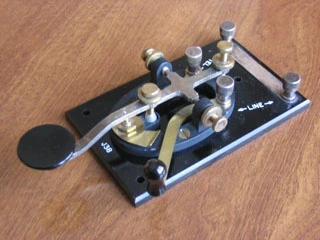
Earth-return telegraph
Earth return halves wire cost by using ground as conductor.
Earth-return telegraph works by using the ground as one half of the electrical circuit. Instead of running two separate metal wires between telegraph stations, one wire is replaced by a connection to the earth via a buried electrode. This cuts the amount of wire needed in half, which also slashes the labor costs for stringing it up. Early telegraph inventors didn't immediately realize this advantage, but the method became standard after Carl August von Steinheil put the first working earth-return telegraph into service in 1838.
By the late 1800s, earth-return systems started running into trouble because of electric trams. The trams caused serious interference, forcing some circuits to switch back to using a full metal return path. Around the same time, telephony—which was even more sensitive to the noise on earth-return lines—began to replace electrical telegraphy altogether, eventually ending the use of earth-return in telecommunications.
A telegraph line needs two conductors to make a complete circuit. Normally that means two separate metal wires, but in an earth-return setup, one of those conductors is replaced by connections to the ground at each end. These connections are made with large metal plates buried deep in the soil, often made of copper or galvanised iron. Other methods included hooking into metal gas or water pipes, or laying a long wire rope on damp ground—though that last method was unreliable and was common in India only until 1868.
Soil has much higher electrical resistance than copper wire, but the Earth is so massive that it acts like a conductor with an enormous cross-sectional area and high overall conductance. The key is ensuring good contact with the ground at both stations. The earth plates must be buried deep enough to stay in moist soil; in dry areas, operators sometimes had to pour water on the plates to maintain the connection. The plates also need to be large enough to carry the required current. To match the conductance of the metal wire it replaces, the plate's surface area must be larger than the wire's cross-section by the same factor that the ground's resistivity exceeds the wire metal's resistivity.
The big advantage of earth return is saving metal wire on long lines that could stretch hundreds or thousands of miles.
- First put into service
- 1838
- Inventor of first service
- Carl August von Steinheil
- Distance of steinheil's line
- five miles
- Early experimenter establishing viabilit
- William Watson (1747)
- First water-return path demonstration
- John Henry Winkler (28 July 1746)
- First low-voltage battery earth-return t
- Basse of Hameln (1803)
- Early earth-return telegraph demonstrati
- Harrison Gray Dyar (1828)
Lore & Background
The first use of an earth return to complete an electric circuit was by William Watson in 1747, excluding experiments using a water return path. Watson sent an electric current through 2,800 feet of iron wire with an earth-return path, later increasing that distance to two miles. These early experiments were not aimed at producing a telegraph but rather designed to determine the speed of electricity. Watson's result seems to have been unknown or forgotten by early telegraph experimenters who used a return conductor. One early exception was a telegraph invented by Harrison Gray Dyar in 1826 using friction machines, demonstrated around a race course on Long Island, New York, in 1828 using an earth-return circuit.
The first telegraph put into service with an earth return is due to Carl August von Steinheil in 1838. Steinheil was working on providing a telegraph along the Nuremberg–Fürth railway line. He first attempted, at the suggestion of Carl Friedrich Gauss, to use the two rails of the track as telegraph conductors. This failed because the rails were not well insulated from earth, but this initial failure made Steinheil realise that the earth could be used as a conductor, and he then succeeded with only one wire and an earth return. Steinheil declined to patent the idea, wishing to make it freely available as a public service.
The introduction of electric power, especially electric tram lines in the 1880s, seriously disturbed earth-return telegraph lines. The starting and stopping of the trams generated large electromagnetic spikes which overwhelmed code pulses on telegraph lines. This was particularly a problem on lines where high-speed automatic working was in use and, most especially, on submarine telegraph cables. At the same time, the rise of telephony, which was even more intolerant to the interference on earth-return systems, started to displace electrical telegraphy altogether, bringing to an end the earth-return technique in telecommunications.
Reader's Guide
Earth-return telegraph significantly reduced the cost of long-distance telegraphy by eliminating one of the two metal wires normally required for a complete circuit. This saving was substantial on lines that might run for hundreds or even thousands of miles. The advantage was not so apparent in early multiwire systems such as Pavel Schilling's experimental system of 1832 with six signal wires, or the Cooke and Wheatstone five-needle telegraph of 1837, which did not require a return conductor at all. However, the expense of multiwire systems rapidly led to single-signal-wire systems becoming the norm, making the cost of the return wire much more significant and leading to earth return becoming standard.
The earth-return technique faced serious problems towards the end of the 19th century due to electric trams, which generated interference that overwhelmed code pulses. Some circuits were returned to the old metal-conductor return system. The rise of telephony, even more intolerant to the interference on earth-return systems, eventually displaced electrical telegraphy altogether. The technique thus had a period of dominance in the mid-to-late 19th century but was ultimately superseded by other technologies. Its legacy lies in demonstrating that the earth itself could serve as a practical conductor, a principle that influenced later developments in electrical engineering.
Did You Know?
- The first earth-return telegraph put into service was by Carl August von Steinheil in 1838 on the Nuremberg–Fürth railway line.
- William Watson demonstrated earth return in 1747 by sending an electric current through 2,800 feet of iron wire.
- Steinheil declined to patent the earth-return idea, making it freely available as a public service.
- Electric trams in the 1880s seriously disturbed earth-return telegraph lines with electromagnetic spikes.
Pioneering Experiments and the Search for Electrical Communication
The dream of sending messages through electricity at a distance stretches back further than most realize. In 1753, an anonymous contributor to the Scots Magazine—signed C.M. and posted from Renfrew, possibly Charles Marshall—proposed an electrostatic telegraph that would use one wire per letter, with pith balls at the far end registering deflections. Georges-Louis Le Sage built a working model in 1774, though it spanned only two rooms of his home and required a separate wire for each of the 26 alphabet letters. A crucial turning point came in 1800 when Alessandro Volta introduced his voltaic pile, offering a continuous low-voltage current that far surpassed the brief discharges of electrostatic machines and Leyden jars. In 1809, German physician Samuel Thomas von Sömmering created an electrochemical telegraph based on an 1804 design by Spanish polymath Francisco Salva Campillo. Their apparatus employed up to 35 wires, each dipped in a glass tube of acid; sequential currents electrolysed the acid, releasing hydrogen bubbles beside the corresponding letter for the operator to read. These early efforts, while impractical, laid the groundwork for everything that followed.
Two Rival Families of Telegraph Machines
Once electrical telegraphy moved from laboratory curiosity to practical use, two fundamentally different approaches dominated the field. The first family, known as needle telegraphs, relied on electromagnetic force: a current traveling down a wire would swing a needle-shaped pointer over a printed list, effectively pointing to a specific letter or symbol. Early models in this category required multiple needles and therefore multiple wires between stations. The Cooke and Wheatstone telegraph, invented in 1837, became the first commercial needle system and the most widely deployed of its kind. The second family, the armature systems, took a different tack. Here the current activated a telegraph sounder that produced an audible click, and operators communicated by sending those clicks in coded rhythmic patterns. Samuel Morse's system, devised in 1838, became the archetype of this approach. By 1865, the Morse system had been adopted as the international standard for telegraphic communication, employing a modified version of Morse's original code that had been refined for use on German railways.
Railway Signalling and the Democratization of Messaging
The telegraph's earliest and most consequential industrial application came from the railway world. Emerging railway companies adopted electrical telegraphy to provide signals for train control systems, minimizing the chances of trains colliding with one another. This was organized around the signalling block system, in which signal boxes positioned along a line communicated with neighboring boxes using telegraphic single-stroke bells and three-position needle telegraph instruments. Beyond the rails, the technology transformed public communication. In the 1840s, electrical telegraphy supplanted older optical systems such as semaphores and became the standard method for dispatching urgent messages. By the latter half of the nineteenth century, most developed nations had built out commercial telegraph networks, with local telegraph offices in most cities and towns. For a fee, any member of the public could compose a telegram addressed to virtually any person in the country, making near-instant written communication accessible far beyond governments and businesses.
Global Cables, Wireless Successors, and a Slow Fade
The telegraph's reach expanded from national networks to a truly global scale beginning in 1850, when submarine cables first enabled rapid communication between people on different continents. This near-instant transmission of messages across and between continents carried widespread social and economic impacts that reshaped how the world operated. The technology also served as a direct precursor to the next great leap in communication: Guglielmo Marconi's invention of wireless telegraphy, the first means of radiowave telecommunication, which he began developing in 1894. Yet the wired telegraph's dominance was already eroding. In the early twentieth century, manual operation of telegraph machines gave way to teleprinter networks, and the growing use of the telephone confined telegraphy to a handful of specialist applications. For the general public, sending a telegram dwindled to a novelty reserved for special occasions such as greetings. Finally, the rise of the Internet and email during the 1990s rendered dedicated telegraphy networks largely obsolete, closing a chapter that had spanned more than a century of human communication.
Frequently Asked Questions
What is Earth-return telegraph?
Earth-return telegraph is a signaling method that uses the ground itself as one conductor in the circuit, so only a single overhead wire is needed between stations instead of the usual pair. A buried electrode at each end completes the path through the soil.
Who put the first working Earth-return telegraph into service?
Carl August von Steinheil is credited with operating the first practical earth-return line in 1838, a five-mile route that proved the concept could carry real traffic. Earlier figures like William Watson and Basse of Hameln had demonstrated the underlying principles decades before.
How does Earth-return telegraph actually work?
Instead of running two parallel wires, the system sends current down one wire and lets it return to the source by traveling through the earth via a buried metal electrode. The ground effectively substitutes for the second conductor, closing the circuit.
Why is Earth-return telegraph considered important in telegraph history?
It halved the amount of metal wire required for a given link, which dramatically cut both material costs and the labor of stringing lines. That economic advantage is why the method quickly became the standard approach once its reliability was established.
When was the Earth-return principle first demonstrated?
John Henry Winkler showed a water-return path as early as 28 July 1746, and William Watson confirmed the idea's viability in 1747. Basse of Hameln then built the first low-voltage battery earth-return setup in 1803, laying the groundwork for Steinheil's 1838 service line.
More in Telegraph Keys and Codes 1-24
Spotted an error? Know more?
Reader corrections go straight into our review queue. Suggest an edit · How this site is sourced