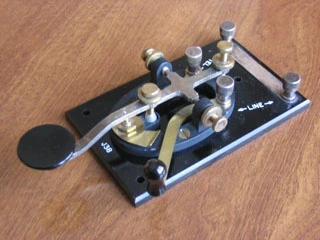
Needle telegraph
An electromagnetic telegraph using needles to indicate messages.
A needle telegraph is an electrical telegraph that displays messages through electromagnetically moved indicating needles. It is one of the two primary types of electromagnetic telegraph, alongside the armature system used in Samuel Morse's telegraph in the United States. Throughout the nineteenth century, needle telegraphs saw widespread use across Europe and the British Empire.
The concept emerged shortly after Hans Christian Ørsted's 1820 discovery that electric currents could deflect compass needles. Pavel Schilling developed a telegraph with needles suspended by threads, intended for Russian government use, but his death in 1837 prevented its implementation. In 1833, Carl Friedrich Gauss and Wilhelm Eduard Weber built a telegraph line in Göttingen for scientific study and communication between university sites. Carl August von Steinheil adapted their cumbersome apparatus for German railways in 1837.
In England, William Fothergill Cooke began building telegraphs based on Schilling's design. Together with Charles Wheatstone, Cooke created a much improved version, which was adopted by several railway companies. Cooke's Electric Telegraph Company, founded in 1846, offered the first public telegraph service. The needle telegraphs of the Electric Telegraph Company and its rivals became the standard form of telegraphy in the United Kingdom for most of the nineteenth century. They remained in use even after the Morse telegraph became the official British standard in 1870, with some still operating well into the twentieth century.
The history began with Ørsted's landmark publication on 21 April 1820, showing that an electric current deflected a compass needle. Almost immediately, other scholars recognized the potential for an electric telegraph. French mathematician Pierre-Simon Laplace was the first to suggest it. On 2 October, André-Marie Ampère, acting on Laplace's suggestion, presented a paper to the Paris Academy of Sciences. Ampère's theoretical telegraph used a pair of wires for each alphabet letter, controlled by a keyboard connecting pairs to a battery. At the receiving end, small magnets (needles) were placed under the wires. However, the effect on the magnet would have been very weak because Ampère did not coil the wire around the needle to multiply the magnetic effect.
- First suggested
- 1820
- First practical electromagnetic telegrap
- 1832 (Schilling)
- First commercial telegraph
- Cooke and Wheatstone telegraph
- Key inventors
- Pavel Schilling, Carl Friedrich Gauss, Wilhelm Eduard Weber, Carl August von Steinheil, William Fothergill Cooke, Charles Wheatstone
- Primary region of use
- Europe and the British Empire
- Continued use into
- twentieth century
Lore & Background
The history of the needle telegraph began with Hans Christian Ørsted's 1820 discovery that an electric current could deflect a compass needle. Shortly after, Pierre-Simon Laplace suggested using this for a telegraph, and André-Marie Ampère proposed a system with a pair of wires for each letter. Johann Schweigger's invention of the galvanometer multiplier was crucial, though Ampère initially did not use it. Peter Barlow investigated Ampère's idea but concluded in 1824 that the effect diminished with only 200 feet of wire, a view that some later writers criticized for retarding telegraph development.
Pavel Schilling in Russia constructed the first needle telegraph intended for practical use in 1832, using Schweigger multipliers. His system used eight wires and a bank of six needle instruments displaying a binary code. Schilling devised a serial code for a single-needle version but found dignitaries preferred the six-needle display. Transmission speed was very slow, possibly as low as four characters per minute, due to severe overdamping with a platinum paddle in mercury. In 1833, Carl Friedrich Gauss and Wilhelm Eduard Weber set up an experimental line in Göttingen using a large bar magnet as the needle, initially to verify Ohm's law. They developed a telegraph code and used the line daily until 1838. Carl August von Steinheil adapted their apparatus for railway use, producing a compact needle instrument that struck bells of different tones to indicate needle deflection. He also discovered the earth-return principle while attempting to use rails as conductors.
In England, William Fothergill Cooke began building telegraphs based on Schilling's design. With Charles Wheatstone, he produced a much improved design that was taken up by several railway companies. Cooke's Electric Telegraph Company, formed in 1846, provided the first public telegraph service. The needle telegraphs of the Electric Telegraph Company and their rivals became the standard form of telegraphy in the United Kingdom for most of the nineteenth century, continuing in use even after the Morse telegraph became the official standard in 1870, with some still in use well into the twentieth century.
Reader's Guide
The needle telegraph was the dominant form of electromagnetic telegraphy in Europe and the British Empire for much of the nineteenth century. Its development followed directly from Ørsted's discovery and the work of Ampère, Schilling, Gauss, Weber, and Steinheil. The Cooke and Wheatstone telegraph became the first commercial telegraph system, providing public telegraph service from 1846. Needle telegraphs were widely adopted by railway companies and remained in use even after the Morse system became the official UK standard in 1870, with some examples persisting into the twentieth century. The system's reliance on visible needle deflections made it intuitive for operators, though early versions were slow and required careful setup. The earth-return principle discovered by Steinheil during his railway installations became a fundamental technique in telegraphy. The needle telegraph's legacy lies in establishing the first practical and commercial electrical telegraph networks, particularly in Britain and its empire, before being gradually superseded by the Morse system.
Did You Know?
- The first needle telegraph intended for practical use was built by Pavel Schilling in 1832.
- Gauss and Weber's 1833 telegraph line was initially used to verify Ohm's law, not for messaging.
- Steinheil's needle instrument struck one of two bells with different tones so operators could hear needle direction without watching.
- The Cooke and Wheatstone telegraph was the first telegraph of any kind used commercially.
The Architecture of Telegraph Codes
A telegraph code is fundamentally a structured mapping between abstract characters and physical signal patterns. Every code is assembled from code points—unique arrangements of discrete elements that set one symbol apart from another. Most systems employ a binary pair of element types, though some historical codes, such as American Morse, used as many as five distinct elements. When the intended reader was a human operator, a guiding principle shaped the design: the most frequently encountered characters received the shortest sequences. In International Morse, the letter E, dominant in English, is a single element, while a rarer letter like Q stretches across a long string. This cut transmission time and eased operator fatigue. Once the audience became mechanical, the philosophy reversed. Late-nineteenth-century machines found variable-length sequences difficult to process, so engineers adopted fixed-length code points. The Baudot code, a five-bit scheme, was the pioneer, though its small space limited output to uppercase. ASCII later expanded to seven bits for both cases, and modern Unicode reaches twenty-one bits to encompass the world's writing systems.
France's Optical Telegraph and the Chappe System
Before electrical wires carried messages, France built the most ambitious telegraph network of its era, rooted in the upheaval of the Revolution. Claude Chappe's system relied on a chain of towers, each equipped with a large pivoted beam called the regulator and two indicator arms at its ends. The angles these components could assume were restricted to multiples of forty-five degrees to keep signals legible from a distance. This constraint produced a theoretical code space of 196 positions, but practical limitations—such as the inability to distinguish an indicator aligned with the regulator from one folded back over it—reduced the usable set. The regulator was always set on a diagonal for valid symbols, with the left diagonal reserved for messages and the right for system control, further narrowing the space to 98, of which a handful served as control characters. The system launched experimentally in 1793 and entered service on the Paris-to-Lille route in 1794. Rather than spelling individual letters, operators transmitted pre-agreed phrases from a code book, so that just two symbols—a page number and a line number—could convey an entire sentence.
Sweden's Edelcrantz Shutter Network
Sweden developed the second-largest optical telegraph network in Europe, built around the Edelcrantz system. Where France's Chappe towers used pivoting arms, the Swedish design employed a set of ten shutters that could be opened or closed. Nine of these shutters were arranged in a three-by-three matrix, and each vertical column functioned as a binary-coded octal digit, with a closed shutter representing a one and the most significant digit positioned at the bottom. This meant every transmitted symbol was effectively a three-digit octal number. The tenth shutter, noticeably larger than the others and placed at the top, served as a modifier: when it was open, it signalled that the code point should be read with an "A" prefix. One practical application of this prefix was arithmetic—placing the "A" shutter before a numeral code point instructed the receiver to append a zero, effectively multiplying the value by ten. The British Admiralty also operated a semaphore network, but its shutter-based mechanism was fundamentally different from the French arm-and-beam approach, necessitating an entirely separate code.
The Long Arc from Semaphore to Unicode
The story of telegraph codes traces a continuous arc from human-readable optical signals to the vast character encodings that power modern computing. For most of the telegraph era, messages were composed and interpreted by people, and codes were shaped around human cognitive strengths—familiar patterns, short sequences for common characters, and code books that let a pair of symbols stand in for an entire sentence. That changed as automation entered the picture in the late nineteenth century. Variable-length sequences, so efficient for a skilled operator, proved awkward for the mechanical printers of the time. The Baudot code answered this need with a uniform five-bit structure, though its modest capacity meant only uppercase letters could be printed. As requirements grew, ASCII added two more bits to reach seven, unlocking lowercase output. Today, the descendant of this lineage is Unicode, a twenty-one-bit encoding capable of representing the scripts of virtually every language on Earth without any need to swap character sets. And while the telegraph age demanded fixed lengths for mechanical simplicity, modern processors handle variable-length schemes like UTF-8 and UTF-16 with ease, making them the standard across the digital world.
Frequently Asked Questions
What is a needle telegraph?
A needle telegraph is an electromagnetic telegraph system that conveys messages by deflecting small indicating needles via electromagnets. It stands as one of the two main categories of electromagnetic telegraph, the other being the armature-based design popularized by Samuel Morse.
Who invented the needle telegraph?
Pavel Schilling built the first practical needle telegraph in 1832, using needles suspended by threads for his Russian installation. Other key contributors to the design's development include Carl Friedrich Gauss, Wilhelm Eduard Weber, Carl August von Steinheil, and the British pair William Fothergill Cooke and Charles Wheatstone.
How does a needle telegraph work?
Electrical signals from the sending station energize electromagnets at the receiver, causing suspended needles to swing and point at specific letters or symbols on a dial. The operator reads the message by observing which needle has been deflected to its corresponding character.
Where was the needle telegraph most widely used?
The needle telegraph saw broad adoption across continental Europe and throughout the British Empire during the nineteenth century. Its use persisted well into the twentieth century in certain regions before being gradually replaced by later telegraph technologies.
How is a needle telegraph different from Morse's armature telegraph?
While Morse's system in the United States relied on an armature mechanism producing audible clicks and a paper-tape record, the needle telegraph used visible electromagnetically driven pointers to display characters. This made the needle design especially well suited to the multi-letter alphabets common in European languages.
More in Telegraph Keys and Codes 1-24
Spotted an error? Know more?
Reader corrections go straight into our review queue. Suggest an edit · How this site is sourced