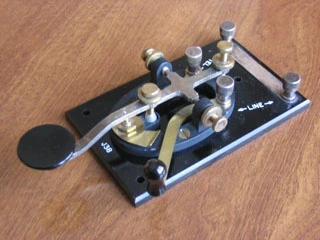
Telegraph sounder
An electromechanical receiver that made Morse code audible via clicks.
The telegraph sounder was an electromechanical receiver used on 19th-century electrical telegraph lines. Alfred Vail invented it after 1850 to replace the bulky Morse register, and it became the first practical device to use an electromagnet. Incoming telegraph messages produced audible clicks—short and long sounds corresponding to the "dots" and "dashes" of Morse code—which operators translated into text. The terms "dot" and "dash" originated from earlier equipment where an electromagnet moved a pencil to mark those symbols on a moving paper strip; that system was abandoned because its mechanism was overly complex and prone to failure compared to listening.
Telegraph networks, operating from the 1850s into the 1970s, transmitted text over long distances using current pulses of two lengths—dots and dashes—that spelled out messages in Morse code. At the sending end, an operator tapped a telegraph key to rapidly connect and break a battery circuit, sending pulses down the line. At the receiving end, the sounder made these pulses audible. Its simple mechanism resembled a relay: an electromagnet connected to the line, with an iron armature balanced on a pivot and held up by a counterweight. When current flowed through the electromagnet, its magnetic field pulled the armature down, producing a "click." When the current stopped, the counterweight returned the armature to its resting position, making a "clack." Thus, the sounder echoed the key's up-and-down state. It was essential that the sounder produced a sound both when the circuit was broken and when it was restored, so the operator could clearly distinguish the long and short keypresses—the dashes and dots—that formed Morse code characters.
- Inventor
- Alfred Vail
- Period of use
- 1850s to 1970s
- Predecessor
- Morse register
- Mechanism
- electromagnet with iron armature and counterweight
Lore & Background
The telegraph sounder was developed after 1850 as a simpler alternative to the Morse register, which used electromagnets to move a pencil that marked dots and dashes on moving paper. That mechanism was abandoned because it was more complicated and failure prone than listening to the sounds. The sounder's mechanism was similar to a relay: it consisted of an electromagnet attached to the telegraph line, with an iron armature near the magnet's pole balanced on a pivot, held up by a counterweight. When current flowed through the electromagnet's winding, it created a magnetic field that attracted the armature, pulling it down to the electromagnet and producing a 'click' sound. When the current ended, the counterweight pulled the armature back up to its resting position, resulting in a 'clack' sound. Thus, as the telegraph key at the sending end made and broke the contact, the sounder echoed the up and down state of the key. It was important that a sounder make a sound both when the circuit was broken and when it was restored, so the operator could clearly distinguish the long and short keypresses – the 'dashes' and 'dots' – that make up the characters in Morse code.
Reader's Guide
The telegraph sounder was the first practical application of the electromagnet and served as the standard receiving device on telegraph networks from the 1850s to the 1970s. Its simple, reliable design allowed operators to translate the audible clicking sounds into text characters representing the telegraph message. The terms 'dot' and 'dash' originated from the earlier Morse register, which actually marked those shapes on paper, but the sounder's auditory method proved more practical and durable. By echoing the state of the sending key, the sounder enabled real-time communication over long distances, forming the backbone of telegraphy for over a century. Its legacy lies in demonstrating how electromagnetism could be harnessed for practical communication, paving the way for later relay-based technologies.
Did You Know?
- The telegraph sounder was invented by Alfred Vail after 1850.
- It replaced the cumbersome Morse register, which used a pencil to mark dots and dashes on paper.
- The sounder produced a 'click' when the armature was attracted to the electromagnet and a 'clack' when the counterweight returned it.
- The terms 'dot' and 'dash' originated from the marks made by the earlier Morse register.
More in Telegraph Keys and Codes 1-24
Spotted an error? Know more?
Reader corrections go straight into our review queue. Suggest an edit · How this site is sourced