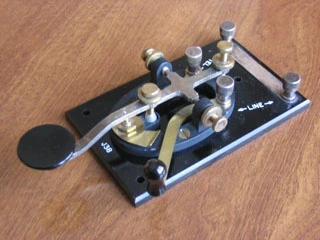
Telegram
A written message transmitted by telegraph, popular from the 19th to mid-20th century.
A telegram is a written or printed message that was originally transmitted via telegraphy. It became a widely used form of communication for both personal and business correspondence during the late 1800s and early to mid-1900s. Even after the telephone became common, the telegram stayed in use and developed its own concise writing style, which later influenced other forms of communication. Telegram services remain available today, but their use has greatly decreased as other text-based methods have taken over.
The term "telegram" comes from the ancient Greek word *gramma*, meaning something written, so a telegram is literally "something written at a distance." A "cablegram" refers to a message sent via a submarine telegraph cable, often shortened to "cable" or "wire." The word "telegraph" describes the process of writing at a distance.
A telegram service is a company or public entity that delivers telegrams directly to the recipient. These services began after electric telegraphy became available. Historically, telegrams traveled between a network of interconnected telegraph offices. A person would visit a local office, pay by the word, and have the message telegraphed to another office, where it was delivered to the addressee on a paper form. Telegrams were faster than mail, and the electric telegraph freed communication from postal time constraints, transforming society and the global economy.
The decline of telegrams started with the rise of the telephone, though it was briefly slowed by the popularity of congratulatory telegrams for special occasions. Traffic actually continued to grow between 1867 and 1893, despite the telephone's introduction. At their peak in 1929, an estimated 200 million telegrams were sent. In 1919, the Central Bureau for Registered Addresses was established in New York City's financial district to reduce misdeliveries. Customers could register unique code names for their telegraph addresses for $2.50 per year per code; by 1934, 28,000 codes were registered.
Telegram services still operate in many parts of the world, but email and text messaging have made them obsolete in numerous countries, with annual telegram numbers dropping sharply since the 1980s. Where they still exist, transmission between offices now uses telex or IP links instead of telegraphy.
- Peak annual volume
- 200 million telegrams (1929)
- Average length (us, 1900s)
- 11.93 words
- Average length (uk, before 1950)
- 14.6 words or 78.8 characters
- Average length (german, end of 19th cent
- 14.2 words
- Average length (german, general)
- 11.5 words or 72.4 characters
- Registered telegraph address codes (1934
- 28,000
Lore & Background
Initially, telegrams were sent by an electrical telegraph operator using Morse code or by a printing telegraph operator using plain text. A cablegram was a message sent by a submarine telegraph cable, often shortened to 'cable' or 'wire'. The suffix -gram derives from ancient Greek, meaning something written; telegram means something written at a distance, while telegraph implies the process of writing at a distance. Telegram services were inaugurated after electric telegraphy became available. Historically, telegrams were sent between a network of interconnected telegraph offices. A person visiting a local telegraph office paid by the word to have a message telegraphed to another office and delivered to the addressee on a paper form. Messages sent by telegraph could be delivered by telegraph messenger faster than mail. The electric telegraph freed communication from the time constraints of postal mail and revolutionized society and the global economy. A decline that began with the growth of the telephone was briefly postponed by the rise of special occasion congratulatory telegrams. Traffic continued to grow between 1867 and 1893 despite the introduction of the telephone in this period. At their peak in 1929, an estimated 200 million telegrams were sent. In 1919, the Central Bureau for Registered Addresses was established in the financial district of New York City to ease the growing problem of messages being delivered to wrong recipients. The bureau offered customers the option to register unique code names for their telegraph addresses, charging $2.50 per year per code. By 1934, 28,000 codes had been registered. Telegram services still operate in much of the world, though e-mail and text messaging have rendered telegrams obsolete in many countries, and the number sent annually has declined rapidly since the 1980s. Where telegram services still exist, the transmission method between offices is no longer by telegraph but by telex or IP link.
Reader's Guide
Telegrams were notable for their distinctive 'telegram style', a concise form of writing driven by per-word pricing. The average length of a telegram in the 1900s in the US was 11.93 words, with more than half of messages being 10 words or fewer. In the UK before 1950, the mean length was 14.6 words or 78.8 characters; for German telegrams, the mean length was 11.5 words or 72.4 characters. At the end of the 19th century, the average length of a German telegram was calculated as 14.2 words. The electric telegraph freed communication from the time constraints of postal mail and revolutionized society and the global economy. Even after the telephone became common, telegram traffic continued to grow between 1867 and 1893, and a decline was briefly postponed by special occasion congratulatory telegrams. The legacy of the telegram persists in the term 'diplomatic telegram', which continues to be used for confidential communications between diplomatic missions and their foreign ministries, regardless of the transmission method. The telegram's influence on concise writing also carried into other media.
More in Telegraph Keys and Codes 1-24
Spotted an error? Know more?
Reader corrections go straight into our review queue. Suggest an edit · How this site is sourced