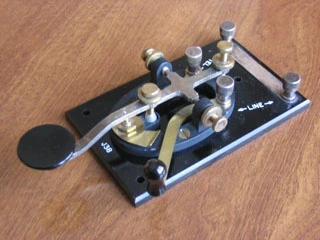
Phillips Code
A telegraphic shorthand standardizing abbreviations for rapid press transmission.
The Phillips Code is a shorthand system for telegraphy, compiled and expanded in 1879 by Walter P. Phillips, who worked for the Associated Press at the time. Its purpose was to speed up the transmission of messages, particularly press reports, by standardizing abbreviations already in common use among telegraph operators. Phillips described his work as largely codifying the collective experience of generations of operators. The code’s final official edition was published in 1925.
The system contains hundreds of abbreviations and initialisms for words frequently used by news writers and copy editors. Very common terms are reduced to a single letter (for example, “C” for “See” and “Y” for “Year”), while less common words receive longer abbreviations (such as “Ab” for “About,” “Abb” for “Abbreviate,” “Abty” for “Ability,” and “Acmpd” for “Accompanied”). The code also includes specialized subcodes: a Market Code for commodities and stocks, a Baseball Supplement, and single-letter codes for Option Months.
Later, the Evans Basic English Code expanded the Phillips Code’s 1,760 abbreviations to 3,848.
As an example of use, the ten-word telegraphic transmission “ABBG LG WORDS CAN SAVE XB AMTS MON AVOG FAPIB” expands to “Abbreviating long words can save exorbitant amounts of money, avoiding filing a petition in bankruptcy.” Another example, from a 1910 newspaper article, is the line “T tri o HKT ft mu o SW on Ms roof garden, nw in pg, etc.,” which translates to “The trial of Harry K. Thaw for the murder of Stanford White on Madison Square Roof Garden, now in progress, etc.”
Notably, the abbreviations POTUS and SCOTUS originated in telegraph code and are part of the Phillips Code. SCOTUS appeared in the very first 1879 edition, while POTUS was in use by 1895 and officially added in the 1923 edition. These terms entered common language through news services like the Associated Press.
Telegraph operators often mixed Phillips Code with numeric wire signals from the American Civil War era, such as the 92 Code, which railroad telegraphers used for logistics. These codes could indicate an article’s priority or confirm transmission and receipt. Occasionally, this metadata appeared in print when typesetters included the codes in newspapers—most famously, the code for “No more—the end,” abbreviated as “- 30 -” on a typewriter.
- Compiler
- Walter P. Phillips
- Year compiled
- 1879
- Affiliation
- Associated Press
- Final edition year
- 1925
- Subcodes
- Market Code, Baseball Supplement, single-letter codes for Option Months
- Notable terms
- POTUS, SCOTUS
Lore & Background
The Phillips Code was compiled in 1879 by Walter P. Phillips, who explained that he was in large part putting down the collective experience of generations of telegraph operators. In the introduction to the 1907 edition of his book, Phillips wrote that research suggests commercial telegraphs and railroads had numerical codes containing at least 100 groupings, but few survived beyond the turn of the century. He stated that the compilation represented the consensus of many whose duties brought them into close contact with the subject.
The code consists of a dictionary of common words or phrases and their associated abbreviations. Extremely common terms are represented by a single letter (C: See; Y: Year); those less frequently used gain successively longer abbreviations (Ab: About; Abb: Abbreviate; Abty: Ability; Acmpd: Accompanied). Later, The Evans Basic English Code expanded the 1,760 abbreviations in the Phillips Code to 3,848 abbreviations.
Telegraph operators would often interleave Phillips Code with numeric wire signals developed during the American Civil War era, such as the 92 Code. These codes were used by railroad telegraphers to indicate logistics instructions and proved useful when describing an article's priority or confirming its transmission and receipt. This meta-data would occasionally appear in print when typesetters included the codes in newspapers, especially the code for 'No more—the end', abbreviated as '- 30 -' on a typewriter.
Reader's Guide
The Phillips Code's significance lies in its role as a standardized shorthand for telegraphic press transmission, enabling faster and more efficient communication of news reports. Its abbreviations, such as POTUS and SCOTUS, originated in telegraph code and entered common parlance when news gathering services, particularly the Associated Press, adopted the terminology. The code's structure—single letters for common terms, longer abbreviations for less frequent ones—allowed operators to compress lengthy messages into concise strings. For example, the ten-word transmission 'ABBG LG WORDS CAN SAVE XB AMTS MON AVOG FAPIB' expanded to 'Abbreviating long words can save exorbitant amounts of money, avoiding filing a petition in bankruptcy.' The code's legacy includes its influence on later brevity codes and its lasting imprint on journalistic and legal shorthand. The final official edition was published in 1925.
Did You Know?
- The terms POTUS and SCOTUS originated in telegraph code and are included in the Phillips Code; SCOTUS appeared in the very first edition of 1879.
- The code included subcodes for commodities and stocks called the Market Code, a Baseball Supplement, and single-letter codes for Option Months.
- The code for 'No more—the end' was abbreviated as '- 30 -' on a typewriter.
More in Telegraph Keys and Codes 1-24
Spotted an error? Know more?
Reader corrections go straight into our review queue. Suggest an edit · How this site is sourced