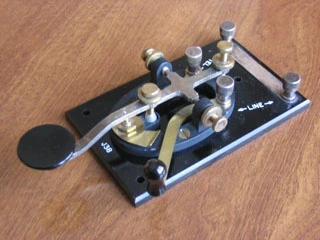
Kleinschmidt keyboard perforator
Keyboard perforator that prepared punched tape for telegraph transmission.
The Kleinschmidt keyboard perforator is a telegraph instrument invented by Edward Kleinschmidt that prepares punched tape for telegraph transmission. It uses a QWERTY keyboard to operate hole punches that prepare a Wheatstone slip, with each Morse code letter selected by projecting tongues on the key bar.
- Inventor
- Edward Kleinschmidt
- Year first constructed
- 1911
- First customer
- Western Union Telegraph Company
- Initial order
- 50 units
- Maximum operator speed
- 80 words a minute
- Notable customers
- Western Union Telegraph Company, F. G. Creed, British Post Office, Teletype Corporation
Lore & Background
The Kleinschmidt keyboard perforator was first invented and constructed by Kleinschmidt in 1911. Kleinschmidt wanted to develop a product that could be sold to telegraph companies rather than just selling patents. Western Union Telegraph Company was the first customer, purchasing 50 units, which led to the formation of the Kleinschmidt Electric Company to manufacture the perforator.
The machine operates by punching centre holes for paper feed first, then lower holes, and then upper holes. The upper holes are mark holes indicating when a symbol (dot or dash) starts, while the lower holes tell when to terminate the symbol. A skilled operator could work the keyboard at up to 80 words a minute.
F. G. Creed ordered ten machines for the 'Creed high-speed Continental Morse code system'. The British Post Office ordered 20, and later in 1914 ordered another 100. In London, the machines were sold by Creed & Co, which had a sales contract with the Kleinschmidt Electric Company. Later, the Teletype Corporation also made this machine.
Reader's Guide
The Kleinschmidt keyboard perforator holds significance as a practical telegraph instrument that moved from patent to production, enabling faster and more consistent tape preparation for telegraph transmission. Its adoption by major entities such as Western Union, the British Post Office, and F. G. Creed demonstrates its utility in both commercial and governmental telegraph networks. The machine's design, using a QWERTY keyboard and a systematic punching sequence for centre, lower, and upper holes, allowed operators to achieve speeds up to 80 words per minute. The formation of the Kleinschmidt Electric Company specifically to manufacture this perforator marked a shift from inventor to industrial production. Its legacy includes influencing later teleprinter technology, as the Teletype Corporation later manufactured the same machine. The sales arrangement with Creed & Co in London extended its reach internationally, particularly for the British Post Office's expanding telegraph operations.
Did You Know?
- The Kleinschmidt keyboard perforator was first constructed in 1911.
- The British Post Office ordered 20 units initially, then another 100 in 1914.
- The upper holes on the tape are mark holes indicating when a dot or dash starts.
More in Telegraph Keys and Codes 1-24
Spotted an error? Know more?
Reader corrections go straight into our review queue. Suggest an edit · How this site is sourced