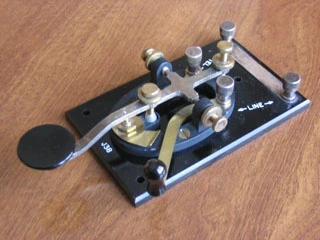
Beardslee Telegraph
A portable military telegraph using a dial and magneto instead of a key.
The Beardslee Telegraph was a portable military telegraph created by George Beardslee and later taken up by Albert J. Myer for use as a mobile field communication system. Instead of the heavy batteries common in civilian telegraphs, it was powered by hand-cranked magnetos and used an alphabet dial with a pointer for sending messages rather than the standard transmission key.
Its main drawbacks included a limited range of roughly ten miles due to weak power, slow transmission speeds, and frequent loss of synchronization between the sending and receiving units. The device was first used on 24 May 1862 during the Peninsular campaign. Its most notable success came at the Battle of Fredericksburg, where it allowed General Burnside to communicate across a river when fog and smoke blocked visual signals.
After that battle, the telegraph’s popularity waned because it competed with faster, more powerful commercial telegraph systems. By November 1863, most of the equipment was abandoned; only the insulated field wire continued to be used by the military.
In operation, the magneto generated electricity to send signals over the wire. The operator moved a lever to a letter on the dial, and the receiving unit’s dial would move to match that position. Transmission was slow: the dial had thirty positions, and sending a double letter required moving through all thirty for the second instance. The advancing mechanism worked like a clock’s escapement, with each step advancing the dial six degrees—twelve degrees per full step, since 360 degrees divided by thirty positions equals twelve degrees. This meant sixty movements were needed for a double letter. As a result, the speed likely never exceeded five words per minute.
- Developer
- George Beardslee
- Adopted by
- Albert J. Myer
- First used
- 24 May 1862 in the Peninsular campaign
- Range
- about ten miles
- Transmission speed
- nothing over 5 words per minute
- Dial positions
- thirty
- Equipment discarded
- November 1863
Lore & Background
The Beardslee Telegraph was first used on 24 May 1862 during the Peninsular campaign. Its first major triumph came during the Battle of Fredericksburg, where it provided General Burnside with communications across the river when fog and smoke had made visual signal communication impossible. The instrument operated using a magneto to generate power, and the operator moved a lever to a point on the dial representing the desired letter; on the receiving end, the dial moved to the corresponding position.
Limitations included a short range of about ten miles due to insufficient power, slow transmission, and frequent lack of synchronization between sending and receiving sets. The dial consisted of thirty positions; in the worst case of a double letter, all thirty positions had to be traversed to send the second iteration. The advancing mechanism was an escapement similar to that in a pendulum-driven clock, requiring two movements per advance, each advancing the dial six degrees. This resulted in a maximum speed of about five words per minute.
After the Battle of Fredericksburg, the Beardslee's popularity declined because it often competed with faster and more powerful commercial telegraph facilities. In November 1863, most of the equipment was discarded; only the insulated field wire remained in military use.
Reader's Guide
The Beardslee Telegraph represents an early attempt to create a mobile field telegraph system that did not rely on heavy batteries, using hand-cranked magnetos instead. Its significance lies in its use during the American Civil War, particularly at the Battle of Fredericksburg, where it provided critical communications when visual signals failed. However, its limitations—short range, slow transmission speed, and synchronization issues—prevented it from competing with commercial telegraph systems. The instrument's design, with an alphabet dial and pointer instead of a traditional key, was innovative but ultimately impractical for widespread military use. By November 1863, most Beardslee equipment was discarded, though the insulated field wire continued to be used. The Beardslee Telegraph thus marks a transitional step in military communications, demonstrating both the potential and the challenges of portable telegraphy in the field.
Did You Know?
- The Beardslee Telegraph used an alphabet dial and pointer instead of the usual transmission key.
- It was operated by hand-turned magnetos and did not require heavy batteries.
- Its first major triumph was during the Battle of Fredericksburg, providing communications when fog and smoke blocked visual signals.
- The dial had thirty positions, and the maximum transmission speed was about five words per minute.
More in Telegraph Keys and Codes 1-24
Spotted an error? Know more?
Reader corrections go straight into our review queue. Suggest an edit · How this site is sourced