Acoustic telegraphy
A method of sending multiple Morse messages over one wire using audio frequencies.
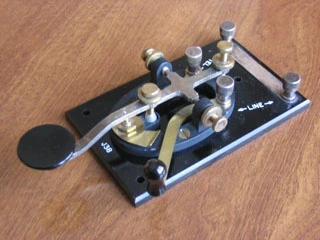
Acoustic telegraphy, sometimes called harmonic telegraphy, refers to a set of techniques for sending several telegraph messages at once over a single wire. Each message was assigned its own audio frequency, or channel. The operator used a standard Morse key to send the message, and each key press produced a pulse at that specific frequency. On the receiving end, a device tuned to that same frequency would vibrate in response to those pulses while ignoring signals on other frequencies.
Several inventors worked on this technology, including Charles Bourseul, Thomas Edison, Elisha Gray, and Alexander Graham Bell. Their goal was to lower the cost of telegraph service, and their experiments ultimately led to the creation of the telephone. Some of Edison’s designs used multiple synchronized tuning forks, each set to a chosen audio frequency, which opened and closed electrical circuits at those frequencies. The concept is similar to modern frequency-division multiple access (FDMA) used in radio.
The word “acoustic” comes from the Greek *akoustikos*, meaning hearing, as in sound waves in air. These devices were electromechanical and produced musical, buzzing, or humming sounds that could be heard a few feet away. However, their main purpose was not to generate sound but to create alternating electrical currents at selected audio frequencies. These currents traveled over long distances through wires, carrying the telegraph messages electrically.
Several patents were granted for this work. Alexander Graham Bell received one on April 6, 1875, for an improvement in transmitters and receivers for electric telegraphs. Elisha Gray received patents on July 27, 1875 (reissued January 28, 1879), and February 15, 1876, for an electrical telegraph for transmitting musical tones and an improvement in electro-harmonic telegraphs. Thomas Edison received multiple patents: on October 10, 1876; December 19, 1876; January 16, 1877; March 5, 1878; April 30, 1878; and December 7, 1880. All five of Edison’s patents were assigned to the Western Union Telegraph Company of New York.
- Inventors
- Charles Bourseul, Thomas Edison, Elisha Gray, Alexander Graham Bell
- First edison patent
- Acoustic Telegraph – Thomas Edison, issued October 10, 1876
- First gray patent
- Electrical Telegraph for Transmitting Musical Tones – Elisha Gray, issued July 27, 1875
- Bell patent
- Improvement in Transmitters and Receivers for Electric Telegraphs – Alexander Graham Bell, issued April 6, 1875
- Assignee of edison patents
- Western Union Telegraph Company of New York
Lore & Background
Acoustic telegraphy was developed by several inventors, including Charles Bourseul, Thomas Edison, Elisha Gray, and Alexander Graham Bell. Their efforts to reduce the cost of telegraph service by sending multiple messages over a single wire led to the invention of the telephone. The word 'acoustic' comes from the Greek 'akoustikos,' meaning hearing, as with sound waves in air. These devices were electromechanical and made musical, buzzing, or humming sound waves in air for a few feet, but their primary function was to generate alternating electrical currents at selected audio frequencies in wires, transmitting telegraphic messages electrically over long distances.
Reader's Guide
Acoustic telegraphy is notable as a precursor to both the telephone and modern frequency-division multiple access (FDMA) used with radio frequencies. The concept of using different audio frequencies as separate channels for simultaneous transmission over a single wire was similar in principle to FDMA. The work of Edison, Gray, Bell, and Bourseul on acoustic telegraphy directly contributed to the invention of the telephone. Edison alone received multiple patents for acoustic telegraph devices between 1876 and 1880, all assigned to Western Union Telegraph Company. The method allowed a telegrapher using a conventional Morse key to send messages that were carried as pulses of a specific audio frequency, with receiving devices tuned to resonate only to that frequency, ignoring others on the same wire. This multiplexing technique reduced the cost of telegraph service by increasing the capacity of existing telegraph lines.
Did You Know?
- Acoustic telegraphy is similar in concept to modern FDMA (frequency-division multiple access) used with radio frequencies.
- Elisha Gray's patent for an 'Electrical Telegraph for Transmitting Musical Tones' was issued July 27, 1875, and reissued January 28, 1879.
- The efforts to develop acoustic telegraphy led to the invention of the telephone.
More in Telegraph Keys and Codes 1-24
Spotted an error? Know more?
Reader corrections go straight into our review queue. Suggest an edit · How this site is sourced