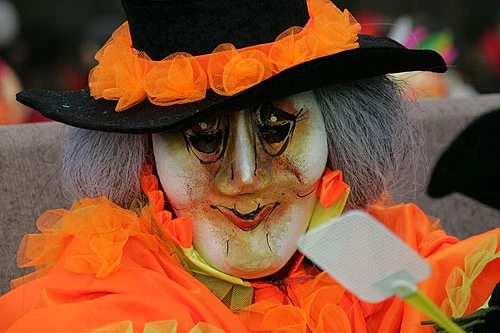
Türst
Dreadful huntsman of Lucerne folklore, feared in stormy weather.

In the pre-Christian farming communities of Lucerne, folklore warned of a figure called Türst (pronounced [tʏʁst]), a "dreadful huntsman" best avoided during storms. He would blow his horn through villages in the wild months leading up to Epiphany, followed by a pack of three-legged hunting dogs. Local traditions about him differ from place to place.
Türst is known for his warning cry, "drü Schritt rechts, gang uswägs" (roughly, "step right; get out of my way"). Anyone who fails to move aside in time is turned into one of his dogs. Some stories say barn doors should be left open so he can hunt through them without trouble. His wife, Sträggele, appears in certain versions, while others claim Türst terrorizes dairy cows, making them fall ill and stop giving milk.
Regional variations include: - In Horw, he is joined by small hounds, a one-eyed lead dog, his witch-like wife Sträggele, and the Pfaffenkellnerin—a ghostly parson's mistress with glowing eyes. - In Rickenbach, he wears a green hunting outfit and leads a pack of creatures that are half dog, half pig. - In Wolhusen, locals set up crosses to ward him off; if a cross falls, farmers suffer bad luck until it is set upright again. - People near Pilatus say Türst is a ghostly huntsman who harries cows until they stop producing milk for a long time. His hounds leave three-legged tracks. - In Ettiswil, farmers keep barn doors open most of the time, fearing that invisible forces from Türst might tear them apart.
- Field
- Folklore
- Nationality
- Swiss (Lucerne)
- Known for
- Dreadful huntsman who threatens pedestrians and terrifies dairy cows
- Associated with
- Wild Hunt, Sträggele, three-legged dogs
Lore & Background
Türst's distinguishing feature is his threat 'drü Schritt rechts, gang uswägs' (roughly 'step right; get out of my way'), by which a careless pedestrian who fails to get out of his way is turned into a member of his dog-pack. It is also said that barn doors should stay open at this time, enabling Türst to hunt through the barn unhindered. Sträggele, his wife, appears in some Türst legends, while other legends say that Türst terrifies dairy cows, causing them to sicken and cease their milk production.
Regional variants abound. In Horw, Türst is accompanied by small hounds, a leading hound with only one eye, his wife Sträggele (a hideous witch), and the Pfaffenkellnerin (the ghost of a deceased parson's mistress with glowing eyes). In Rickenbach, he appears in a green hunting costume, accompanied by a pack of animals which are half dog and half pig. In Wolhusen, citizens erected crosses to avoid Türst; if a cross were to fall, the farmers would have bad luck until the cross stood straight again. The local people of Pilatus say Türst is a ghost who drives and bothers cows such that they stop producing milk, and his hounds' tracks are easily identified as they have only three legs. Barn doors in Ettiswil are kept open most of the time as farmers fear they might be torn asunder by Türst's invisible forces.
Reader's Guide
Türst represents a localized Swiss variant of the Wild Hunt motif, a pre-Christian folk belief in a spectral huntsman and his ghostly pack. His significance lies in how agricultural communities of Lucerne used the figure to explain and cope with the dangers of stormy weather and the vulnerability of livestock. The threat of being turned into a dog if one fails to step aside reinforces social expectations of deference and caution during tempests. Regional variations—from the one-eyed hound in Horw to the half-dog, half-pig pack in Rickenbach—demonstrate how a single folk figure could be adapted to local fears and customs. The practice of keeping barn doors open in Ettiswil and erecting crosses in Wolhusen shows that belief in Türst had tangible effects on daily life and landscape. Though pre-Christian in origin, the figure's association with the period before Epiphany suggests later Christian overlay. Türst endures as a cautionary figure, embodying the unpredictable and sometimes hostile forces of nature that pre-modern farmers faced.
Did You Know?
- Türst blows his hunting horn through villages in the tempestuous months preceding Epiphany.
- His threat 'drü Schritt rechts, gang uswägs' can turn a careless pedestrian into a member of his three-legged dog pack.
- In Rickenbach, Türst appears in a green hunting costume with a pack of animals that are half dog and half pig.
- In Wolhusen, citizens erected crosses to avoid Türst; if a cross fell, farmers would have bad luck until it stood straight again.
More in Swiss folklore 1-24
Spotted an error? Know more?
Reader corrections go straight into our review queue. Suggest an edit · How this site is sourced