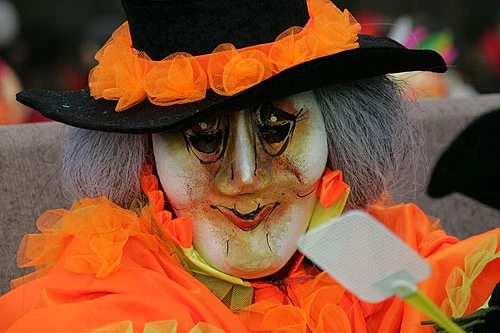
Klausjagen
Swiss festival blending pagan roots with Christianized Saint Nicholas traditions.

The Klausjagen, meaning "Nicholas chase," is a festival in the Swiss town of Küssnacht that occurs on the evening before Saint Nicholas Day. Roughly 20,000 people attend each year, and the parade involves about 1,500 participants, continuing well into the night.
The event likely originates from pre-Christian pagan traditions of chasing wild spirits, similar to the Wild Hunt. Early versions were disorderly and loud, drawing disapproval from both church and state. Though officially banned in 1732, the practice could not be stopped. In the late 1800s, the custom was Christianized, and bishop’s mitres were introduced to the procession. During the 1920s, a village committee tamed the still-rough event, creating the modern, well-organized parade. Since 1928, the St. Nicholas Society of Küssnacht has overseen the tradition.
The parade unfolds in six parts. First, men crack long, two-handed sheep whips. Next come men wearing *Iffelen* or *Infuln*—enormous, ornate paper hats resembling a mix of a bishop’s mitre and a stained glass window, lit from inside by candles and standing up to seven feet tall. Saint Nicholas follows, accompanied by four attendants in black robes and hoods called *Schmutzlis*, who hand out pastries. A brass band then plays the traditional Klaus song, followed by a large group ringing *trycheln*—large bells derived from cow bells. Finally, men blowing cow horns bring up the rear. Afterward, participants and spectators typically head to local taverns for celebrations.
- Field
- Festival / Folk custom
- Location
- Küssnacht, Switzerland
- Known for
- Pre-Christian pagan roots, elaborate paper hats (Iffelen), and a six-stage procession
Lore & Background
The Klausjagen is believed to have its roots in pre-Christian pagan traditions involving the chasing of wild spirits, comparable to the Wild Hunt. Early forms of the festival involved much unruliness and noise, which led the Church and authorities to frown upon it. It was officially outlawed in 1732, but could not be effectively suppressed.
In the late 19th century, the custom was Christianized, and bishop's mitres first appeared in the procession. In the 1920s, the still rather rough procession was tamed by a committee of villagers who created the modern, clearly organized parade. Since 1928, the St. Nicholas Society of Küssnacht has been responsible for the continuation of the custom.
The procession is organized in six stages: men cracking long two-handed sheep whips; men wearing enormous, ornate paper hats (Iffelen or Infuln) lit from inside by candles and up to seven feet tall; Saint Nicholas with four attendants in black robes and hoods (Schmutzlis) who hand out pastries; a brass band playing the traditional Klaus song; a large group ringing trycheln (large bells descended from cow bells); and finally men blowing cow horns. Participants and watchers then generally head to celebrations in local taverns.
Reader's Guide
The Klausjagen represents a rare survival of a pre-Christian winter custom that was adapted rather than eradicated by religious and civic authorities. Its significance lies in the layered history visible in its six-stage procession: the whip-cracking and horn-blowing echo ancient noise-making to drive away spirits, while the bishop's mitre-shaped hats and the figure of Saint Nicholas reflect the 19th-century Christianization. The festival's persistence despite an official ban in 1732 demonstrates the strength of local tradition. The 1920s reorganization by a village committee and the subsequent stewardship by the St. Nicholas Society since 1928 show how communities can formalize and preserve folk practices. Today, the Klausjagen draws about 20,000 spectators annually, making it a major cultural event for Küssnacht. Its legacy is as a living example of how pagan, Christian, and modern civic elements can coexist in a single celebration, offering insight into the evolution of European folk festivals.
Did You Know?
- The Klausjagen takes place on the eve of Saint Nicholas Day in Küssnacht, Switzerland.
- Participants wear Iffelen or Infuln, paper hats up to seven feet tall lit from inside by candles.
Klausjagen's Place in the Swiss Festival Landscape
Klausjagen is a parade festival held on the eve of Saint Nicholas Day, and it occupies a specific slot within the broader tapestry of Swiss folk celebrations. Swiss folklore, as a body of tradition, encompasses local stories, celebrations, and customs practiced by the alpine and sub-alpine peoples who have inhabited Switzerland for centuries. Klausjagen is not an isolated event but one thread among many: it sits alongside the pre-Lenten carnival of Fasnacht, the spring fire festival of Sechseläuten, the masked Tschäggätä parade, the Christmas Ubersitz, the New Year's Eve Silvesterklausen of Appenzell-Ausserrhoden, the Unspunnenfest, the Schützenfest, the Berchtoldstag honouring Berchta or Berchtold, and the children's Fasnacht event Eis-zwei-Geissebei in Rapperswil. Together these festivals mark the Swiss calendar with a rhythm of communal gathering, performance, and ritual that distinguishes the country's folkloric heritage from those of its neighbours.
A Tradition Forged at Europe's Crossroads
The cultural soil in which Klausjagen takes root stretches back far beyond the founding of Switzerland as a political alliance in 1291. The Swiss as a people and a culture predate that date, emerging from Pagan and later Christian Germanic tribes. Before those Germanic peoples arrived, the region was home to Roman and Gallo-Roman populations, and before even the Romans, the Celtic Helvetii occupied the land. Switzerland has functioned as a crossroads of Europe since at least the Roman Empire, and the constant movement of cultures and ideas through the region has produced a folklore tradition of remarkable variety. Within that tradition, the country is home to distinct German, French, Italian, and Romansh-speaking communities, the latter concentrated in Graubünden, each maintaining its own unique folkloric heritage. Klausjagen, as a parade festival observed on the eve of Saint Nicholas Day, is one expression of this layered, multilingual, and historically deep cultural landscape.
Alpine Identity and the Pluralism of Local Custom
Swiss folklore is fundamentally the body of local stories, celebrations, and customs belonging to the alpine and sub-alpine peoples who have made their homes in Switzerland. Klausjagen, a parade festival timed to the eve of Saint Nicholas Day, belongs to this category of communal celebration rather than to the realm of mythical narrative, though the two often intertwine. The alpine and sub-alpine setting shapes the character of these traditions: festivals like the Sechseläuten spring fire, the Tschäggätä masked parade, and the Ubersitz Christmas parade all reflect a culture oriented toward seasonal change and community gathering. Each of the country's linguistic and cultural groups—German, French, Italian, and Romansh—carries its own version of these folkloric practices, meaning that even a single festival type may take different local forms. Klausjagen exists within this pluralistic framework, a Swiss tradition that nonetheless carries the particular imprint of the community that stages it.
Volkskunde and the Academic Study of Swiss Festivals
The scholarly examination of Swiss folklore, known in German as Volkskunde, is a discipline that took formal shape in the nineteenth century. The central figure in its academic development was Eduard Hoffmann-Krayer, who in 1896 founded the Swiss Society for Volkskunde, an institution dedicated to the systematic collection and study of the country's folk traditions. Festivals such as Klausjagen, the parade festival held on the eve of Saint Nicholas Day, fall squarely within the scope of this scholarly enterprise, alongside customs like the Räbeliechtli turnip-lantern walks, the Bäregräubschi and Chöderchessi wedding gifts of the Simmental, and the physical traditions of Schwingen and Steinstossen. The establishment of a dedicated society for Volkskunde meant that practices like Klausjagen were no longer merely passed down through local memory but became subjects of documentation, comparison, and academic inquiry, giving Swiss folklore a structured place in the broader European study of cultural heritage.
More in Swiss folklore 1-24
Spotted an error? Know more?
Reader corrections go straight into our review queue. Suggest an edit · How this site is sourced