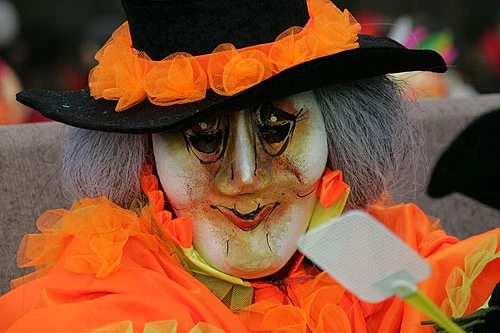
Eis-zwei-Geissebei
Swiss Carnival festival with food thrown from town hall windows.

Eis-zwei-Geissebei is a Carnival celebration that takes place in Rapperswil, Switzerland, on Shrove Tuesday. The tradition may originate from the 1350 siege and destruction of Rapperswil on St. Matthew’s Day by Rudolf Brun, the first mayor of Zürich. During that time, local residents reportedly gave food to hungry children through their windows, a gesture that the modern festival is thought to echo.
On Shrove Tuesday, the day begins with the traditional "Herrenessen" (a dinner for council members) at the Rapperswil town hall, followed by a cabaret show with notable guests. Later, hundreds of children gather in the main square. At exactly 15:15, the town hall windows open and a fanfare is played. A council member asks in Swiss German, “Sind alli mini Buebe doo?” (“Are all my boys here?”), and the children reply, “Joo! Eis - Zwei - Geissebei!” (“Yes, one, two, goat-leg!”). Then sausages, bread rolls, and Biberli (a sweet) are dropped down to the children in the Hauptplatz. After this distribution, called the Austeilete, the evening brings intense activity, culminating in all the Guggenmusik (carnival marching bands) gathering for a loud concert.
- Field
- Carnival festival
- Location
- Rapperswil, Switzerland
- Observed
- Shrove Tuesday
- Known for
- Throwing sausages, bread rolls, and Biberli from town hall windows to children
Lore & Background
Eis-zwei-Geissebei is held annually on Shrove Tuesday in Rapperswil. The festival begins with a traditional 'Herrenessen' (dinner of the council members) in the Rathaus Rapperswil and a cabaret program with distinguished guests. Hundreds of children then gather in the main square. At exactly 15:15, the windows of the town hall open and a fanfare sounds. A council member asks, 'Sind alli mini Buebe doo?' (Swiss German: Are all my boys here?), and the children answer, 'Joo! Eis - Zwei - Geissebei!' (Yes, one, two, goat-leg!). Sausages, bread rolls, and Biberli (a sweet) are then dropped down to the children on the Hauptplatz.
Reader's Guide
Eis-zwei-Geissebei is a significant local tradition in Rapperswil, Switzerland, that commemorates a possible act of charity during the 1350 siege of the city. The festival's name and the call-and-response with children preserve a unique cultural heritage. The event's structure—from the council dinner to the window toss and evening Guggenmusik concert—reinforces community bonds and marks the climax of Carnival. Its legacy lies in maintaining a centuries-old memory through participatory ritual, though the exact historical origin remains uncertain. The festival continues to draw hundreds of children and features a distinctive blend of civic ceremony and festive chaos.
Did You Know?
- The festival is held on Shrove Tuesday in Rapperswil, Switzerland.
- Its origin may go back to the siege of Rapperswil in 1350 by Rudolf Brun of Zürich.
- At exactly 15:15, sausages, bread rolls, and Biberli are dropped from town hall windows to children.
- The evening includes a concert by all Guggenmusik (carnival marching bands).
A Children's Fasnacht in Rapperswil
Eis-zwei-Geissebei is a Fasnacht event held specifically for children in the Swiss town of Rapperswil. As a Fasnacht celebration, it falls within the pre-Lenten carnival season, a period when communities across Switzerland gather for festive observances marking the transition before the solemnity of Lent. The event is one of many local celebrations and customs that make up the rich tapestry of Swiss folklore, which encompasses the stories, festivals, and traditions of the alpine and sub-alpine peoples who have inhabited the country for centuries. While the broader Fasnacht tradition is shared across multiple Swiss cultural regions, Eis-zwei-Geissebei carries the particular character of a children's gathering, distinguishing it from adult-oriented parades and masked processions found elsewhere in the Swiss festival calendar. Its placement in Rapperswil situates it within the German-speaking portion of Switzerland, one of several distinct cultural and linguistic communities that together form the nation's folkloric heritage.
Among Switzerland's Festival Calendar
Eis-zwei-Geissebei occupies a specific niche within the wider Swiss festival landscape. The country's folkloric calendar includes numerous celebrations, from Berchtoldstag honouring the white-cloaked figure Berchta, to Sechseläuten's spring fire festival, to the masked Tschäggätä parades and the Klausjagen processions on the eve of Saint Nicholas Day. Fasnacht, also called Fastnacht, stands among these as a pre-Lenten carnival tradition, and Eis-zwei-Geissebei represents one local expression of that broader observance. What sets it apart is its explicit orientation toward children, making it a distinct entry in a list that otherwise features events with more general or adult participation. The Swiss festival tradition is not monolithic; it reflects the country's composition of German, French, Italian, and Romansh-speaking communities, each maintaining its own unique folkloric customs. A children's Fasnacht in Rapperswil thus exists as one thread in a multicoloured weave of seasonal celebrations stretching from Christmas parades like Ubersitz through New Year's Eve traditions in Appenzell-Ausserrhoden to the Unspunnenfest and beyond.
Layers of Cultural Inheritance
The traditions that give rise to events like Eis-zwei-Geissebei rest upon deep historical strata. Switzerland has occupied a crossroads position in Europe since at least the Roman Empire, and the region's folklore bears the imprint of successive cultural layers. The Celtic Helvetii inhabited the land before Roman and Gallo-Roman populations arrived. Pagan and later Christian Germanic tribes followed, eventually becoming the Swiss people, whose cultural identity predates the formal alliance of 1291. This constant movement of peoples, ideas, and customs into the Swiss heartland produced a folklore tradition of remarkable variety and depth. The alpine and sub-alpine communities that developed their own stories, celebrations, and customs drew from all these inherited streams. A children's Fasnacht in Rapperswil is thus not an isolated invention but a contemporary expression of a long, layered cultural process in which conquest, migration, and the blending of traditions have continuously shaped what Swiss communities celebrate and how they pass those celebrations to the next generation.
The Scholarly Framework
The academic study of Swiss folklore, known in German as Volkskunde, provides the intellectual framework within which events such as Eis-zwei-Geissebei can be understood and preserved. This field of study originated in the nineteenth century, a period when European scholars began systematically collecting and cataloguing the local stories, festivals, and customs of rural and alpine populations. The central figure in the academic development of Swiss Volkskunde was Eduard Hoffmann-Krayer, who in 1896 founded the Swiss Society for Volkskunde, establishing an institutional home for the scholarly examination of traditions spanning the German, French, Italian, and Romansh-speaking regions. Through such efforts, the rich and varied folklore of Switzerland's crossroads position was documented and given academic legitimacy. A children's Fasnacht in Rapperswil, while rooted in community practice, also exists within this broader scholarly context, part of a national heritage that nineteenth-century and later folklorists worked to identify, describe, and protect from the erosion of modernity.
More in Swiss folklore 1-24
Spotted an error? Know more?
Reader corrections go straight into our review queue. Suggest an edit · How this site is sourced