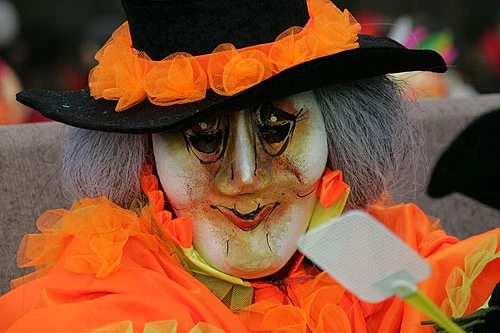
Perchta
Ambivalent Alpine goddess of spinning, winter, and moral enforcement.

Perchta, also known as Berchta or Percht, is a female figure in Alpine paganism of the Upper German, Austrian, and Slovenian regions of the Alps. She is often identified as stemming from the same Germanic goddess as Holda and other female figures of Germanic folklore, and is considered Holda's southern cousin or equivalent, sharing oversight of spinning and guardianship of woodland beasts. Her lore holds sway precisely where Holda leaves off, and she appears during the Twelve Days of Christmas.
- Field
- Alpine paganism and folklore
- Nationality
- Upper German, Austrian, Slovenian
- Known for
- Guardian of spinning, punisher of lazy spinners and fast-breakers, associated with the Twelve Days of Christmas and Epiphany
- Also called
- Frau Percht, Pehtra Baba, Perchtlgoba, Berigl, Berchtlmuada, Rauhweib, and others
Lore & Background
Perchta enforces spinning duties, inspecting the distaff during the twelve days. Lazy spinners who leave flax or wool unspun face punishment: she scratches their faces, smacks their fingers, or slits their bellies and stuffs them with flax. She similarly punishes those who eat forbidden foods on fast days, slitting their bellies and stuffing them with straw or stones. However, she rewards diligent spinners with full spindles, golden threads, flax tow, or coins. She is also said to be responsible for the growth of grain. In contemporary culture, she is portrayed as a rewarder of the generous and punisher of the bad, particularly lying children, though this bogeyman aspect was a later development.
Reader's Guide
Perchta's significance lies in her role as a moral enforcer of communal taboos, particularly regarding spinning and fasting, during the midwinter period. She embodies the dual nature of many Germanic folklore figures—both rewarding and punishing—and her lore complements that of Holda, marking a regional variation in Alpine folklore. Her name likely derives from Old High German 'giberaht naht' meaning 'Epiphany night', though Jacob Grimm argued for 'Perahta' meaning 'the bright one', while Eugen Mogk proposed an etymology from 'pergan' meaning 'hidden' or 'covered'. The historical Bertha Broadfoot, mother of Charlemagne, may have influenced the conception of Perchta's strange foot. Her legacy persists in customs such as the Perchtenlauf and in the figure of Pehtra Baba among Slovenes, and she continues to be referenced in regional traditions and as a bogeyman figure.
Did You Know?
- Perchta is also known as Pehtra Baba in Slovene Carinthia and as Parychta in Bohemia.
- She is said to have one large foot, sometimes called a goose foot or swan foot, which Grimm saw as a mark of a shapeshifting higher being.
- The eve of Epiphany was called Berchta's Day, and the period of her activity is known as Rauhnächte ('Rough nights').
- In the Tyrol, she is portrayed as a little old woman with a wrinkled face, bright eyes, a hooked nose, disheveled hair, and tattered garments.
Identity & Regional Reach
Perchta occupies a distinctive niche in the folk traditions of the Alpine and Upper German world. She is understood as a goddess of Alpine paganism whose sphere of influence stretches across Bavaria, Swabia, the Vogtland, the Salzburg region, Italian South Tyrol, Slovene Carinthia, Alsace, and Switzerland. Scholars note that her lore holds sway precisely in the areas where the figure of Holda fades, the two complementing one another as regional equivalents of the same Germanic female deity linked to Frija-Frigg. Both figures oversee the craft of spinning and serve as guardians of woodland beasts, and both make their appearances during the Twelve Days of Christmas. In the Slovene-speaking communities of Carinthia she is known as Pehtra Baba or Pechtra, while Czech parallels include Peruta, Parychta, and Šperechta across Bohemia and Moravia. She is commonly addressed with the honorific Frau Percht or Frau Perchta, and a long list of local nicknames—Rauhweib, Zampermutta, Bechtrabab, Sampa—testifies to how deeply she was woven into the everyday vocabulary of rural households.
The Beautiful and the Ugly: Dual Aspects
In the Tyrolean tradition, Perchta is painted as a small, deeply wrinkled old woman with bright, lively eyes, a long hooked nose, disheveled hair, and tattered, torn garments. Yet she is not a single fixed image. At Lienz in the Tyrol, costumed procession participants split into two roles: the beautiful Perchta, dressed in ribbons and galloons, and the hideous counterpart, from whose body dangle rats, mice, bells, and chains. A persistent motif across many languages is her single oversized foot—called a goose foot, swan foot, or broad foot. Jacob Grimm connected this to the historical Bertrada of Laon, Charlemagne's mother, and interpreted the strange foot as a mark of a higher being capable of shapeshifting into animal form. He also saw in it the splayfoot of a spinning woman working a treadle and the trampling foot of the figure Stempe or Trempe. The motif appears in Middle German, French, Latin, and Italian, where a medieval epic even carries the title Berta dai gran piè, suggesting the image was widely shared across the Alpine and broader European folk imagination.
The Rough Nights and the Price of Laziness
During the midwinter period known as the Rauhnächte—the Rough Nights stretching from St. Thomas's Eve on December 21 through Epiphany—Perchta was believed to roam the countryside and slip into households, particularly on the Twelfth Night and the eve of Epiphany, a day locally called Berchta's Day. As guardian of the spinner's trade, she enforced a strict rule: all flax and wool allotted for the year had to be spun before the holidays, and spinning during them was taboo. On the twelve days she inspected each distaff. A girl found with unspun tow faced a terrifying reckoning: Perchta would scratch her face, smack her fingers until they bore permanent scars, or worse, slit open her belly and stuff it full of flax. The same brutal punishment awaited anyone who broke a fast day by eating something beyond the permitted fish and gruel—her belly would be opened, packed with straw, and sewn shut using a plowshare as a needle and chains as thread. In milder tellings, the transgressor simply suffered a nightmare, the Alptraum.
Tracing the Name: Etymology and Early Attestation
The origin of the name Perchta remains debated. Jacob Grimm proposed that it descends from the Old High German Perahta, meaning "the bright one," a reading that would link it to Proto-Germanic *berhtaz and make it a cognate of Berchtentag, the Epiphany day. Yet no firm documentary evidence has been produced to confirm this lineage. The linguist Eugen Mogk offered a competing explanation, tracing the name to the Old High German verb pergan, which carries the sense of "hidden" or "covered." Independently of these etymological disputes, the name and the associated festival Perchtenlauf are thought to derive from the Old High German phrase giberaht naht, meaning "Epiphany night." What is certain is that Perchta does not appear in the written record before the thirteenth century, where she is referenced by the Latinized title Domina Perchta. Before that, she existed only in the oral and performative traditions of Alpine villages, passed down through costumed processions, household warnings, and the seasonal rituals that kept her presence vivid in the collective memory of the region.
More in Swiss folklore 1-24
Spotted an error? Know more?
Reader corrections go straight into our review queue. Suggest an edit · How this site is sourced