Silvesterklaus
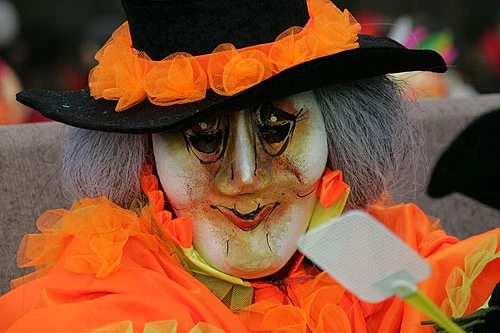
Masked Swiss figure celebrating New Year's Eve in Appenzell.

In the Swiss half-canton of Appenzell Innerrhoden, a figure known as a Silvesterklaus—or New Year's Mummer—takes part in Saint Sylvester's Day celebrations, keeping the Chlausen tradition alive. This masked character, dressed for the occasion, is recognized as part of Switzerland’s intangible cultural heritage.
The tradition marks the turn of the year twice: once on 31 December (Gregorian calendar) and again on 13 January (Julian calendar). If either date falls on a Sunday, the festivities move to the preceding Saturday. Small groups of Silvesterkläuse, wearing strange costumes and ringing large bells, wander from house to house, performing a very slow yodel to wish people a happy new year.
The Chlausen festival is thought to have originated not from pagan roots but from a late medieval Advent custom among students at a monastic school. By the 15th century, the celebrations had grown wild and carnival-like, leading the Catholic Church to object to such behavior during Advent. This likely prompted the shift of the custom to New Year's Eve. The earliest known written record dates to 1663, when church authorities complained about disorderly conduct and noise associated with 'Chlausen' in general, not specifically the Silvesterklaus. In the Catholic half-canton of Appenzell Innerrhoden, 18th-century records show that participating could result in a heavy fine of five thalers. Still, the tradition persisted there on a small scale until around 1900, often tolerated quietly by local authorities, especially in border areas near Reformed Appenzell Ausserrhoden—such as Haslen, surrounded by Hundwil, Stein, Teufen, and Buehler, or Gonten near Urnäsch and Hundwil. Mixed groups from both half-cantons occasionally formed, and isolated characters sometimes appeared. Today, the custom is actively maintained in the Protestant half-canton of Appenzell Ausserrhoden.
Three main types of Silvesterchläuse exist: the Schöne (Beautiful), the Schö-Wüeschte (Pretty-Ugly), and the Wüeschte (Ugly). The Beautiful wear ornate embroidered headgear depicting scenes of peasant life, crafts, buildings, sports, or family, requiring hundreds of hours of work, with a dress resembling local traditional costume. The Pretty-Ugly wear costumes made from fir twigs, ivy, moss, and other natural materials, with headgear similar in shape but decorated with natural elements.
- Field
- Folk tradition / Intangible cultural heritage
- Nationality
- Swiss (Appenzell, Switzerland)
- Known for
- Participating in the Silvesterklausen tradition, wearing ornate or natural costumes and masks, and performing slow yodeling while ringing bells from house to house on New Year's Eve (Gregorian and Jul
- Born
- Earliest known written record from 1663
- Died
- Tradition continues in Appenzell Innerrhoden and Ausserrhoden
Lore & Background
The Silvesterklaus tradition is assumed to have late medieval Advent origins involving students of a monastic school, not pagan roots. In the 15th century, celebrations became increasingly wild and carnival-like, leading the Catholic Church to object, which may explain why the custom was transferred from Advent to New Year's Eve. The earliest known written record dates to 1663, when church authorities complained about disorderly conduct and noise associated with 'Chlausen' in general, not specifically the Silvesterklaus. In the Catholic half-canton of Appenzell Innerrhoden, 18th-century records show that participating in 'Chlausen' was punished with a heavy fine of five thalers, yet the tradition survived there on a small scale up to around 1900. While historically men were the primary participants, in modern times women and children also take part in some groups.
Reader's Guide
The Silvesterklausen tradition is significant as a living example of Swiss intangible cultural heritage, maintained primarily in the Protestant half-canton of Appenzell Ausserrhoden. It commemorates Saint Sylvester twice—once on 31 December (Gregorian calendar) and again on 13 January (Julian calendar)—with groups of masked figures visiting houses to wish a happy new year. The tradition features three main costume types: Beautiful (ornate embroidered headgear), Pretty-Ugly (natural materials like fir twigs and ivy), and Ugly (coarser natural materials with wild headgear), plus a rarer Joker variant. Only men participate due to the heavy costumes and bells. The tradition's survival despite early church opposition and fines in the Catholic half-canton underscores its cultural resilience. Its legacy includes a 2022 group formed in New Glarus, Wisconsin, showing its spread beyond Switzerland.
Did You Know?
- The Silvesterklaus tradition is celebrated twice a year: on 31 December (Gregorian calendar) and on 13 January (Julian calendar).
- If 31 December or 13 January falls on a Sunday, the ceremony is held on the preceding Saturday.
- Three main types of Silvesterchläuse exist: Beautiful, Pretty-Ugly, and Ugly, distinguished by their costumes and masks.
- Only men participate in the groups because the costumes are heavy and the bells are very large.
More in Swiss folklore 1-24
Spotted an error? Know more?
Reader corrections go straight into our review queue. Suggest an edit · How this site is sourced