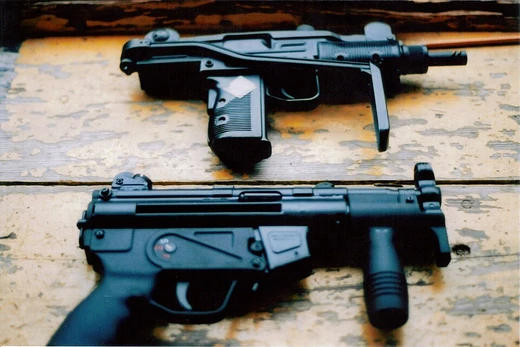
Uzi
Israeli open-bolt submachine gun with telescoping bolt design.

Defensiebladen · CC BY-SA 4.0
The Uzi is a family of Israeli submachine guns and machine pistols that operate using an open bolt and blowback action. It was first designed by Major Uziel "Uzi" Gal in the late 1940s, not long after the State of Israel was founded. The weapon was among the first to use a telescoping bolt, which lets the magazine sit inside the pistol grip, making the gun shorter. A prototype was completed in 1950, and the Uzi entered service with Israel Defense Forces special forces in 1954. Two years later, it became standard issue across the military.
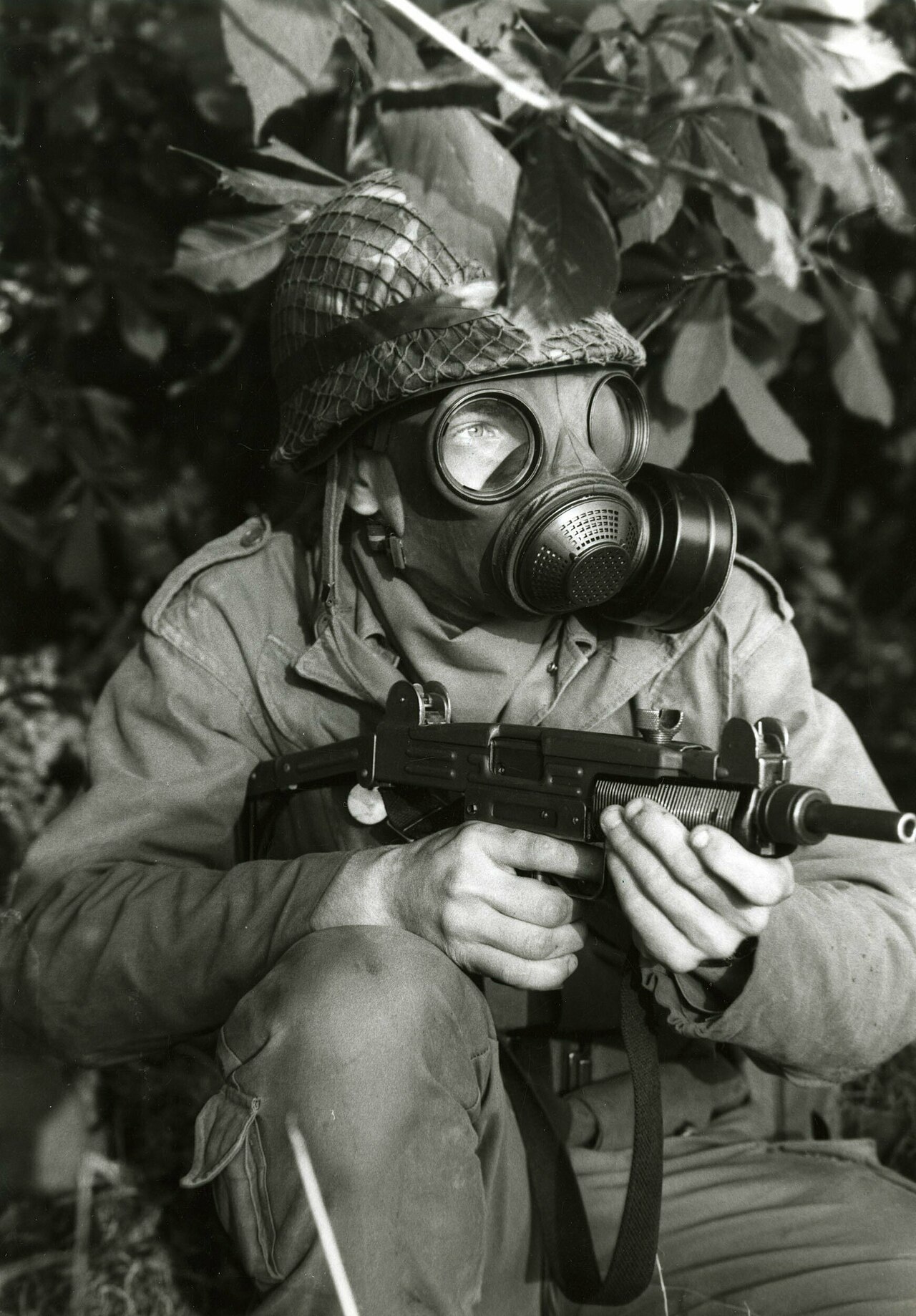
The design is similar to the Czech ZK 476 prototype and the Sa 23 through Sa 26 series of submachine guns from 1948. The open bolt helps cool the barrel during sustained fire, but because the bolt stays to the rear when cocked, the receiver can pick up sand and dirt. The telescoping bolt wraps around the breech end of the barrel, allowing the barrel to sit farther back in the receiver. This makes for a heavier, slower-firing bolt in a shorter, better-balanced weapon. The Uzi is mostly made from stamped sheet metal, which keeps manufacturing costs low, and it has few moving parts, making it easy to strip for cleaning or repair. The magazine inside the pistol grip allows for intuitive reloading in low light or difficult conditions—the shooter’s hand naturally finds the other hand. A grip safety helps prevent accidental firing, though the vertical magazine makes shooting from a prone position awkward. The weapon also has a bayonet lug.
The charging handle sits on top of the receiver cover and does not move with the bolt during firing. Some variants have a ratchet safety that catches the bolt if it is pulled back past the magazine but not far enough to engage the sear. When the handle is pulled all the way back, the bolt catches on the sear, and the handle and cover spring forward. The military and police versions fire as soon as a round is chambered, since the Uzi is an open-bolt design. There are two external safeties: a three-position selector on top of the grip (with a rear "safe" position that locks the sear and bolt), and a grip safety at the rear of the grip to prevent firing if the weapon is dropped or the shooter loses hold. The trigger only controls the release of the bolt or firing pin holding mechanism, as there is no internal hammer.
Quick Facts
- Origin
- Israel
- Is Ranged
- yes
- Service
- 1954–present
- Designer
- Uziel Gal
- Design Date
- 1950
- Manufacturer
- Israel Military Industries / Israel Weapon Industries / Copies or variants made by: / FN Herstal / Norinco / Z111 Factory / Lyttleton Engineering Works (under Vektor Arms) / RH-ALAN / Group Industries
- Production Date
- 1950–present
- Number
- 2,000,000+
- Weight
- 3.5 kg
- Length
- 445 mm stockless / 470 mm folding stock collapsed / 640 mm folding stock extended
- Part Length
- 260 mm
- Cartridge
- .22 LR / .41 AE / .45 ACP / 9×19mm Parabellum / 9×21mm IMI
Facts from the source article.
Lore & Background
The Uzi uses an open-bolt, blowback-operated design, similar to the Czech ZK 476 prototype and the Sa 23–26 series. The open bolt exposes the barrel's breech end for cooling but makes the receiver more susceptible to sand and dirt. Its telescoping bolt wraps around the breech end of the barrel, allowing a heavier, slower-firing bolt in a shorter, better-balanced weapon. The weapon is constructed primarily from stamped sheet metal, making it less expensive to manufacture, and has relatively few moving parts for easy maintenance. The magazine is housed within the pistol grip, enabling intuitive reloading under the principle of "hand finds hand," and the pistol grip is fitted with a grip safety to prevent accidental discharge. However, the protruding vertical magazine makes the gun awkward to fire when prone. The Uzi features a bayonet lug.
The non-reciprocating charging handle on top of the receiver cover retracts the bolt. Variants have a ratchet safety mechanism that catches the bolt if retracted past the magazine but not far enough to engage the sear. The military and police versions fire immediately upon chambering a cartridge as an open-bolt weapon. There are two external safety mechanisms: a three-position selector lever (safe, semi-auto, full-auto) and a grip safety. The trigger mechanism controls the release of the bolt or firing pin holding mechanism. The open-bolt system creates a noticeable delay between trigger pull and firing. The magazine release button is on the lower portion of the pistol grip, flush to prevent accidental release. When de-cocked, the ejector port closes to keep out dust and dirt, though the weapon can still jam with heavy sand accumulations if not cleaned regularly.
Stocks include a wooden stock with metal buttplate in three variations (flat or angled butt, straight or curved comb, with or without hollows for cleaning rod and oil bottle), a polymer version from IMI, and an aftermarket Choate polymer stock. In 1956, IMI developed a downward-folding twin-strut metal stock. The Mini Uzi has a forward-folding single-strut metal stock, and the Micro Uzi a similar model. Original box magazines for 9mm had 25-round capacity; a 32-round extended magazine later became standard. The Mini and Micro Uzi use a shorter 20-round magazine. Extended magazines include 40- and 50-round types, plus aftermarket 70-round and 100-round drums. The .45 ACP Uzi used 16- or 22-round magazines; conversion kits allowed use of .22 LR or .41 AE by changing barrel, bolt, and magazine.
Reader's Guide
The Uzi was designed by Captain (later Major) Uziel Gal following the 1948 Arab–Israeli War. It won out over more conventional designs due to its simplicity and economy of manufacture. Gal did not want the weapon named after him, but his request was ignored. Officially adopted in 1951, it was first introduced to IDF special forces in 1954 and placed into general issue two years later. The first Uzis had a short, fixed wooden buttstock and saw combat during the 1956 Suez Campaign. Later models used a folding metal stock. The Uzi served as a personal defense weapon for rear-echelon troops, officers, artillery troops, and tankers, as well as a frontline weapon for elite light infantry assault forces. Its compact size and firepower proved instrumental in clearing Syrian bunkers and Jordanian defensive positions during the 1967 Six-Day War. Though phased out of frontline IDF service in the 1980s, some Uzis and variants remained in use until December 2003, when the IDF retired the Uzi from all forces, replacing it with the fully automatic Micro Tavor. The Uzi was generally reliable in military service but could be affected by extreme sand and dust conditions, as during the Sinai Campaign of the Yom Kippur War. From the 1960s through the 1980s, more Uzi submachine guns were sold to military, law enforcement, and security markets than any other submachine gun ever made.
Did You Know?
- The Uzi is one of the first weapons to incorporate a telescoping bolt design, allowing the magazine to be housed in the pistol grip.
- The Uzi has been exported to over 90 countries.
- The Uzi was officially adopted in 1951 and first saw combat during the 1956 Suez Campaign.
Origins & Design Philosophy
The Uzi traces its roots to the immediate aftermath of Israel's founding, when Major Uziel Gal began developing a compact sidearm for the young nation's armed forces. He completed his prototype in 1950, and the weapon would go on to become one of the earliest firearms to employ a telescoping bolt. In this arrangement, the bolt wraps around the breech end of the barrel, permitting the barrel to be drawn far back into the receiver. That single innovation freed up space inside the pistol grip for the magazine, producing a shorter, better-balanced gun that could still accommodate a heavier, slower-cycling bolt. Gal also chose stamped sheet metal over machined forgings for the receiver, slashing per-unit manufacturing costs while keeping the parts count low enough that any soldier could strip the weapon for maintenance with minimal tools. The result was a design philosophy centered on simplicity, affordability, and compactness—principles that would define the Uzi's decades of service.
Operational Mechanics & Safety
The Uzi cycles on an open-bolt, blowback principle closely related to the Czech Sa series submachine guns of 1948. Because the bolt rests at the rear when cocked, the breech end of the barrel is exposed, which aids cooling during sustained fire but leaves the receiver more vulnerable to sand and dirt ingress. A non-reciprocating charging handle rides along the top of the receiver cover; pulling it fully rearward cocks the bolt on the sear, after which a small spring snaps the handle and cover forward. The cover then stays in place during firing, since it does not travel with the bolt. Two external safeties guard against mishaps: a three-position selector lever at the top of the grip that locks the sear in the safe position, and a grip safety at the rear of the handle that must be depressed before the trigger functions. Notably, the Uzi has no internal hammer or cocking mechanism—its conventional trigger merely releases either the bolt or the firing-pin hold. This mechanical simplicity comes at a cost: a perceptible delay elapses between pulling the trigger and the round actually firing.
Service History & Global Proliferation
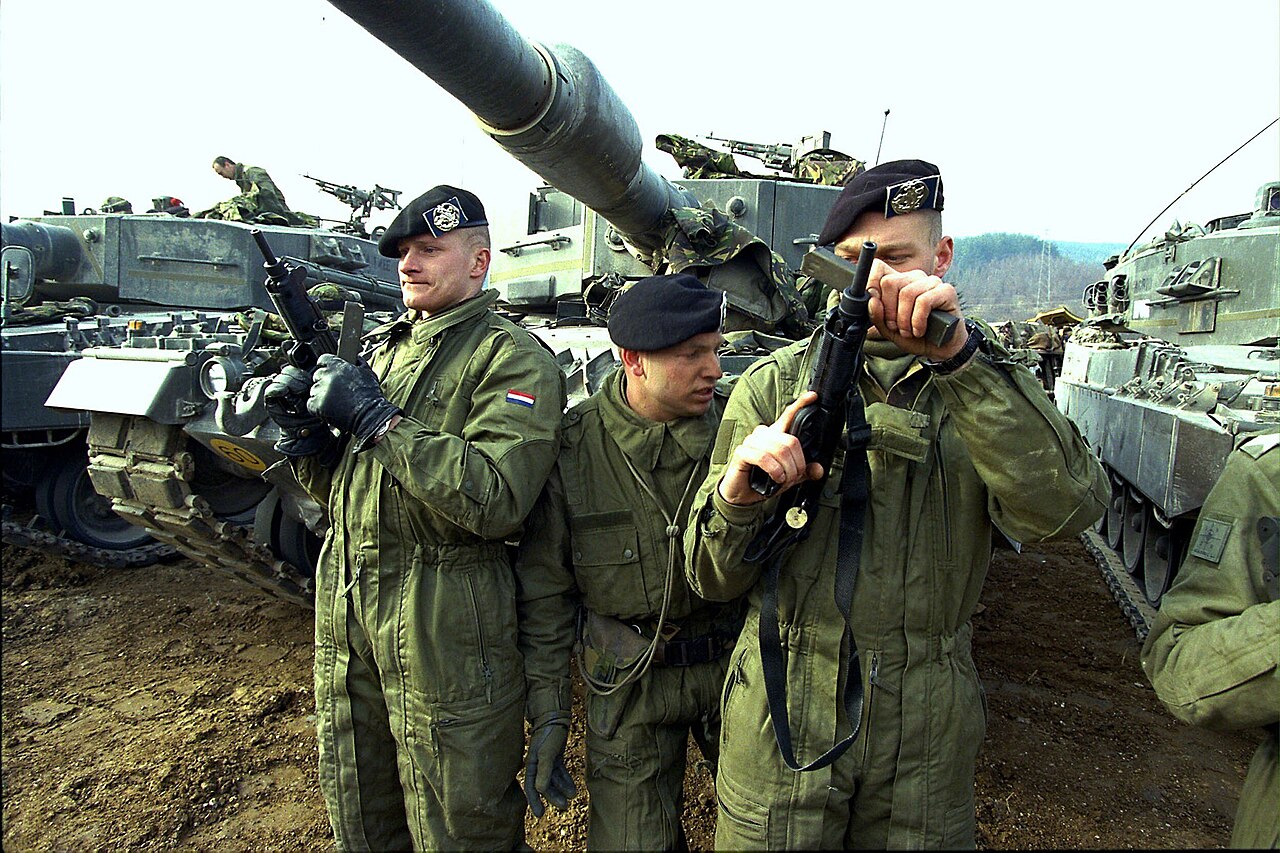
Israel's defense establishment moved quickly to field the new weapon. Special-forces units received the first Uzis in 1954, and by 1956 the gun had entered general issue across the IDF. It was distributed not only to elite light-infantry assault troops but also to rear-echelon personnel, officers, artillery crews, and tank crews, making it a ubiquitous sidearm throughout the force. The Uzi's reputation soon crossed borders. Over its service life it was exported to more than ninety countries and produced under license by Israel Military Industries, FN Herstal, and other manufacturers. From the 1960s through the 1980s, no other submachine gun matched the Uzi's sales volume across military, law-enforcement, and private-security markets worldwide. A bayonet lug on the barrel further extended its utility in close-quarters combat, and the weapon's low production cost—thanks to its stamped-metal construction—made it accessible to nations that could not afford more expensive alternatives.
Practical Trade-offs & Variant Ecosystem
Housing the magazine inside the pistol grip was the Uzi's most distinctive ergonomic choice. The logic was straightforward: in darkness or under stress, a shooter's non-firing hand naturally finds the grip, making reloads intuitive. A flush, paddle-style magazine release on the lower grip prevents accidental ejection during rough handling. Yet the same vertical magazine protruding from the grip makes the weapon awkward to fire from a prone position. Stock options ranged from three IDF wooden variants—differing in butt angle, comb shape, and whether they carried hollows for a cleaning rod and oil bottle—to IMI's 1956 downward-folding twin-strut metal stock. The Mini Uzi and Micro Uzi each adopted forward-folding single-strut stocks whose buttplates double as foregrips when stowed. Magazine capacity evolved from an original 25-round box to a 32-round standard after 40- and 50-round prototypes proved unreliable, while the Mini and Micro use 20-round mags. In desert environments, heavy sand accumulation could still cause jams if the weapon was not cleaned regularly, despite pressed reinforcement slots in the receiver.
Gallery



Frequently Asked Questions
Who designed the Uzi and when?
Major Uziel "Uzi" Gal developed the weapon in the late 1940s, shortly after the State of Israel was established. A working prototype was completed by 1950, and the gun first entered service with IDF special forces in 1954.
What makes the Uzi's design unique?
The Uzi was among the first firearms to use a telescoping bolt, a feature that lets the magazine sit inside the pistol grip. This is what gives the gun its famously compact overall length without sacrificing barrel length.
How does the Uzi operate?
It runs on an open-bolt, blowback action, so the bolt rests in the forward position and recoil drives the entire cycling cycle. That simple, robust mechanism is a big part of why the gun is known for reliability and easy field maintenance.
When did the Uzi become standard issue in Israel?
After debuting with special forces in 1954, the Uzi was adopted as general-issue equipment across the IDF in 1956. It has remained a mainstay of Israeli military and police arsenals ever since.
How widely was the Uzi exported?
The Uzi family has been sold to more than 90 countries worldwide. Its compact footprint, low manufacturing cost, and dependable operation made it a go-to choice for police and military units around the globe.
More in Submachine Guns 1-24
Spotted an error? Know more?
Reader corrections go straight into our review queue. Suggest an edit · How this site is sourced