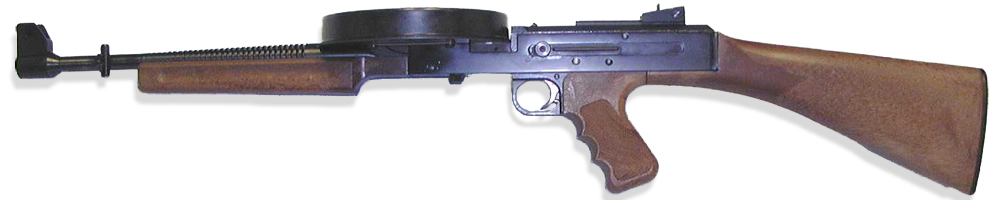
American-180
A high-rate-of-fire submachine gun using .22 caliber cartridges from a pan magazine.

Wikimedia Commons · Public domain
The American-180 is a submachine gun from the 1960s that uses a pan magazine to feed .22 Long Rifle or .22 ILARCO ammunition. It evolved from the Casull Model 290, which employed a flat pan magazine similar to pre-World War II designs. Only 87 Casull M290s were ever made due to high production costs. The American-180 is a refined version of that earlier weapon.
The gun operates with a conventional blowback system and fires from an open bolt, using a flat pan magazine. Its rate of fire is very high, around 1,200 rounds per minute. Before the 1986 Hughes Amendment banned new automatic weapons for the U.S. civilian market, most American-180s were bought by private individuals. The Utah Department of Corrections also adopted it for prison guards.
ILARCO produced a twin-barreled variant, mounting two receivers on a single stock weighing over 14 pounds, with a rate of fire exceeding 3,000 rounds per minute. A quad-barreled version was also made, mounted on a large tripod. Its four guns could be fired individually, in pairs, or all at once, achieving rates of fire between 3,000 and 12,000 rounds per minute.
The American-180 saw use in several countries. Croatia used the Slovenian-made MGV-176 copy during the Yugoslav wars. France employed two examples in the 1980s, one with the GIPN of Marseille and another with the Paris Research and Intervention Brigade. New Zealand Police’s Anti-Terrorist Squad issued it in September 1978, though it is no longer in service. It was also used by the Rhodesian SAS, South Africa’s 4th Reconnaissance Regiment, and various U.S. law enforcement and correctional agencies.
A semi-automatic-only variant, the American SAR 180/275, is still custom-produced by E&L Manufacturing in Riddle, Oregon.
Quick Facts
- Origin
- United States
- Is Ranged
- yes
- Designer
- Richard J. Casull
- Manufacturer
- Voere / Illinois Arms Company, Inc. / American Arms International
- Production Date
- early 1970s to mid-1980s
- Number
- ~10,000
- Variants
- Voere SAM-180 (semi-automatic variant) / select-fire variant
- Weight
- 5.7 lb empty / 10 lb loaded with 177-round magazine
- Length
- 35.5 in
- Part Length
- 14 in (select-fire variant) / 17.5 in (semi-automatic variant)
- Cartridge
- .22 Long Rifle / .22 ILARCO (.22 Winchester Short Magnum Rimfire/.22 American)
- Action
- blowback, open bolt
Facts from the source article.
Lore & Background
The American-180 operates through a conventional blowback mechanism with an open bolt and fires at a very high rate of fire of approximately 1,200 rounds per minute. It was purchased mostly by private parties prior to the Hughes Amendment in 1986, which banned the production of automatic weapons for the American civilian market. The weapon was adopted by the Utah Department of Corrections to arm prison guards.
Variants include a twin-barrelled configuration manufactured by ILARCO, with two receivers mounted on a single stock weighing more than 14 lb (6.4 kg) and a rate of fire over 3,000 rounds per minute. A quad-barrelled variant was also produced by ILARCO, mounted on a large tripod, with a rate of fire from 3,000 to 12,000 rounds per minute; each gun could be fired individually, in pairs, or all at once.
A semi-automatic only variant called the American SAR 180/275 is still produced on a custom basis by E&L Manufacturing of Riddle, Oregon.
Reader's Guide
The American-180 is notable for its use of a pan magazine and high rate of fire in a compact .22 caliber platform. Its development from the expensive Casull Model 290 led to a more practical design that saw adoption by various users, including the Utah Department of Corrections and law enforcement agencies in the United States. The weapon was also used by the New Zealand Police Anti-Terrorist Squad, issued in September 1978, and by the Rhodesian SAS and South Africa's 4th Reconnaissance Regiment. In France, two were used respectively by the GIPN of Marseille and the Research and Intervention Brigade of Paris in the 1980s. A Slovenian-made copy, the MGV-176, was used by Croatian guerrilla forces during the Yugoslav wars. The American-180's legacy includes influencing similar designs such as the Calico M100 and the MGV-176, and its continued production in a semi-automatic variant by E&L Manufacturing.
Design Heritage and Operating Principle
The American-180 traces its conceptual roots to the Casull Model 290, a weapon that employed a flat pan magazine echoing designs popular in the era before the Second World War. However, the M290 proved prohibitively costly to produce, and only eighty-seven examples ever left the factory floor. The American-180, developed during the 1960s, arrived as a refined successor that retained the distinctive pan-magazine feed while chambering either the .22 Long Rifle or the .22 ILARCO cartridge. Mechanically, the gun relies on a straightforward blowback system with the bolt held open at rest, a configuration that contributes to its remarkably high cyclic rate of roughly 1,200 rounds per minute. The result is a compact, high-volume personal-defense weapon whose operating cycle prioritizes simplicity and rapid fire over the more complex gas-operated or roller-delayed systems found in many contemporary submachine guns.
Multi-Barrel Configurations
ILARCO pushed the American-180 platform far beyond its single-receiver origins by offering two extraordinary multi-gun configurations. The twin-barrel variant paired two complete receivers onto a single stock, producing a combined weight exceeding fourteen pounds and a theoretical rate of fire surpassing three thousand rounds per minute. The quad-barrel arrangement went further still: four individual guns were mounted on a large tripod, and the operator could select from a range of firing combinations—triggering a single gun, alternating between the left and right sides, or unleashing all four simultaneously. In its fullest configuration, the quad system could cycle between three thousand and twelve thousand rounds per minute, making it less a submachine gun in the traditional sense and more a dedicated volume-of-fire platform. These variants demonstrated the inherent scalability of the pan-magazine, blowback concept, though their sheer weight and complexity likely confined them to specialized or experimental roles.
Global Service Record
Although the American-180 was designed in the United States, its operational footprint stretched across several continents. In the U.S. itself, the weapon found a niche in correctional and law-enforcement settings, most notably with the Utah Department of Corrections, which adopted it to equip prison guards. Internationally, the Rhodesian Special Air Service and South Africa's 4th Reconnaissance Regiment both fielded the type. New Zealand's Police Anti-Terrorist Squad received examples in September 1978, though they have since been withdrawn from operational service. In France, two units saw limited use during the 1980s: one with the GIPN unit in Marseille and another with the Research and Intervention Brigade in Paris. Perhaps most strikingly, the concept survived the breakup of Yugoslavia in the form of the MGV-176, a Slovenian-manufactured copy that saw action in the hands of Croatian guerrilla fighters during the Yugoslav wars. Prior to the 1986 Hughes Amendment, the A180 was also acquired by private parties within the United States.
Post-Regulatory Legacy and Surviving Lines
The 1986 Hughes Amendment, which prohibited the manufacture of fully automatic firearms for the American civilian market, effectively ended production of the original automatic American-180 in the United States. Yet the design's lineage has not gone entirely dormant. E&L Manufacturing, based in Riddle, Oregon, continues to produce a semi-automatic-only variant designated the American SAR 180/275, available on a custom, made-to-order basis. This modern descendant preserves the pan-magazine feed and .22-caliber chambering while complying with current regulations. The broader design philosophy of the A180—high-rate blowback fire from a flat pan magazine—also found a parallel in the Calico M100, a weapon of similar concept. Meanwhile, the MGV-176 produced in the former Yugoslavia represents a modernized continuation of the original 1960s design. Together, these surviving threads illustrate that the American-180's engineering ideas outlived its initial production run by decades.
Gallery

Frequently Asked Questions
What is the American-180?
The American-180 is a 1960s-era submachine gun built around a flat pan magazine that feeds .22 caliber cartridges. It is essentially a refined successor to the earlier Casull Model 290 design.
What ammunition does the American-180 chamber?
It accepts either .22 Long Rifle or .22 ILARCO cartridges, both loaded into a flat pan magazine. This .22-caliber choice sets it apart from the 9 mm or .45 ACP rounds typical of most other submachine guns.
How does the American-180 cycle and what is its rate of fire?
It operates on a conventional blowback principle and fires from an open bolt position. Its cyclic rate reaches roughly 1,200 rounds per minute, making it an exceptionally rapid-fire weapon for its class.
What is the relationship between the American-180 and the Casull M290?
The American-180 is a direct refinement of the Casull Model 290, carrying forward its distinctive flat pan-magazine concept. Only 87 M290s were ever completed because production costs proved prohibitive, and the American-180 was developed to address those manufacturing challenges.
Why do fans consider the American-180 a notable design?
Its pairing of a .22-caliber pan-magazine feed with a roughly 1,200-round-per-minute blowback action is a rare and distinctive combination in submachine gun history. It also stands out as one of the few attempts to refine a concept that originally yielded fewer than 90 finished examples.
More in Submachine Guns 1-24
Spotted an error? Know more?
Reader corrections go straight into our review queue. Suggest an edit · How this site is sourced