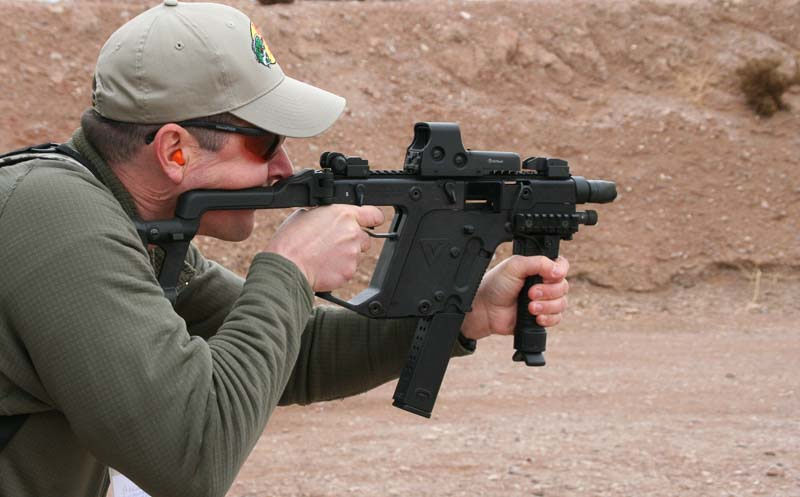
KRISS Vector
A delayed-blowback submachine gun with an articulated bolt to reduce recoil.

Grasyl · CC BY-SA 4.0
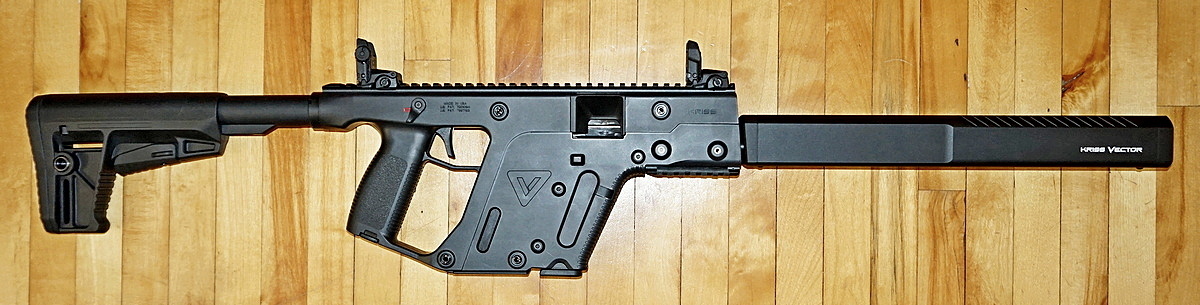
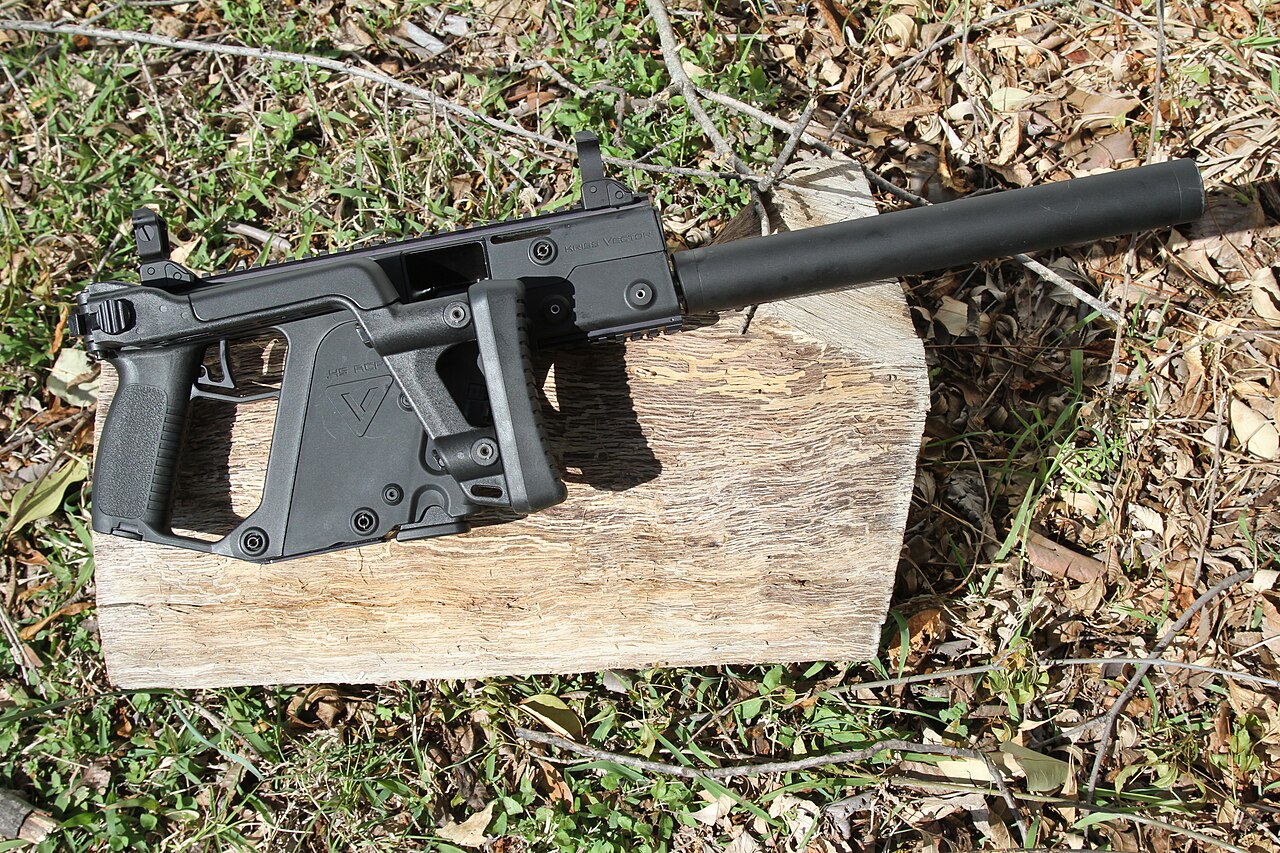
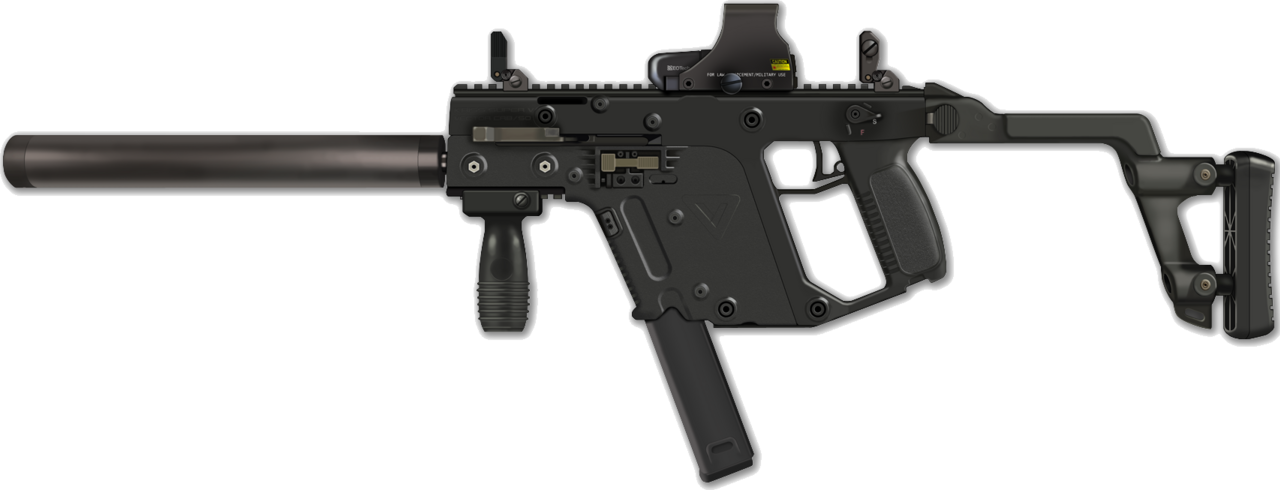
The KRISS Vector is a submachine gun developed by the American company KRISS USA, formerly Transformational Defense Industries (TDI). It uses an unconventional delayed blowback system combined with an in-line design to reduce perceived recoil and muzzle climb, invented by French engineer Renaud Kerbrat. Designed in 2006 and seeing limited production since 2009, the Vector is chambered for a variety of pistol cartridges and accepts extended Glock magazines.
Quick Facts
- Origin
- United States
- Is Ranged
- yes
- Design Date
- 2006
- Manufacturer
- Kriss USA, Inc.
- Production Date
- 2009–present
- Weight
- 6 lb (SMG, SBR) / 7 lb (CRB)
- Length
- 24.3 in (SMG, SBR) / 16 in w/ stock folded / 34.8 in (CRB) / 26.5 in w/ stock folded
- Part Length
- 5.5 in (SMG, SBR, SDP) / 6.5 in (Optional for SMG, SBR, SDP Gen II) / 16 in (CRB) / 18.6 in (CRB, Canadian version)
- Cartridge
- .22 LR / .357 SIG / .40 S&W / .45 ACP / 9×19mm Parabellum / 9×21mm / 10mm Auto
- Action
- Off-axis bolt travel blowback, closed bolt
- Range
- 55 yards (50 meters); 70 yards (64 meters) with 16-inch barrel
- Rate
- 1,200 rounds/min
Facts from the source article.
Lore & Background
The KRISS Vector was developed by TDI, which announced an experimental submachine gun in the spring of 2007. The name "Kriss" comes from a Southeast Asian dagger with a flame-shaped blade. The second-generation prototype, the K10, was announced at the 2011 SHOT Show, featuring a redesigned lower receiver for easy caliber interchangeability, a new telescoping stock, and a four-sided accessory rail tube. The K10 was not displayed after SHOT Show 2013 and its status is unknown, likely canceled. In 2015, Kriss announced "Gen II" versions of the original Vector models with a redesigned pistol grip, trigger, safety selector, and compatibility with a new 9×19mm lower, replacing the K10 prototypes without carrying over any K10 features. At the 2024 SHOT Show, the "Gen III" Vector was unveiled with a slimmer, lighter upper housing, ambidextrous magazine release, M-LOK handguard, and improved trigger handling.
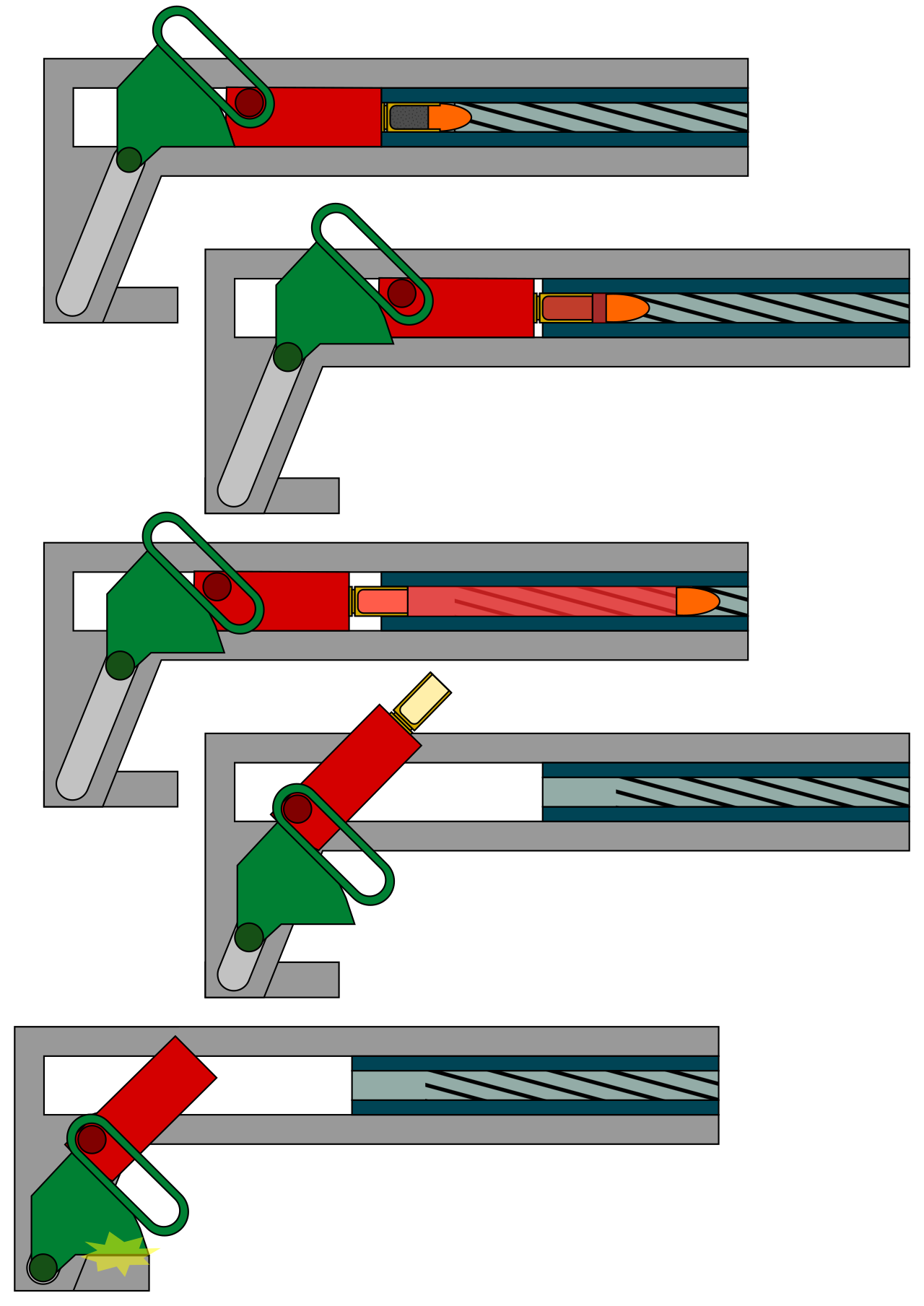
The Vector uses the "Kriss Super V" articulated mechanism, where the bolt and an inertia block move downward into a recess behind the magazine well, transmitting energy downward rather than rearward to reduce felt recoil. The barrel axis is in line with the shoulder and the shooter's hand, intended to reduce muzzle climb. The weapon is split into two major assemblies like the AR-15, secured with four push pins; the lower contains the action, charging handle, magazine well, and barrel, while the upper contains the ejection port, rail system, pistol grip, fire control components, and stock. This modular design allows toolless caliber conversions by swapping lowers. The safety is ambidextrous, but the ejection port, charging handle, bolt release, and magazine release are right-handed only. Vectors in .45 ACP use Glock 21 magazines, and 9mm models use Glock 17 magazines; extended magazine kits are available.
Reader's Guide
The KRISS Vector is notable for its distinctive Super V operating system, which addresses recoil and muzzle climb in a compact submachine gun format. Its in-line design and off-axis bolt travel represent a departure from conventional blowback or gas-operated actions, offering a unique shooting experience. The Vector's modular construction, allowing caliber changes by swapping lower receivers, adds versatility for both military and civilian users. While the selective-fire SMG variant is restricted to military and law enforcement, semi-automatic versions for the civilian market include the Vector CRB (carbine), Vector SBR (short-barrel rifle), and Vector SDP (pistol), available in multiple calibers. The weapon's adoption of Glock magazines ensures wide compatibility and aftermarket support. The Vector's legacy includes the development of the KRISS KARD pistol and a 12-gauge shotgun, though the Vector itself remains the most recognized product. Its unusual appearance and operating mechanism have made it a distinctive presence in the firearms industry, with successive generations refining ergonomics and features while maintaining the core Super V system.
Did You Know?
- The initial prototype achieved a rate of fire of 1,500 rounds per minute, later reduced to 1,200 on production models.
- The Vector's bolt and inertia block move downward into a recess behind the magazine well to reduce felt recoil.
- A .22 LR variant uses a traditional straight blowback system rather than the Super V delayed system.
The Super V System and Recoil Management
The KRISS Vector's defining engineering achievement is its Super V system, an articulated mechanism conceived by French engineer Renaud Kerbrat that fundamentally rethinks how recoil energy is managed. Rather than allowing the bolt to travel straight backward as in conventional blowback weapons, the Vector channels the bolt and a paired inertia block downward into a recess positioned behind the magazine well. At the end of this downward stroke, the kinetic energy is redirected vertically instead of rearward, which dramatically softens the shooter's felt recoil. Combined with an in-line barrel axis that aligns with both the shoulder and the gripping hand, the design suppresses muzzle climb in a way that traditional submachine guns struggle to match. The trade-off is a noticeably elevated sight line relative to the bore. The weapon is divided into two primary assemblies—upper and lower—held together by four push pins, a layout reminiscent of the AR-15. This split enables toolless caliber changes simply by swapping the lower receiver, a level of modularity that sets the Vector apart from most of its peers.
From Prototype to Third Generation
The Vector's development timeline reads like a series of iterative experiments. TDI first revealed the project in spring 2007, naming it after a Southeast Asian dagger known for its flame-shaped blade. A second-generation prototype called the K10 debuted at the 2011 SHOT Show, offering a more compact frame with a single takedown pin that let operators swap between 9×19mm, .40 S&W, and .45 ACP lowers. Its charging handle traveled at a near-vertical diagonal, and it featured a telescoping stock plus a four-sided barrel rail. However, the K10 vanished from public display after 2013 and is widely believed to have been quietly canceled. In 2015, KRISS rolled out the Gen II line, which introduced a reshaped pistol grip, a revised trigger, a safety lever with a reduced 45-degree swing, and a dedicated 9mm lower—yet none of the K10's distinctive features survived. The latest iteration, the Gen III, appeared at the 2024 SHOT Show with a slimmer, lighter upper housing, an ambidextrous magazine release, M-LOK mounting in place of the old Picatinny handguard, and refined trigger feel.
Glock Magazine Ecosystem and Caliber Flexibility
One of the Vector's most practical design choices is its reliance on the Glock magazine ecosystem, which gives owners access to a vast aftermarket and simplifies logistics. The 9×19mm chambering uses standard Glock 17 magazines, the .45 ACP version takes Glock 21 mags, the .40 S&W variant runs on Glock 22 magazines, and the 10mm Auto model accepts Glock 20 magazines. KRISS has also offered proprietary extension kits to boost capacity: the MagEx 30, later rebranded as a 25+ round kit, stretches a factory 13-round .45 Glock magazine, while the MagEx 2, released in 2019, expands standard Glock mags to hold 40 rounds of 9mm, 33 of 10mm, or 30 of .45 ACP. Caliber flexibility is further enhanced by the two-part assembly: because the lower receiver houses the action and barrel, swapping it allows a toolless change between calibers. A .22 LR version was teased at the gun's initial release, disappeared for years, and was finally confirmed for production at the 2020 SHOT Show.
SMG vs. Civilian: Two Markets, One Platform
The Vector family is cleanly divided between a full-auto SMG reserved for military and law-enforcement buyers and a range of semi-automatic civilian models. The SMG variant ships with a 5.5-inch barrel (or 6.5 inches on Gen II), a folding stock, flip-up backup iron sights, and a full-length Picatinny rail for optics. It is offered exclusively in 9×19mm and .45 ACP, with either a two-mode or three-mode fire selector. Crucially, the auto trigger pack cannot be mated to a semi-automatic lower, enforcing a hard boundary between the two markets. Civilian buyers choose among three configurations—the CRB, SBR, and SDP—and can select from 9mm, .45 ACP, .40 S&W, 10mm Auto, or .357 calibers. Gen II models dropped the barrel-top opening that once housed an optional Surefire light, and KRISS expanded the color palette beyond Flat Black to include Olive Drab, Flat Dark Earth, Alpine white, and Combat Gray Cerakote finishes. Notably, while the safety and fire-mode selector are ambidextrous, the ejection port, charging handle, bolt release, and magazine release remain right-handed only.
Gallery
Frequently Asked Questions
What makes the KRISS Vector different from other submachine guns?
Instead of a conventional reciprocating bolt, the Vector uses a delayed-blowback mechanism with an articulated bolt that channels recoil downward rather than straight backward. Combined with its in-line layout, this design dramatically reduces perceived muzzle climb and makes the platform far easier to keep on target at high cyclic rates.
Who designed the KRISS Vector and when was it made?
The gun was created by French engineer Renaud Kerbrat and developed under Transformational Defense Industries, a company that later rebranded itself as KRISS USA. The design was finalized in 2006, and limited production began in 2009.
What calibers is the KRISS Vector available in?
The Vector has been offered in a wide spread of pistol cartridges, including 9×19mm Parabellum, .40 S&W, .45 ACP, 10mm Auto, .357 SIG, 9×21mm IMI, and even .22 LR. This breadth of options lets a shooter pick a round that matches a specific role or preference.
What is the KRISS Vector's rate of fire?
Early prototypes cycled at roughly 1,500 rounds per minute, but production models settled on a rate of about 1,200 rounds per minute. That speed, paired with the recoil-mitigating bolt system, is a big reason the Vector became a staple in close-quarters competitive shooting.
What magazines does the KRISS Vector use?
The Vector is built to accept extended Glock magazines, a practical choice because Glock mags are widely available and inexpensive. This compatibility also means users can stock up on spare capacity without hunting for proprietary parts.
More in Submachine Guns 1-24
Spotted an error? Know more?
Reader corrections go straight into our review queue. Suggest an edit · How this site is sourced