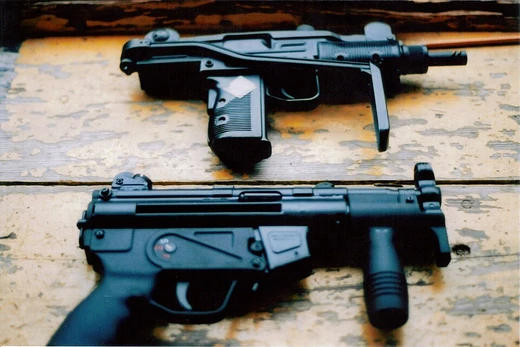
Škorpion
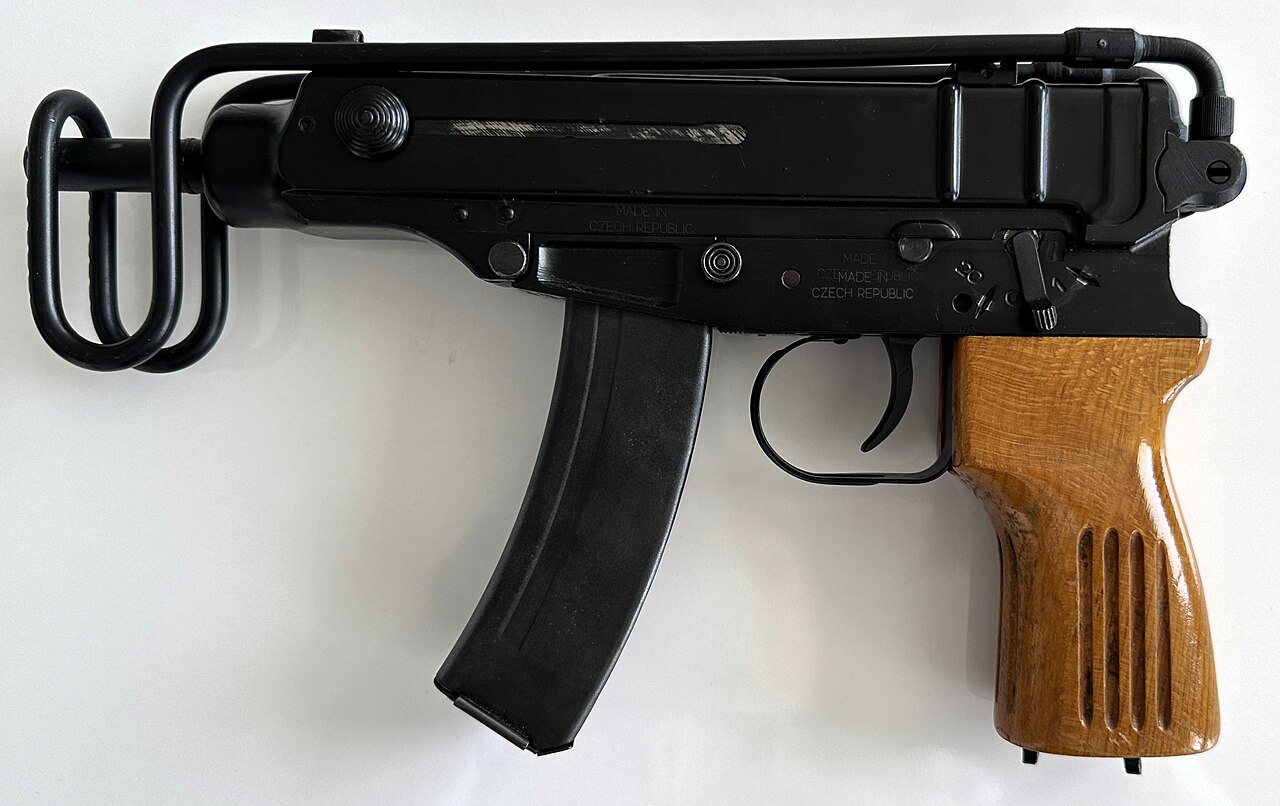
A compact Czechoslovak machine pistol with a distinctive folding stock.

StefanGollnick · CC BY-SA 3.0
The Škorpion vz. 61 is a Czechoslovak machine pistol designed by Miroslav Rybář, with development beginning in the late 1950s under the working name "model 59." The design was finished in 1961 and officially designated Samopal vzor 61. Production ran from 1963 to 1979 at the Česká zbrojovka factory in Uherský Brod, and resumed in 2009 under Czech Small Arms. The standard version fires .32 ACP ammunition.
The weapon operates on a straight blowback system, firing from a closed bolt. The .32 ACP round produces low recoil, allowing simple unlocked blowback without a delay mechanism; the cartridge is held only by the bolt’s inertia and the return springs. When fired, gas pressure pushes the case back against the bolt and its two recoil springs. The bolt extracts and ejects the empty case upward through a port in the receiver’s top cover. Compact size comes from a telescopic bolt that wraps around much of the barrel. A spring-loaded extractor sits inside the bolt head, and a fixed double ejector protrudes from the frame.
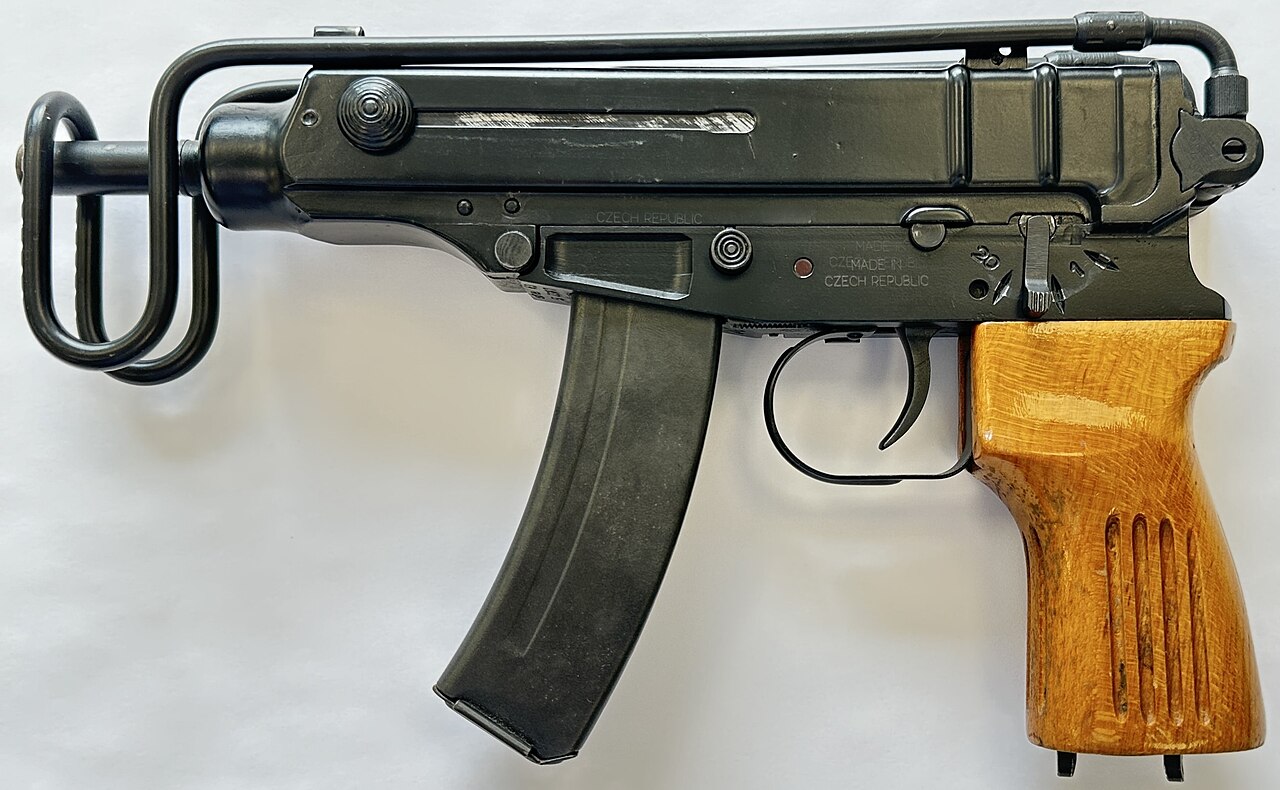
Because the bolt is light, an inertial rate reducer inside the wooden pistol grip lowers the rate of fire from about 1,000 rounds per minute to roughly 850. When the bolt reaches the rear of its stroke, it hits a spring-powered hook on the back plate and drives a lightweight plunger down into the grip. The plunger passes through a heavy weight that lags behind due to inertia. After compressing its spring, the plunger rises and meets the descending inertia buffer, which slows its upward movement. When the plunger reaches the top, it rotates the hook, releasing the bolt forward under the recoil springs’ force.
The hammer-fired trigger mechanism includes a fire selector on the left side of the receiver above the grip, with three settings: "0" (safe), "1" (semi-automatic), and "20" (fully automatic). The safe setting disables the trigger and locks the bolt forward by sliding the bolt catch lever upward.
Iron sights consist of an adjustable front post and a flip rear sight with notches for 75 and 150 meters. A folding metal wire stock, when folded over the receiver, locks onto the front sight protector, giving the weapon a scorpion-like tail appearance. It can be fired with the stock folded for quick deployment from a holster or extended for better accuracy and control.
Quick Facts
- Origin
- Czechoslovakia
- Is Ranged
- yes
- Service
- 1961–present
- Wars
- Vietnam War / Lebanese Civil War / Rhodesian Bush War / The Troubles / Internal conflict in Peru / Yugoslav Wars / First Liberian Civil War / Russian invasion of Ukraine / Gaza war
- Designer
- Miroslav Rybář
- Design Date
- 1959
- Manufacturer
- Česká zbrojovka Uherský Brod, Zastava Arms
- Production Date
- 1961–1979 and 2009–present
- Number
- Approx. 200,000
- Weight
- 1.30 kg
- Length
- 517 mm stock extended / 270 mm stock folded
- Part Length
- 115 mm
Facts from the source article.
Lore & Background
The Škorpion was developed in the late 1950s by Miroslav Rybář under the working name 'model 59', with the design completed in 1961 and designated Samopal Vz. 61. It was subsequently adopted by the Czechoslovak Army and security forces, serving as a personal sidearm for lower-ranking staff, vehicle drivers, armored vehicle personnel, and special forces. The weapon's compact dimensions were achieved by using a telescopic bolt assembly that wraps around a considerable portion of the barrel, and its folding wire stock, when folded, resembles the tail of a scorpion, giving the weapon its name.
The Škorpion operates via straight blowback, with the .32 ACP cartridge's low recoil impulse enabling simple unlocked operation. An inertial rate reducer device housed inside the wooden pistol grip lowers the rate of fire from 1,000 rounds/min to 850 rounds/min. The weapon is hammer-fired with a three-position fire mode selector (safe, semi-automatic, fully automatic) and features open-type iron sights with a folding stock that can be used either folded or extended. It uses two types of double-column curved box magazines: a short 10-round or a 20-round capacity magazine.
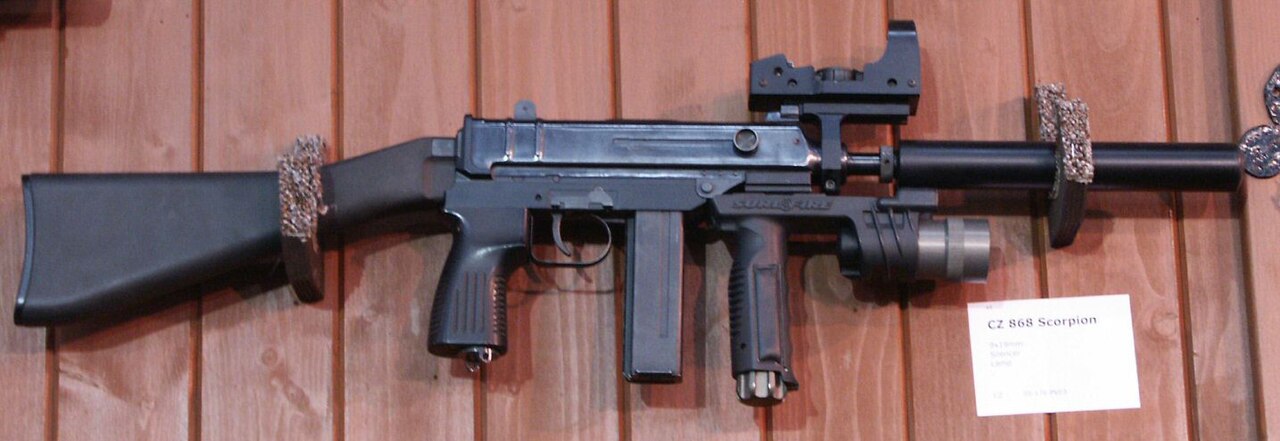
Several export variants were produced, including the vz. 64 (.380 ACP), vz. 65 (9×18mm Makarov), and vz. 68 (9×19mm Parabellum), as well as later models such as the vz. 83 and the semi-automatic CZ-91S. A licensed variant, the Zastava M84, was produced in Yugoslavia with a synthetic pistol grip. The weapon has been used by armed forces of numerous countries and also by non-state groups, including the Irish Republican Army, the Irish National Liberation Army, and the Italian Red Brigades.
Reader's Guide
The Škorpion vz. 61 occupies a unique niche as a machine pistol designed primarily for security forces and as a personal defense weapon for military personnel who did not require a full-sized rifle. Its compact size, enabled by the telescopic bolt and folding stock, allowed it to be carried in a holster like a traditional pistol, while its select-fire capability provided a significant increase in firepower over a standard sidearm. The weapon's adoption by the Czechoslovak Army and its subsequent export to numerous countries underscore its practical design for close-quarters roles.
Beyond military and police use, the Škorpion gained notoriety through its adoption by various armed groups. It was used by the Italian Red Brigades during the 1978 kidnapping and murder of Aldo Moro, and by the Irish Republican Army and Irish National Liberation Army. In the 1990s, the Gang de Roubaix used it in attacks in France, and in 2022 it was used in a hostage taking in an Apple store in Amsterdam and in the Wallasey pub shooting. Its distinctive appearance and compact form have also made it a frequent presence in popular culture, appearing in numerous films such as 'The Matrix', 'The Dark Knight', and 'Captain America: The Winter Soldier', as well as inspiring the Klobb gun in the video game 'GoldenEye 007'. Production resumed in 2009 by Czech Small Arms, and in 2022, 2,085 units were supplied to Ukraine by the Czech Republic following the Russian invasion.
Did You Know?
- An inertial rate reducer inside the pistol grip lowers the rate of fire from 1,000 to 850 rounds per minute.
- The weapon was used by the Italian Red Brigades in the 1978 kidnapping and murder of Aldo Moro.
- The Klobb gun from the 1997 video game GoldenEye 007 is based on the Škorpion.
Engineering & Mechanical Innovation
The engineering behind the Škorpion reflects a philosophy of achieving maximum functionality within minimal space. Miroslav Rybář, who completed the design in 1961 after beginning work in the late 1950s under the working designation 'model 59,' employed a straight blowback mechanism that fires from a closed bolt. Because the .32 ACP cartridge generates very low recoil impulse, no gas-delay or other locking mechanism was necessary; the bolt's own mass and two recoil springs handle the entire extraction cycle. To keep the weapon compact, Rybář devised a telescopic bolt assembly that wraps around a significant portion of the barrel. Perhaps the most ingenious element is the rate reducer: a spring-powered hook on the rear plate catches the bolt at the end of its rearward travel, driving a lightweight plunger into the wooden grip. The plunger races past a heavier inertia weight, compresses its spring, rebounds, and collides with the descending buffer, slowing the cycle before releasing the bolt forward. This mechanism trims the cyclic rate from a theoretical 1,000 rounds per minute down to a controllable 850.
Military Service & Continued Relevance
Although the Škorpion was originally conceived as a personal weapon for security personnel, its adoption extended well beyond that initial scope. The Czechoslovak Army accepted it as a sidearm for lower-ranking officers, vehicle drivers, armoured vehicle crews, and special forces units. Production ran at the Česká zbrojovka facility in Uherský Brod from 1963 through 1979, after which the weapon continued to see service in the arsenals of multiple nations. Its compact, holster-carryable form made it particularly attractive for personnel who needed a selective-fire option without the bulk of a full submachine gun. The weapon's international footprint grew through export to a variety of countries, and even after the original production run ended, demand persisted. In 2009, Czech Small Arms resumed manufacturing the vz. 61, demonstrating that nearly five decades after its introduction the design still held practical relevance. Today, the Škorpion remains in active service with the armed forces of several countries as a compact sidearm, a testament to the enduring utility of Rybář's 1961 design.
Variant Family & Export Reach
To meet diverse international requirements, Česká zbrojovka developed a family of calibred variants around the core vz. 61 platform. The earliest export iterations—the vz. 64 in .380 ACP, the vz. 65 in 9×18mm Makarov, and the vz. 68 in 9×19mm Parabellum—differed from the original only in minor mechanical details, with the vz. 68 being slightly larger and switching to straight box magazines. Later additions included the vz. 61E in .32 ACP, the vz. 82 with a 113 mm barrel in Makarov, and the vz. 83 in .380 ACP. For the civilian market, the CZ-91S offered a semi-automatic-only configuration with a stainless steel receiver and black-enamelled external parts, available across the aforementioned calibres. Yugoslavia's Zastava arms factory produced a licensed variant, the M84, which replaced the original wooden grip with a synthetic one. By the early 1990s, CZ was actively marketing the vz. 83 and CZ-91S to new markets, ensuring the platform's commercial longevity well beyond its original Cold War context.
Shadow History: Criminal & Paramilitary Use
Beyond its legitimate military and police service, the Škorpion found a dark second life in the hands of armed criminal and paramilitary groups across Europe. The Irish Republican Army and the Irish National Liberation Army both employed the weapon during their campaigns. In Italy, the Red Brigades used a Škorpion during the 1978 kidnapping of former Prime Minister Aldo Moro and subsequently to carry out his execution. In France, the Gang de Roubaix relied on the weapon throughout a series of violent attacks during the 1990s. The pistol's compact size, selective-fire capability, and relative availability on the grey market made it a favoured choice for operatives who needed a concealed, high-capacity option. By 2017, the Swedish Police Authority estimated that roughly fifty formerly deactivated Škorpiions had been reactivated and were circulating in the country, underscoring how the weapon's simple mechanical design—particularly the absence of complex locking parts—made it relatively straightforward to restore to working order even after official deactivation procedures.
Gallery

Frequently Asked Questions
Who designed the Škorpion vz. 61?
Miroslav Rybář, a Czechoslovakian firearms designer (1924–1970), created the weapon. Development began in the late 1950s under the internal label 'model 59' before the design was finalized in 1961.
What round does the Škorpion fire and how does it cycle?
It chambers the .32 ACP (7.65×17mmSR Browning Short) cartridge and runs on a simple straight blowback system from a closed bolt. Because that round generates relatively low recoil, no gas-delay or other locking mechanism is required.
When was the Škorpion manufactured and by whom?
Česká zbrojovka in Uherský Brod produced it from 1963 through 1979, and Czech Small Arms resumed manufacturing the design starting in 2009.
What is the rate of fire and magazine capacity?
With its built-in rate reducer the gun cycles at roughly 850 rounds per minute. Feed comes from a double-column curved box magazine holding either 10 or 20 rounds.
What makes the Škorpion visually distinctive?
It is a very compact machine pistol that pairs a slim receiver with a distinctive folding wire stock, giving it a profile unlike most other submachine guns of its era.
More in Submachine Guns 1-24
Spotted an error? Know more?
Reader corrections go straight into our review queue. Suggest an edit · How this site is sourced