MAS-38
French submachine gun used by French and German forces in WWII.

Gerd Eichmann · CC BY-SA 4.0
The MAS-38 was a French submachine gun developed during the 1930s and saw service with both French and German forces in World War II. Its origins trace back to a French small arms program between 1918 and 1922, overseen by the Service Technique de l'Armement, which aimed to create a new submachine gun, light machine gun, and semiautomatic rifle to replace existing weapons. However, the cost of building the Maginot Line delayed adoption of these designs, and only the LMG 1924 entered service.
The Pistolet Mitrailleur MAS modèle 38 evolved from the experimental MAS-35, which itself came from the STA 1922 and MAS 1924 prototypes, both in 9 mm, produced shortly after World War I. Before this, France relied on various German and Swiss submachine guns. The weapon was made by the Manufacture d'Armes de Saint-Étienne (MAS), a French arms supplier that also produced the MAS-36 rifle, MAS-49 rifle, and FAMAS, and is now part of Nexter. The French Ministry of War initially saw no need for a submachine gun, so mass production did not start until 1939.
When German forces seized the MAS plant in 1940, the MAS-38 was just entering large-scale production. The Germans adopted it as a substitute standard weapon, designating it the 7.65 mm MP722(f), and continued manufacturing it for their own troops while also supplying some to Vichy France. On April 28, 1945, Italian partisans used one to execute former Fascist leader Benito Mussolini. Production ended in 1949. Before the German occupation, 1,958 units were made; later production figures are unknown. After World War II, French police used the MAS-38 until it was replaced by the MAT-49 in the 1950s.
The MAS-38 measured 623 mm (24.53 in) overall with a 224 mm (8.82 in) barrel and weighed 2.87 kg (6.33 lb) empty. It fed from a 32-round box magazine, had a muzzle velocity of 350 m/s (1,148 ft/s), and a rate of fire between 600 and 700 rounds per minute. It was chambered for the 7.65mm Longue cartridge, similar to the .30 Pedersen cartridge but not an exact copy, with slight differences in the shell groove. This cartridge was also used in France’s M1935 service pistols, enabling some standardization, but it prevented French soldiers from using captured enemy ammunition.
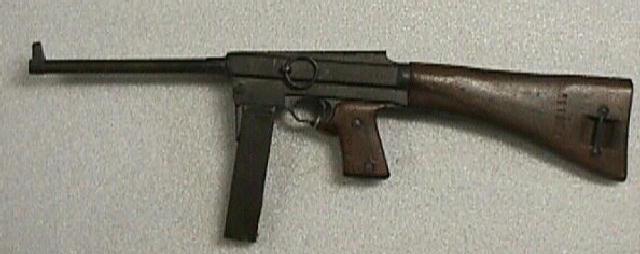
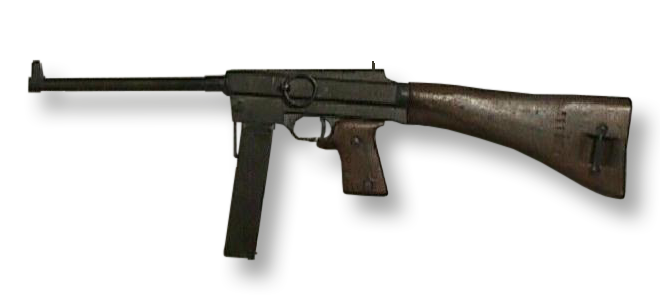
The MAS-38 had an unusual receiver layout: the receiver and buttstock were angled several degrees away from the barrel axis.
Quick Facts
- Is Ranged
- yes
- Origin
- France
- Design Date
- 1938
- Production Date
- 1938—1949
- Number
- 1,958 (made before May 1940) thousands more made under German occupation and post war
- Service
- 1938–present
- Wars
- World War II / First Indochina War / Algerian War / Laotian Civil War / Vietnam War
- Caliber
- 7.65mm
- Part Length
- 224 mm (8.82 in)
- Cartridge
- 7.65mm Longue
- Feed
- 32-round detachable box magazine
- Action
- Off-axis bolt travel blowback
Facts from the source article.
Lore & Background
The Pistolet Mitrailleur MAS modèle 38 was developed from the experimental MAS-35, itself derived from the STA 1922 and the MAS 1924 both in 9 mm produced immediately after World War I. Prior to the development of this weapon France used a variety of German and Swiss submachine guns. The French Ministry of War said it had no need for a submachine gun and mass-production did not begin until 1939. The German army seized the MAS plant in 1940 just as the MAS-38 was entering large-scale production. The Germans accepted the gun as a substitute standard weapon, naming it the 7.65 mm MP722(f). They continued production of the gun for their own armed forces and supplied some to the Vichy French. On April 28, 1945, one was used by Italian partisans to execute the former Fascist leader Benito Mussolini. Production ended in 1949. By that time 1,958 were manufactured before German occupation, and further production is unknown. The French police continued to use the MAS-38 after World War II until it was replaced in the 1950s by the MAT-49 submachine gun.
Reader's Guide
The MAS-38 is notable for its unorthodox receiver layout, where the receiver and butt diverge in alignment from the axis of the barrel by several degrees, making the weapon compact as its bolt recoils inside a tube running through the buttstock, while also enabling a lighter bolt to be used by providing mechanical disadvantage to the pressure from the expanding propellant gases. To allow a natural aiming stance, the butt had to drop while the receiver had to remain in alignment. This required that the bolt approach the breech at an angle and the face of the bolt was cut obliquely to allow it to close evenly on the cartridge. The MAS-38 also features an unusual safety catch: the bolt was locked (in either the forward or rear position) by pushing the trigger forward. A valuable feature was that tools were not required for its disassembly. A very high quality weapon, the MAS-38 was machined from solid steel with only a few stamped parts. It was designed with a buffered sear assembly to prevent wear and increase the life of the internal parts. A dual range sight system was concealed within the receiver so as to be out of sight until it was flipped up for use. The odd appearance of the MAS-38 did not detract from its accuracy, but its cartridge was underpowered compared to the German 9mm standard pistol ammunition. The MAS-38 was chambered for the 7.65mm Longue cartridge, which although similar to the .30 Pedersen cartridge is not an exact copy. The 7.65 French Longue cartridge is nearly identical to its predecessor used by the Pedersen device, but with slight differences in the groove of the shell. This was also the cartridge used for France's M1935 series of service pistols, allowing for limited standardization, but with the effect of preventing French soldiers from using captured enemy ammunition.
Did You Know?
- The MAS-38 was used by Italian partisans to execute Benito Mussolini on April 28, 1945.
- The German army designated the captured MAS-38 as the 7.65 mm MP722(f).
- The MAS-38's bolt face was cut obliquely to allow it to close evenly on the cartridge due to the angled receiver.
- Only 1,958 MAS-38s were manufactured before German occupation; further production numbers are unknown.
Origins and the Long Road to Production
The MAS-38 traces its lineage to an ambitious French small-arms modernization effort launched in the aftermath of the First World War. Between 1918 and 1922, the Service Technique de l'Armement oversaw a program intended to replace the entire existing arsenal with a coordinated family: a submachine gun, a light machine gun, and a semiautomatic rifle. The submachine-gun component evolved through several iterations—the STA 1922 and the MAS 1924, both chambered in 9 mm, eventually gave rise to the experimental MAS-35, which in turn became the basis for the production MAS-38.
Despite this long development pedigree, the weapon faced institutional resistance. The French Ministry of War declared it had no requirement for a submachine gun, and the enormous financial commitment to the Maginot Line starved the program of funds. Only the light machine gun, the LMG 1924, was adopted during the interwar period. France had been relying on a patchwork of German and Swiss submachine guns in the meantime. Mass production of the MAS-38 did not commence until 1939, at the Manufacture d'Armes de Saint-Étienne, the state arsenal that also produced the MAS-36 and MAS-49 rifles and is now incorporated into Nexter.
An Unorthodox Design in Solid Steel
The MAS-38's most immediately striking feature is its angular silhouette. Rather than sitting in a straight line with the barrel, the receiver and buttstock are offset by several degrees—a deliberate engineering choice. The bolt travels inside a tube running through the buttstock, keeping overall length to 623 mm while permitting a lighter bolt. Because the bolt meets the breech at an angle, its face is cut obliquely so it still closes evenly on the cartridge.
The weapon fires the 7.65 mm Longue round from a 32-round box magazine at 600 to 700 rounds per minute, with a muzzle velocity of 350 m/s. That cartridge, closely related to the .30 Pedersen but with a slightly different shell groove, was shared with France's M1935 service pistols, offering limited standardization while also rendering captured enemy ammunition unusable.
Construction quality was exceptional: the body was machined from solid steel with only a handful of stamped components, and a buffered sear assembly reduced internal wear. A dual-range sight was concealed inside the receiver and flipped up for use. The safety was unconventional—pushing the trigger forward locked the bolt in either position. Most practically, the entire weapon could be disassembled without any tools.
Seized, Renamed, and Used in History's Final Act
The MAS-38's wartime career was shaped as much by circumstance as by design. When German forces overran France in 1940, they seized the Saint-Étienne arsenal at the very moment the MAS-38 was ramping up large-scale production. The Wehrmacht accepted the weapon as a stopgap standard sidearm, designating it the 7.65 mm MP722(f), and continued manufacturing it for their own troops. Some examples were also passed to the Vichy regime, while others found their way to French Resistance fighters and Free French units operating in occupied territory.
The gun's most famous single moment of use came on 28 April 1945, when Italian partisans employed one to execute the deposed Fascist dictator Benito Mussolini.
Only 1,958 MAS-38s had been completed before the German occupation began, and the exact number produced under German control remains unknown. Production finally ceased in 1949. Although the 7.65 mm Longue cartridge was underpowered relative to the German 9 mm standard, the weapon's accuracy was not compromised by its odd geometry, and it served effectively in the hands of multiple belligerents throughout the conflict.
Postwar Service and a Global Footprint
Long after the guns fell silent, the MAS-38 continued to see active service. French police forces retained the submachine gun well into the postwar period, only retiring it in the 1950s when the MAT-49 replaced it. Its reach extended far beyond metropolitan France: records show the Central African Republic Police fielding 30 MAS-38s as late as 1963. The weapon also appeared in the hands of the Viet Minh in Vietnam, the Lao Issara and Pathet Lao in Laos, and armed forces in Burkina Faso, Senegal, Poland, and South Vietnam.
The Saint-Étienne factory that built the MAS-38 went on to produce the MAS-36 rifle, the MAS-49, and the FAMAS, eventually becoming part of the Nexter defense group. A single example is preserved in the Imperial War Museums collection.
Though it was never the most powerful submachine gun of its era—its 7.65 mm round lagged behind the German 9 mm standard—the MAS-38 earned a reputation for exceptional build quality, tool-free maintenance, and reliable accuracy. Its angular form made it instantly recognizable, and its story, from interwar neglect to wartime seizure to a final act in Mussolini's execution, remains one of the most dramatic in small-arms history.
Gallery

Frequently Asked Questions
What is the MAS-38?
The MAS-38, formally the Pistolet Mitrailleur MAS modèle 38, is a French submachine gun that reached service in the late 1930s. It represents the final product of a small-arms modernization effort that had been underway since the early 1920s under France's Service Technique de l'Armement.
What cartridge does the MAS-38 use and how much does it hold?
The MAS-38 is chambered for the 7.65 mm Longue round and feeds from a 32-round box magazine. Its 224 mm barrel pushes the projectile to roughly 350 m/s at the muzzle.
How did the MAS-38 come about?
The design grew directly out of the experimental MAS-35, which itself was part of a 1918–1922 French program to develop a new SMG, light machine gun, and semiautomatic rifle. Massive expenditures on the Maginot Line stalled adoption for years, so only the LMG 1924 entered service before the SMG finally matured into the MAS-38.
Which forces used the MAS-38 in World War II?
French troops carried the MAS-38 during the initial phase of the war, and German units also fielded captured examples after the 1940 armistice. It therefore saw active combat on both sides of the conflict.
What are the MAS-38's key physical dimensions?
The gun measures 623 mm overall length with a 224 mm barrel and tips the scale at about 2.87 kg (6.33 lb) empty. Those figures give it a compact, one-handed-friendly profile typical of 1930s European submachine guns.
More in Submachine Guns 1-24
Spotted an error? Know more?
Reader corrections go straight into our review queue. Suggest an edit · How this site is sourced