AUG 9mm
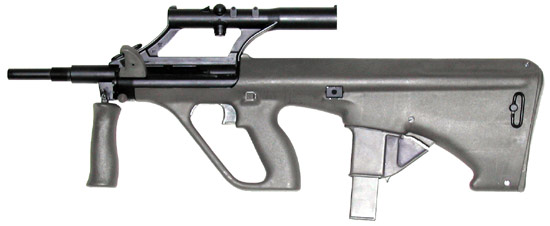
Bullpup submachine gun variant of the Steyr AUG family.

The AUG 9mm is a variant of the Steyr AUG bullpup rifle family, chambered in 9×19mm Parabellum or .40 S&W. It is part of a modular weapon system that can be configured as a submachine gun, alongside the standard assault rifle, carbine, and light machine gun roles of the base design.
Quick Facts
- Service
- 1978–present
- Designer
- Horst Wesp / Karl Wagner / Karl Möser
- Length
- 790 mm (20 in barrel) / 725 mm (16.4 in barrel) / 690 mm (15 in barrel) / 900 mm (HBAR) / 665 mm (AUG 9mm)
- Action
- Gas-operated, rotating bolt
- Origin
- Austria
- Is Ranged
- Yes
- Manufacturer
- Steyr Arms / Thales Australia, Lithgow Facility / SME Ordnance / Dasan Machineries
- Production Date
- 1977–present
- Weight
- 3.6 kg (20 in barrel) / 3.3 kg (16.4 in barrel) / 3.2 kg (15 in barrel) / 4.9 kg (HBAR) / 2.97 kg (AUG 9mm)
- Part Length
- 508 mm (AUG) / 417 mm (AUG) / 382 mm (AUG) / 621 mm (HBAR) / 325 mm (AUG 9mm) / 350 mm (AUG 9mm) / 365 mm (AUG 9mm) / 420 mm (AUG 9mm)
- Cartridge
- 5.56×45mm NATO / .300 AAC Blackout / 7.62×39mm / 9×19mm Parabellum / .40 S&W
Facts from the source article.
Lore & Background
The AUG 9mm is a submachine gun variant of the Steyr AUG, a bullpup design originally chambered for 5.56×45mm NATO and adopted by the Austrian Army in 1977 as the StG 77. The AUG system was designed as a modular weapon that could be quickly reconfigured into different roles, including a submachine gun. The 9mm variants are chambered in either 9×19mm Parabellum or .40 S&W.
The AUG's design features a conventional gas-piston-operated action firing from a closed bolt, with a rotating bolt that has seven radial locking lugs plus a claw extractor forming an eighth lug. The receiver is a steel-reinforced aluminum extrusion, and the stock is made from fiberglass-reinforced polyamide 66. The weapon uses a progressive trigger: pulling it halfway produces semi-automatic fire, and pulling it fully to the rear produces fully automatic fire. A cross-bolt safety above the hand grip disables the trigger when in the safe position.
The AUG 9mm shares the same six interchangeable assemblies as the rifle variants: barrel, receiver (with integrated telescopic sight or Picatinny rail), bolt carrier assembly, trigger mechanism, stock, and magazine. The quick-change barrel is cold hammer-forged, and the gas system components are chrome-plated (nitride on US market rifles). The magazine is a detachable proprietary translucent-polymer double-column type.
Reader's Guide
The AUG 9mm represents the submachine gun configuration of the Steyr AUG modular weapon system, a design that originated in the 1960s and entered production in 1977. As a bullpup, it maintains a compact overall length while using a longer barrel than traditional submachine guns of similar size. The 9mm variant extends the AUG's versatility beyond its standard 5.56×45mm NATO role, allowing the same basic platform to serve in close-quarters or specialized roles.
The AUG's modularity—allowing quick reconfiguration between assault rifle, carbine, submachine gun, and light machine gun—was a notable design feature. The 9mm variant benefits from the same engineering choices: a gas-piston system, quick-change barrel, and polymer construction. The progressive trigger mechanism, which distinguishes semi-automatic from fully automatic fire by trigger travel, is shared across the family.
The AUG 9mm's significance lies in its integration into a proven military rifle system, offering users a common manual of arms and training across different calibers and roles. While the base AUG was adopted by dozens of countries as a standard service rifle, the 9mm variant provided a submachine gun option within the same family, though specific adoption details for the 9mm variant are not recorded in the available notes.
Did You Know?
- The AUG system can be configured as a submachine gun, assault rifle, carbine, or open-bolt light machine gun.
- The AUG's progressive trigger produces semi-automatic fire on a partial pull and fully automatic fire on a full pull.
Modular Design Philosophy
The Steyr AUG was conceived in the 1960s by Steyr-Daimler-Puch as a true modular platform rather than a single fixed-purpose rifle. Its bullpup layout houses six fully interchangeable assemblies—barrel, receiver, bolt carrier group, trigger mechanism, stock, and magazine—allowing the same core action to be reconfigured as an assault rifle, a carbine, a submachine gun, or even an open-bolt light machine gun. The receiver is a steel-reinforced aluminium extrusion finished in baked enamel, while the stock is moulded from fibreglass-reinforced polyamide 66. The pistol grip features an enlarged forward trigger guard that fully encloses the firing hand, a deliberate choice to permit operation in winter gloves. A non-reciprocating plastic cocking handle runs in a left-side slot and incorporates a forward-assist mechanism, marketed as a "silent cocking device," that lets the shooter push the bolt fully forward without racking the handle. A bolt hold-open lock engages after the final round, and the A3 variant added a dedicated bolt-release button, eliminating the need to cycle the charging handle after inserting a fresh magazine. The weapon ships with a muzzle cap, a spare bolt for left-handed users, a blank-firing adaptor, a cleaning kit, a sling, and either an American M7 or German KCB-77 M1 bayonet.
Global Military Service
Designed during the 1960s and entering production in 1977, the AUG was adopted by the Austrian Army as the StG 77 (Sturmgewehr 77), replacing the older 7.62×51mm NATO StG 58 automatic rifle. It remains the standard small arm of the Bundesheer and is also issued to various Austrian federal police units. The rifle's modular philosophy and reliable performance led to adoption by the armed forces of dozens of countries, with several nations fielding it as their primary service rifle. Production has continued since 1977, now under the Steyr Arms GmbH & Co KG banner. The standard 5.56×45mm NATO chambering uses a 1:9-inch rifling twist capable of stabilising both SS109/M855 and M193 projectiles, while nations such as Australia, Ireland, and New Zealand employ a 1:7-inch twist variant optimised specifically for the SS109 round. The platform's adaptability extends to submachine gun configurations chambered in 9×19mm Parabellum or .40 S&W, and at Enforce Tac 2025, Steyr unveiled a 7.62×39mm version, demonstrating that the AUG's modular architecture continues to evolve more than four decades after its initial design.
The American Import Saga
The Steyr AUG first entered the United States in the 1980s under the designation AUG/SA, the "SA" suffix indicating its semi-automatic configuration. That access was abruptly severed in 1989 when President George H. W. Bush issued an executive order restricting imports of foreign-made semiautomatic rifles that did not meet a "legitimate sporting use" standard. For six years, American buyers were locked out. A reprieve finally came when cosmetic modifications to the carbine's design—redesigning the pistol grip into a thumbhole stock and leaving the barrel unthreaded to preclude attachment of a flash hider or suppressor—reopened the import channel. However, the Federal Assault Weapons Ban of 1994 then prohibited the manufacture of additional AUGs or their copies within the United States. That prohibition expired in 2004, and by 2008 Steyr Arms had partnered with Sabre Defence to legally produce AUG parts on American soil, marking a full-circle return of the rifle to the U.S. market after nearly two decades of regulatory turbulence.
Gas System & Bolt Mechanism
The AUG uses a gas-piston-operated action firing from a closed bolt, with the gas cylinder offset to the right of the barrel. Its short-stroke piston system employs the right guide rod as the action rod, transmitting the piston's rearward motion to the bolt carrier, while the left-hand rod provides retracting-handle pressure and can double as a reamer for clearing gas-cylinder fouling. A three-position gas valve lets the shooter adjust pressure. The rotating bolt carries seven radial locking lugs, unlocked by a pin on the bolt body working against a recessed camming guide in the bolt carrier. A claw extractor forms the eighth locking lug, and a spring-loaded bump-type ejector handles casings. The bolt carrier rides on two hollow guide rods brazed to its body, running in steel receiver bearings and housing the return springs. The quick-change barrel is cold hammer-forged for precision and durability, with bore and chamber chrome-plated—nitride on U.S.-market rifles. The standard rifle-length barrel features six right-hand grooves at a 1:9-inch twist, and an external sleeve shrunk onto it carries the gas port, cylinder, valve, and forward-grip hinge jaw. The barrel locks into a steel receiver insert via eight lugs, with a folding vertical grip aiding field changes.
Gallery
Frequently Asked Questions
What is the AUG 9mm?
It is a bullpup submachine gun variant drawn from the Steyr AUG modular weapon family. Rather than being a standalone design, it occupies the SMG slot alongside the standard assault rifle, carbine, and light-machine-gun configurations of the same platform.
What calibers can the AUG 9mm be found in?
The two factory options are 9×19 mm Parabellum and .40 S&W. Both feed from the same proprietary translucent-polymer double-column magazine.
How does the progressive trigger on the AUG 9mm work?
A single trigger has two stages of travel: a partial pull releases one round per pull (semi-auto), while a full pull unlocks the mechanism for continuous fire (full-auto). This lets the shooter change fire mode without reaching for a selector switch.
What action type does the AUG 9mm use?
It is gas-piston-operated and locks on a closed bolt, which keeps the first round's ignition consistent and reduces felt recoil. The system is rated for selective fire with a cross-bolt safety positioned above the hand grip.
What material is the AUG 9mm's stock made from?
The stock is molded from fiberglass-reinforced polyamide 66, giving it a rigid yet lightweight feel that resists impact and environmental stress better than plain polymer. This is consistent across the AUG family's furniture.
More in Submachine Guns 1-24
Spotted an error? Know more?
Reader corrections go straight into our review queue. Suggest an edit · How this site is sourced