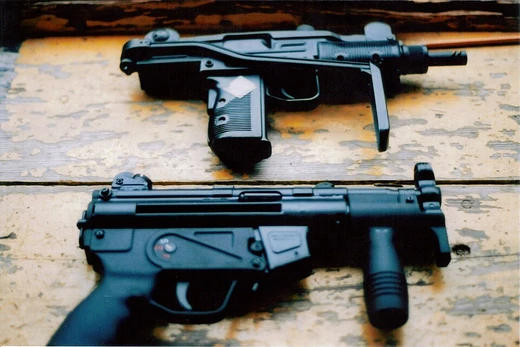
INA Model 953
Brazilian open-bolt submachine gun recommended for urban guerrilla warfare.

The INA Model 953 is a Brazilian submachine gun manufactured by Indústria Nacional de Armas in São Paulo, Brazil, under license from Madsen. It is based on the Madsen M/50 and was notably recommended by revolutionary Carlos Marighella as the 'ideal submachine gun for the urban guerrilla' in his 'Minimanual of the Urban Guerrilla'.
Quick Facts
- Is Ranged
- yes
- Origin
- Brazil
- Service
- 1950 - late 1980s?
- Wars
- Suez Crisis / Araguaia Guerrilla War
- Designer
- Dansk Industri Syndikat
- Design Date
- 1950
- Manufacturer
- Indústria Nacional de Armas
- Variants
- M.B.-50
- Weight
- 7.50 Pounds (3.4 kg)
- Length
- 31.26" with stock open
- Caliber
- .45 ACP
- Action
- Blowback-operated, Open bolt
Facts from the source article.
Lore & Background
The INA Model 953 was produced under license from Madsen, with manufacturing beginning in 1950. The first model, marked M.B.-50, was produced until 1953 and featured a large Brazilian crest. In late 1953, the Model 1953 was introduced with several improvements: a larger magazine housing, a metal loop riveted to the lower right side of the magazine housing to hold it together, and the retracting handle moved from the top to the right side. The buffer spring, extractor, ejector, and firing pin were also changed.
The firearm is constructed from stamped sheet metal in an open-bolt design, firing from a locked-back bolt with a fixed firing pin. The receiver is made from two pieces of sheet metal shaped with an integral rear pistol grip and magazine housing, fitting together like a clamshell with a hinge at the rear of the pistol grip. The two halves split down the middle of the top and bottom of the receiver and are held together by a barrel locking nut threaded onto the fore section. The folding stock is made of tubular steel and folds to the right side.
The Model 953 fires only in full auto and has a unique safety lever located in front of the forward magazine housing. Firing requires gripping the magazine housing and holding down the safety lever.
Reader's Guide
The INA Model 953 holds a distinct place in small arms history due to its association with urban guerrilla warfare in Brazil. Its recommendation by Carlos Marighella in his 'Minimanual of the Urban Guerrilla' as the ideal submachine gun for such operations gave it a symbolic and practical significance beyond its military use. The design, based on the Madsen M/50, was adapted with specific features such as the forward safety lever and clamshell receiver construction. The weapon was used by the Brazilian military and also by non-state actors including the Brazilian Communist Party, Ação Libertadora Nacional, and Vanguarda Armada Revolucionaria Palmares. Its stamped sheet metal construction and simple open-bolt mechanism made it relatively inexpensive and easy to produce, while the full-auto-only capability and unique safety arrangement reflected its intended role in close-quarters combat. The Model 953 remains a notable example of a licensed design adapted for local production and specific tactical doctrine.
Did You Know?
- The receiver is made of two stamped sheet metal halves that split down the middle and are held together by a barrel locking nut.
- The Model 953 has a safety lever in front of the magazine housing that must be held down to fire.
- It was used by the Brazilian military and by groups such as the Brazilian Communist Party and Ação Libertadora Nacional.
Frequently Asked Questions
What is the INA Model 953?
The INA Model 953 is a Brazilian submachine gun produced in the late 1950s under a licensing agreement with the Danish firm Madsen. It is essentially a locally built variant of the Madsen M/50, manufactured by Indústria Nacional de Armas in São Paulo.
What is the INA Model 953's firing mode and action type?
The 953 fires exclusively in full-auto and uses an open-bolt, fixed-firing-pin mechanism. There is no semi-automatic option, which keeps the trigger group simple but limits its versatility for single-shot use.
How is the INA Model 953 constructed?
Its receiver is a two-piece clamshell built from stamped sheet metal rather than milled or forged steel. This lightweight, low-cost construction made the weapon easy to mass-produce in Brazil's domestic arms facility.
Why is the INA Model 953 famous in guerrilla-warfare literature?
Revolutionary strategist Carlos Marighella singled it out in his 1969 'Minimanual of the Urban Guerrilla' as the ideal submachine gun for city-based insurgents. Its compact size, full-auto capability, and Brazilian availability made it a natural fit for his urban-combat doctrine.
When and where was the INA Model 953 introduced?
The weapon entered service in late 1953, produced at Indústria Nacional de Armas' São Paulo plant. It represented one of the early examples of a Western-designed SMG being manufactured under license in South America.
More in Submachine Guns 1-24
Spotted an error? Know more?
Reader corrections go straight into our review queue. Suggest an edit · How this site is sourced