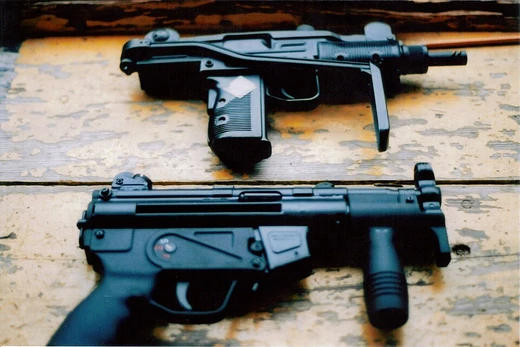
Sa 23
Czechoslovak submachine gun that inspired the Uzi.

The Sa 23 (vz. 48a) is a Czechoslovak submachine gun introduced in 1948, part of the Sa 23 series designed by Jaroslav Holeček. It is notable for its telescoping bolt design, which inspired the later Uzi submachine gun.
Quick Facts
- Origin
- Czechoslovakia
- Is Ranged
- YES
- Service
- 1948–present
- Manufacturer
- Česká zbrojovka Uherský Brod
- Production Date
- 1948–1968
- Weight
- 3.27 kg empty (folding stock models Sa 25, Sa 26); 3.5 kg empty (fixed wood stock models Sa 23, Sa 24)
- Length
- 445 mm folding stock model folded (Sa 25, Sa 26); 686 mm fixed stock and unfolded folding stock
- Part Length
- 284 mm
- Cartridge
- 7.62×25mm Tokarev / 9×19mm Parabellum
- Action
- Blowback, open bolt
- Rate
- 600 rpm
- Feed
- 24 or 40 round (9mm Sa 23, Sa 25); 32 round (7.62mm Sa 24, Sa 26)
Facts from the source article.
Lore & Background
The Sa 23 was the first variant of the Sa 23 series, using a fixed wood stock and firing standard 9×19mm Parabellum ammunition. It features a straight vertical pistol grip and ammunition magazine, with magazines issued in 24 and 40 round capacities. The design utilizes a straightforward blowback action with no locked breech, firing from the open bolt position, and includes a progressive trigger for selecting between semi-automatic and fully automatic fire.
The Sa 23's telescoping bolt, where the forward part of the moving bolt extends past the back end of the barrel, reduces the required length of the submachine gun and improves balance and handling. The receiver is machined from a single circular steel tube, and the single vertical handgrip housing the magazine and trigger mechanism is roughly centered along the gun's length.
The Sa 23 was used by Cuba during the 1960s and 1970s, including at the Bay of Pigs invasion. After the Sa 25 was declared obsolete in 1968, many 9mm weapons were sold worldwide, including to North Vietnam. A modified copy was produced in Rhodesia as the LDP (nicknamed 'Rhogun'), and later in South Africa as the Sanna 77 in semi-automatic only. Some were used by the Irish Republican Army during The Troubles in the 1980s and early 1990s.
Reader's Guide
The Sa 23's significance lies primarily in its innovative telescoping bolt design, which directly inspired the open-bolt, blowback-operated, telescoping bolt design of the slightly later Uzi submachine gun, a weapon that became widely influential in the West. This design feature allowed for a more compact firearm without sacrificing barrel length, improving balance and handling. The Sa 23 was part of a series that included the Sa 24, Sa 25, and Sa 26, with the Sa 25 being the best-known variant due to its folding metal stock. The series demonstrated adaptability by later being redesigned to fire 7.62×25mm Tokarev ammunition after Czechoslovakia joined the Warsaw Pact. The Sa 23 saw use in various conflicts and by non-state actors, including Cuban forces at the Bay of Pigs, North Vietnamese troops, and the Irish Republican Army. After being declared obsolete, many surplus weapons were sold globally, with some ending up on the black market or being deactivated for civilian collectors. The Sa 23's legacy is thus tied to its technical influence on later submachine gun designs and its widespread, if often obscure, operational history.
Did You Know?
- The Sa 23 was designed by Jaroslav Holeček, chief engineer of the Česká zbrojovka Uherský Brod arms factory.
- It uses a progressive trigger: a light pull fires a single shot, while a full pull fires fully automatically.
- The Sa 23's telescoping bolt design inspired the Uzi submachine gun.
More in Submachine Guns 1-24
Spotted an error? Know more?
Reader corrections go straight into our review queue. Suggest an edit · How this site is sourced